Spirit Animal
Unicorn Spirit Animal
Unicorn spirit animal meaning, traced from the modern purity-and-magic reading back through Ted Andrews's Animal Speak to Ctesias of Cnidus's Indica (5th century BCE), Pliny the Elder, the Septuagint/KJV translation of Hebrew re'em as 'unicorn,' the Physiologus, and the Chinese qilin (usually confused with the unicorn in English).
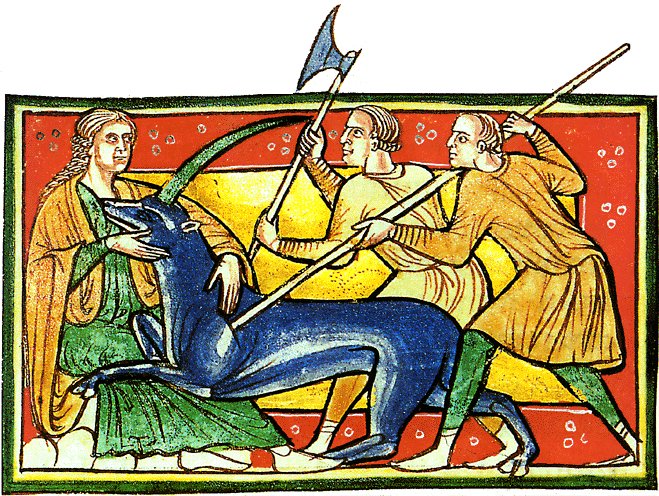
In modern American "spirit animal" usage, the unicorn stands for purity, magic, transformation, and a kind of elusive innocence. That reading comes through Ted Andrews's Animal Speak (Llewellyn, 1993) and the longer Western tradition that shaped it. The trail is specific. The earliest description is Ctesias of Cnidus's Indica (5th century BCE), preserved in Photius's Bibliotheca, describing a wild ass of India with a single horn. Pliny's Natural History 8.31 repeats Ctesias. The Septuagint translators (3rd–2nd century BCE) rendered the Hebrew re'em (a wild ox, now identified as the aurochs) as monokerōs ('single-horned'), which the King James translators followed as 'unicorn' in nine Old Testament verses. The Physiologus (2nd century CE) allegorized the unicorn as a Christ-figure hunted by a virgin. The Chinese qilin, often translated 'unicorn' in English, is a completely different creature.
Nine verses in the King James Version of the Old Testament contain the word “unicorn.” Every one of them is a translation of the Hebrew word re’em, which almost certainly refers to the aurochs, a now-extinct European and Near Eastern wild ox, and which has two horns. The Septuagint translators in the 3rd century BCE, not knowing the animal, guessed monokerōs (“single-horned”). The Vulgate followed. The KJV followed. And for 400 years, English-speaking Christians read Psalm 92 and pictured a unicorn.
It is one of the stranger long-lived translation errors in the Western religious record.
The four traditions on the trail
Ctesias. The 5th-century BCE Greek physician at the Persian court, whose Indica survives only in fragments through Photius’s 9th-century Bibliotheca. His unicorn is a single-horned wild ass of India whose powdered horn neutralizes poison. Modern scholarship (Chris Lavers, The Natural History of Unicorns, William Morrow, 2009) reads Ctesias as describing a muddled composite of the Indian rhinoceros and the chiru antelope.
The re’em. The Hebrew aurochs. Nine verses in the KJV mistranslate it as “unicorn.” Every modern translation (JPS, NRSV, NIV) corrects this.
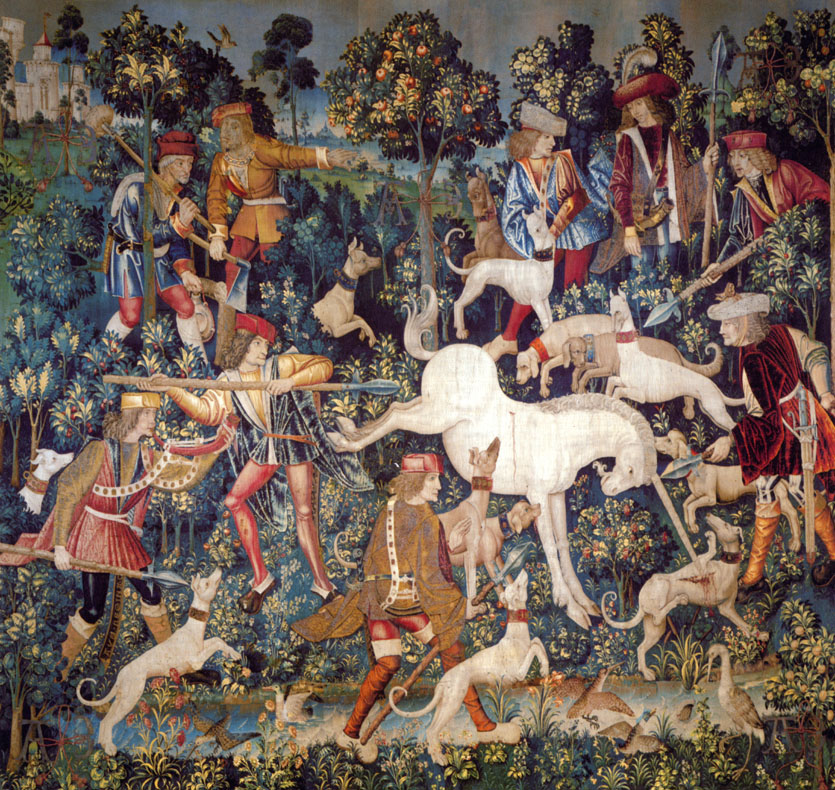
The Physiologus. 2nd-century Alexandrian allegorical bestiary. The unicorn cannot be captured by force but lays its head in a virgin’s lap. The virgin is Mary; the unicorn is Christ incarnate. This allegory is what the late-15th-century Hunt of the Unicorn tapestries at the Met Cloisters are depicting. It is the dominant Western reading from the 4th through the 17th centuries.
The qilin. Chinese, genuinely different, but routinely translated “unicorn” in English to the confusion of everyone. Composite auspicious animal. Two horns in classical depictions. Its appearance presages the birth or death of a sage. The Shijing and the Zuo Zhuan are the earliest textual sources.
The pop reading and its strange history
Ted Andrews’s 1993 unicorn is the Physiologus unicorn softened into personal-spirit language: purity, magic, elusive innocence. The reading works. It also rests on a chain that includes: a 5th-century BCE Greek physician’s secondhand account of an Indian animal he never saw, a Greek mistranslation of a Hebrew word for a different animal that had two horns rather than one, a 2nd-century Christian allegorization of the resulting composite creature, five centuries of medieval tapestry programs, and a late-20th-century Llewellyn paperback.
That is the record. Knowing it is different from not knowing it. The unicorn is not quite what it seems, and tracing its actual route is one of the most instructive things you can do with any mythic animal.
Across traditions
Ctesias of Cnidus (the 5th-century BCE Greek source)
Ctesias of Cnidus served as a court physician to the Persian king Artaxerxes II for seventeen years and wrote an Indica (Indian account) based on his Persian-filtered information about India. The Indica survives only in fragments, preserved mainly in Photius's 9th-century Bibliotheca (cod. 72). In Ctesias's description, the unicorn is a white wild ass with a horn of red, black, and white, whose powdered horn neutralized poison.
Pliny the Elder, Natural History 8.31 (c. 77 CE), preserves a version of the Ctesias account, and Aelian's On the Nature of Animals 4.52 (3rd century CE) adds further details. The modern scholarly consensus (Chris Lavers, The Natural History of Unicorns, William Morrow, 2009) is that Ctesias was describing a confused synthesis of the Indian rhinoceros, the one-horned Tibetan chiru antelope (seen in profile), and perhaps the oryx.
- PRIMARY Ctesias of Cnidus, Indica (fragments preserved in Photius, Bibliotheca cod. 72) — Nichols trans., Routledge, 2011.
- PRIMARY Pliny the Elder, Natural History 8.31 — Rackham trans., Loeb Classical Library.
- PRIMARY Aelian, On the Nature of Animals 4.52 — Scholfield trans., Loeb Classical Library.
- PEER-REVIEWED Chris Lavers, The Natural History of Unicorns — William Morrow, 2009.
The re'em: Hebrew wild ox, Greek 'unicorn'
The Hebrew Bible uses the word re'em (רְאֵם) nine times (Numbers 23:22, 24:8; Deuteronomy 33:17; Job 39:9–10; Psalm 22:21, 29:6, 92:10; Isaiah 34:7). The re'em is almost certainly the aurochs (Bos primigenius), a large wild ox that was still extant in the ancient Near East, known for unmanageable strength and two horns.
The Septuagint translators (3rd–2nd century BCE), unfamiliar with the animal, rendered re'em as monokerōs ("single-horned"). The Latin Vulgate followed as unicornis. The King James Version (1611) kept "unicorn" in all nine Hebrew Bible passages. Modern translations (JPS 1985, NRSV 1989) correct this back to "wild ox" or "aurochs." Every KJV-era Christian who read Psalm 92:10 and imagined a literal unicorn was reading a translation error more than two thousand years old.
- PRIMARY Hebrew Bible re'em passages (Numbers 23:22; Deuteronomy 33:17; Job 39:9; Psalm 22:21, 29:6, 92:10; Isaiah 34:7; etc.) — BHS Masoretic text; JPS 1985 English trans.
- PRIMARY Septuagint, monokerōs translation — Rahlfs-Hanhart critical edition.
- REFERENCE King James Version (1611), 'unicorn' in nine Old Testament verses
- PEER-REVIEWED Cyrus Gordon, 'The Biblical Sarafim' — JNES 9 (1950), various later updates on re'em.
Physiologus and medieval bestiary (the virgin-hunt allegory)
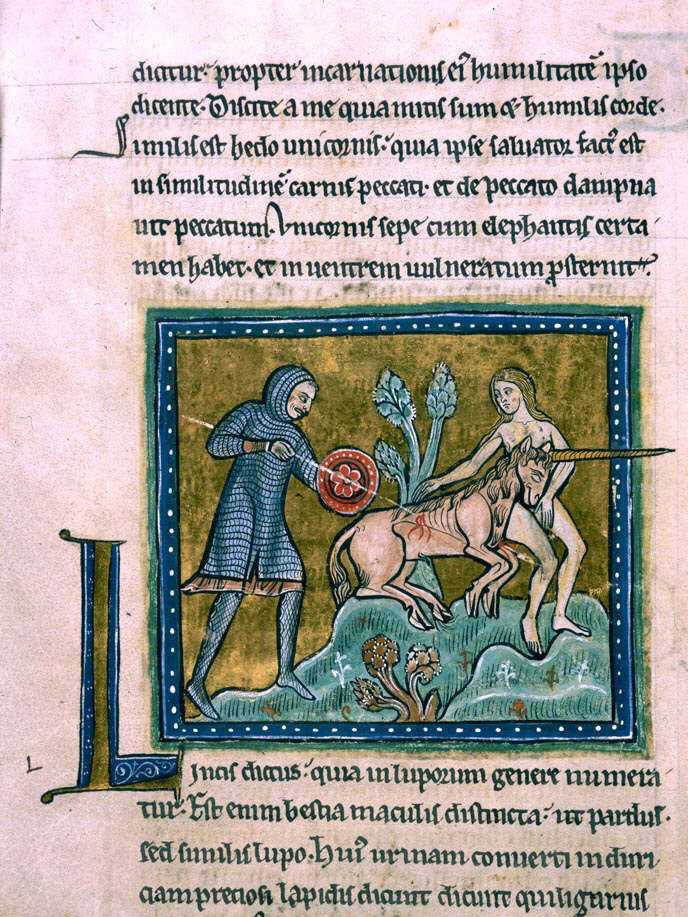
The Physiologus (2nd century CE, Alexandria) created the allegorical unicorn the West inherited. In the Physiologus's account, the unicorn is a small fierce animal that cannot be captured by force but lays its head in the lap of a virgin, whereupon hunters emerge from hiding and seize it. The Physiologus interpreted the virgin as Mary and the unicorn as Christ incarnate.
This allegorical reading drove the medieval iconography, culminating in the late-15th-century tapestry cycle The Hunt of the Unicorn (c. 1495–1505, now at the Met Cloisters in New York and at the Musée de Cluny in Paris), one of the most elaborate surviving Gothic tapestry series. Every subsequent Western unicorn image (Raphael's Young Woman with a Unicorn, c. 1506; Peter Beagle's 1968 The Last Unicorn; contemporary fantasy fiction) runs through this allegorical channel.
- PRIMARY Physiologus, chapter on the unicorn — Curley trans., University of Chicago Press, 2009.
- MUSEUM The Hunt of the Unicorn tapestries — The Met Cloisters, New York; c. 1495–1505.
- PEER-REVIEWED Margaret B. Freeman, The Unicorn Tapestries at the Metropolitan Museum of Art — Metropolitan Museum of Art, 1976.
Chinese (qilin, 麒麟)
The Chinese qilin (麒麟, Japanese kirin) is routinely translated "Chinese unicorn" in English, but the translation is misleading. The qilin is a composite auspicious animal (dragon-horse-ox-deer features in various descriptions) whose appearance was said to presage the birth or death of a great sage; Confucius's birth and death are both traditionally associated with qilin appearances. The earliest attestations are in the Shijing (Book of Odes, c. 7th century BCE) and the Zuo Zhuan (Confucian historical commentary, c. 4th century BCE).
The qilin has two horns in most classical depictions, though some later iconography gives it one. Calling it a "unicorn" is an English convention that obscures how different the two creatures are in their actual cultural-symbolic function. Martha Chaiklin's Cultural Commerce and Dutch Commercial Culture (Leiden, 2003) discusses the qilin-unicorn translation problem in detail.
- PRIMARY Shijing (Book of Odes), Lin zhi zhi — Waley trans., Grove Press, 1960.
- PRIMARY Zuo Zhuan (Confucian commentary) — Durrant, Li & Schaberg trans., University of Washington Press, 2016.
- PEER-REVIEWED Martha Chaiklin, Cultural Commerce and Dutch Commercial Culture — CNWS, Leiden, 2003.
Ted Andrews (1993)
Andrews's 1993 unicorn is the Physiologus-allegorical unicorn condensed into personal-spirit keywords: purity, magic, elusive innocence, transformation. He mentions the Ctesias source glancingly. The Hebrew re'em translation-error is absent; the Chinese qilin is treated as a parallel without discussion of the substantial differences.
- REFERENCE Ted Andrews, Animal Speak — Llewellyn, September 1993.
Frequently asked
- What does a unicorn symbolize spiritually?
- In modern pop usage, purity, magic, elusive innocence, and transformation, the reading shaped by the Physiologus, medieval tapestries, and Andrews 1993. The actual sources are more specific. Ctesias of Cnidus (5th century BCE) gave the earliest Greek description, probably based on a confused synthesis of rhinoceros and antelope. The Septuagint's translation of Hebrew re'em (aurochs) as monokerōs is the source of the nine KJV 'unicorn' verses. The Physiologus created the virgin-hunt allegory. The Chinese qilin is a separate tradition.
- Are unicorns in the Bible?
- The King James Version (1611) uses 'unicorn' in nine Old Testament verses (Numbers 23:22; Deuteronomy 33:17; Job 39:9–10; Psalm 22:21, 29:6, 92:10; Isaiah 34:7). In each case, the Hebrew is re'em, a word that almost certainly refers to the aurochs (Bos primigenius), a large wild ox. The Septuagint translators rendered it monokerōs ('single-horned'), the Vulgate followed as unicornis, and the KJV kept 'unicorn.' Modern translations (JPS 1985, NRSV 1989) correct this to 'wild ox.' The biblical 'unicorn' is a translation error.
- Is the Chinese qilin a unicorn?
- It is routinely translated 'Chinese unicorn' in English, but the translation is misleading. The qilin is a composite auspicious animal (dragon-horse-ox-deer features) whose appearance presaged the birth or death of a sage (Confucius's birth and death are both associated with qilin appearances). Classical depictions usually give it two horns, not one. The Shijing (Book of Odes) and the Zuo Zhuan are the earliest textual sources. Calling it a 'unicorn' obscures how different the two creatures are.
- Where does the virgin-and-unicorn image come from?
- From the Physiologus, a 2nd-century CE Alexandrian allegorical bestiary, which tells that the unicorn cannot be captured by force but will lay its head in a virgin's lap, at which point hunters can seize it. The Physiologus read the virgin as Mary and the unicorn as Christ incarnate. This allegory drove medieval iconography, culminating in the late-15th-century Hunt of the Unicorn tapestries now at the Met Cloisters in New York and the Musée de Cluny in Paris.
Sources
- PRIMARYCtesias of Cnidus, Indica (fragments in Photius, Bibliotheca cod. 72) — Nichols trans., Routledge, 2011.
- PRIMARYPliny the Elder, Natural History 8.31 — Loeb Classical Library.
- PRIMARYAelian, On the Nature of Animals 4.52 — Loeb Classical Library.
- PEER-REVIEWEDChris Lavers, The Natural History of Unicorns — William Morrow, 2009.
- PRIMARYHebrew Bible re'em passages — BHS / JPS 1985 trans.
- PRIMARYSeptuagint (Rahlfs-Hanhart)
- REFERENCEKing James Version (1611)
- PRIMARYPhysiologus (Curley trans., 2009)
- MUSEUMThe Hunt of the Unicorn tapestries, Met Cloisters
- PEER-REVIEWEDMargaret B. Freeman, The Unicorn Tapestries — Metropolitan Museum of Art, 1976.
- PRIMARYShijing — Waley trans., Grove Press, 1960.
- PRIMARYZuo Zhuan — University of Washington Press, 2016.
- REFERENCETed Andrews, Animal Speak — Llewellyn, September 1993.