Spirit Animal
Turtle Spirit Animal
Turtle spirit animal meaning, traced from the modern patience-and-longevity reading back through Ted Andrews's Animal Speak to the Haudenosaunee Turtle Island creation narrative, the Hindu Kurma avatar, the Chinese Black Tortoise Xuanwu, and the Hawaiian honu.
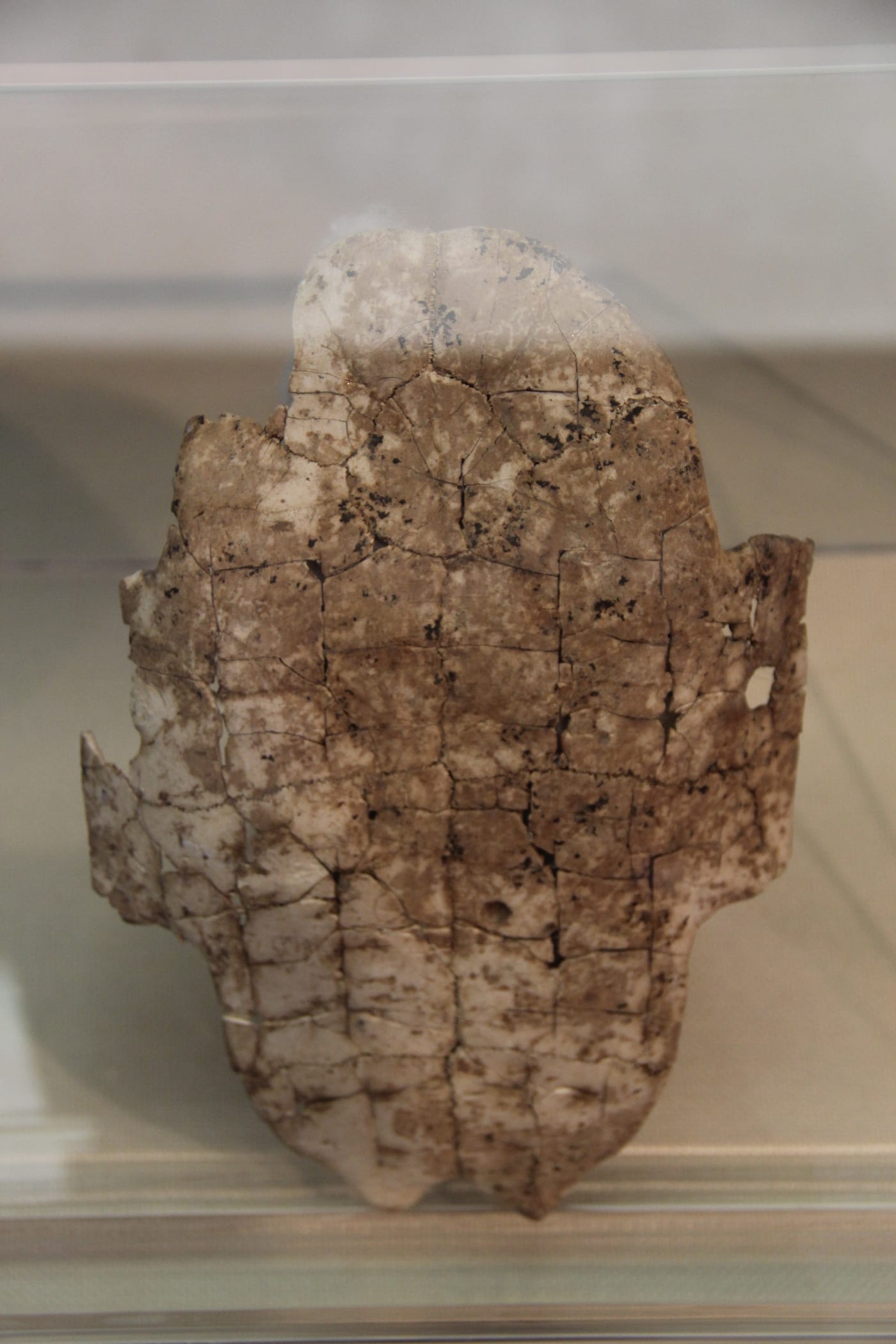
In modern American "spirit animal" usage, the turtle stands for patience, longevity, groundedness, and the carrying of home on one's back. That reading comes through Ted Andrews's Animal Speak (Llewellyn, 1993). The older traditions are dense and cosmological. The Haudenosaunee (Iroquois Confederacy) creation narrative names the continent itself Turtle Island, with the earth resting on a great turtle's back, recorded by J.N.B. Hewitt's 1903 and 1928 Iroquoian Cosmology for the Smithsonian. The Hindu Kurma is Vishnu's second avatar, a turtle supporting Mount Mandara during the churning of the cosmic ocean. The Chinese Xuanwu (Black Tortoise of the North) is one of the Four Symbols, partnered with a snake. And the Hawaiian honu carries specific 'aumakua (ancestral guardian) meaning in the Kumulipo creation chant.
The continent of North America has a name in English, “North America,” and it has a name in many Indigenous languages: Turtle Island. The two names refer to the same landmass. They do not refer to the same thing. One is a European cartographic label. The other is the name of the land inside a creation narrative in which Sky Woman fell from the upper world onto the back of a great turtle, and on that turtle’s back the earth grew.
If you are writing about the turtle as a spiritual animal in 2026 and you have not sat with that, you have skipped the part that matters most.
The Haudenosaunee narrative, in brief
J.N.B. Hewitt was an ethnographer at the Smithsonian’s Bureau of American Ethnology who spent decades between the 1880s and 1930s recording Iroquoian oral tradition from named elders, most centrally John Arthur Gibson, an Onondaga faith-keeper of extraordinary depth. Hewitt’s Iroquoian Cosmology, published in two parts in the Smithsonian’s Annual Reports (Part 1 in 1903, Part 2 in 1928), is the largest surviving body of documented Haudenosaunee creation narrative.
Sky Woman fell. The water-animals saw her falling. Turtle surfaced and offered his back. Muskrat dove deep and brought up mud. The mud, placed on Turtle’s back, became the earth. Sky Woman walked the earth and gave birth to twins, the Good Mind and the Evil Mind, who made the world of animals and plants and people.
The name Turtle Island does not decorate that reading; it is that reading.
Contemporary Haudenosaunee scholars, including Audra Simpson (Columbia) and Taiaiake Alfred (University of Victoria, emeritus), continue to argue that the Turtle Island frame is not a historical artifact but a living political-spiritual claim about the relationship between the Haudenosaunee and the land they live on. Settler-colonial politics has not dissolved it.
The Hindu cosmic support
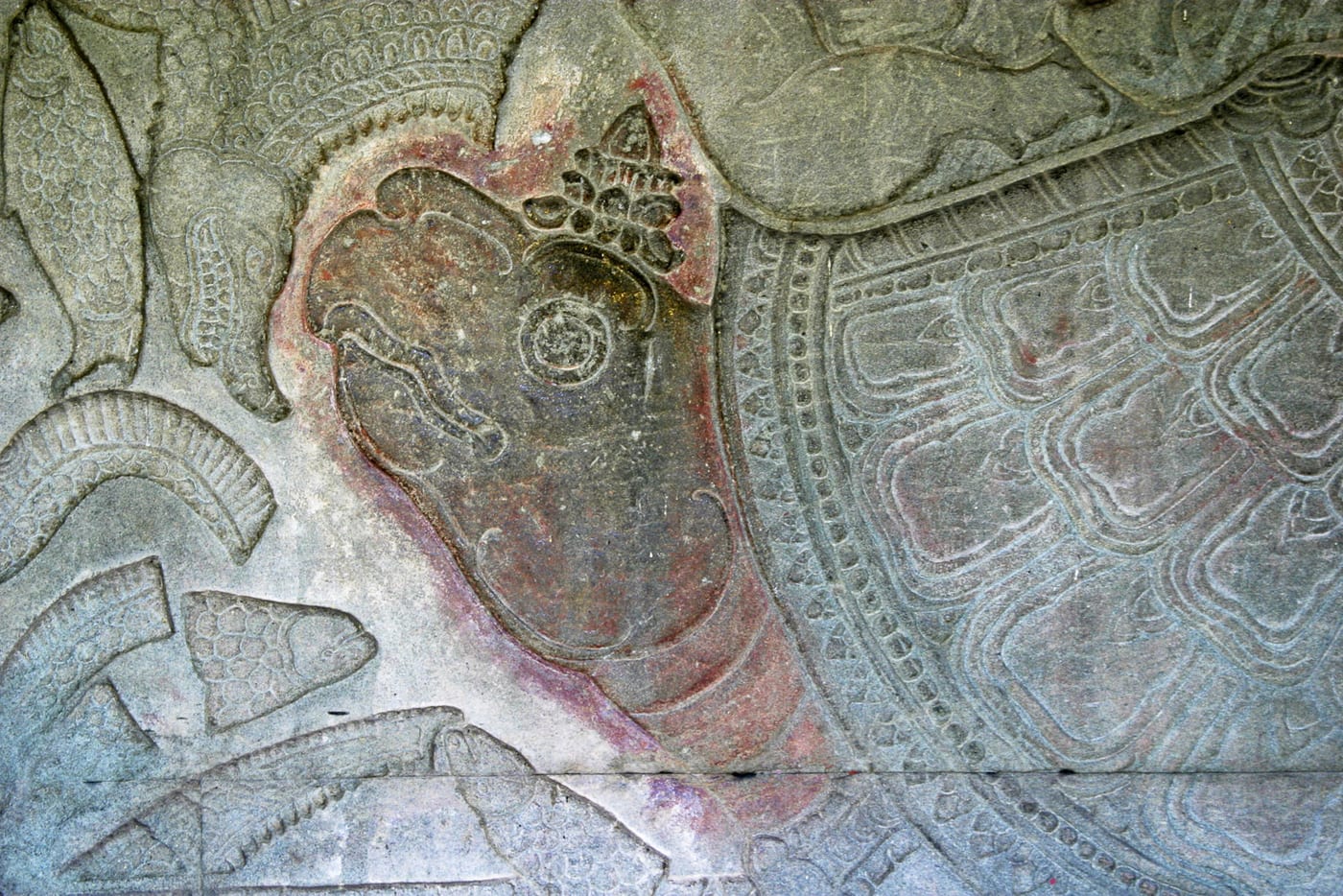
Kurma, Vishnu’s second avatar, is a turtle who supports Mount Mandara during the churning of the ocean of milk. The Mahābhārata’s Ādiparva narrates the churning: gods and asuras, unable to cooperate, pull together on the cosmic serpent Vāsuki, who is wrapped around Mandara as the churning-rod. Something has to support the mountain from below. That something is Kurma. Out of the churning comes amrita, the nectar of immortality, along with Lakshmi, Airavata, and the other cosmic treasures.
This is a turtle whose role is to bear the weight of the cosmic axis. Not a small figure.
The Chinese Black Tortoise and the Hawaiian honu
Xuanwu, the Black Tortoise of the North, is one of the Four Symbols of Chinese cardinal-direction cosmology, formalized in the Han and visible in every major Han tomb mural. Depicted as a tortoise entwined with a snake. In later Daoist theology, deified as the Dark Heavenly Emperor. The 15th-century Ming reconstruction of Wudang Mountain as a Daoist temple complex is the single largest Xuanwu-devotional project in Chinese history.
The Hawaiian honu, the green sea turtle, appears in the Kumulipo (the great Hawaiian creation chant) among the early emergent sea creatures. For specific Hawaiian families, the honu is an ‘aumakua, an ancestral guardian whose living animal-form visits descendants. Pu’uloa on Hawai’i Island, one of the Pacific’s largest petroglyph fields, contains thousands of honu carvings. The relationship is old and deep.
What the four share
The turtle in each of these is the animal of cosmic foundation, cosmological orientation, or ancestral guardianship. None of them reduces to “patience and longevity.” Those attributes are part of why the turtle was chosen for the foundational role, probably; the turtle does live a long time and does move slowly. But the foundational role is what the traditions are actually doing. The characteristics are the evidence, not the conclusion.

The 1993 pop reading
Ted Andrews’s turtle is the Western observational reading cleaned up: patience, longevity, groundedness, the carrying of home. It is a real reading, especially for anyone who has watched a turtle cross a backyard at a glacial pace. It is not a substitute for Turtle Island, Kurma, Xuanwu, or the honu. Those are the real weights.
Working with the Turtle
If you want a regular practice rather than a one-time read, an oracle deck is the standard tool: you draw a card and sit with whatever animal comes up. The foundational modern spirit-animal oracle: 44 cards drawn from Sams's Seneca and other Indigenous teachings, with a guidebook that actually explains its sources. The deck most later ones are imitating.
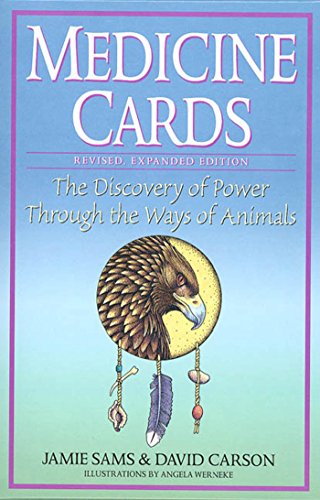
Medicine Cards
The foundational modern spirit-animal oracle: 44 cards drawn from Sams's Seneca and other Indigenous teachings, with a guidebook that actually explains its sources. The deck most later ones are imitating.
Compare the field in our ranked guide to spirit animal oracle decks, or browse decks, crystals, and journals in spirit animal gifts & tools.
Across traditions
Haudenosaunee (Turtle Island)
The Haudenosaunee (the Six Nations: Mohawk, Oneida, Onondaga, Cayuga, Seneca, and Tuscarora) name the North American continent Turtle Island. In the creation narrative, Sky Woman falls from the upper world onto the back of a great turtle, and on the turtle's back the earth grows. J.N.B. Hewitt's Iroquoian Cosmology (Smithsonian Bureau of American Ethnology Annual Report 21, 1903; Part 2, Annual Report 43, 1928) is the foundational English-language ethnography, recorded from named Onondaga and Mohawk elders including John Arthur Gibson.
Contemporary Haudenosaunee scholars including Taiaiake Alfred and Audra Simpson have written extensively on the continued contemporary force of the narrative. Turtle Island is not a historical artifact; it is, for the Haudenosaunee and for many other Algonquian and Iroquoian-speaking nations who share versions of the creation story, the actual name of the continent they live on.
- PRIMARY J.N.B. Hewitt, Iroquoian Cosmology — Smithsonian BAE Annual Report 21, 1903; Annual Report 43, Part 2, 1928.
- PEER-REVIEWED Audra Simpson, Mohawk Interruptus: Political Life Across the Borders of Settler States — Duke University Press, 2014.
- PEER-REVIEWED Taiaiake Alfred, Peace, Power, Righteousness: An Indigenous Manifesto — Oxford University Press, 2nd ed. 2009.
Hindu (Kurma, Vishnu's turtle avatar)
Kurma is the second of Vishnu's ten avatars, a cosmic turtle who supports Mount Mandara during the samudra manthana, the churning of the ocean of milk by gods and asuras together. The Mahābhārata (Book 1, Ādiparva) narrates the churning; the Kurma Purana (c. 8th century CE in its current form) expands the Kurma mythology. The churning produces the nectar of immortality (amrita), Lakshmi, Airavata the white elephant, and other cosmic treasures.
Kurma temples across India, especially the Kurmanathaswamy Temple in Srikurmam, Andhra Pradesh, are sites of active pilgrimage. The turtle here is the cosmic support-animal, the foundation on which the world-mountain rests.
- PRIMARY Mahābhārata, Book 1 (Ādiparva), samudra manthana — van Buitenen trans., University of Chicago Press, 1973.
- PRIMARY Kurma Purana — Shastri trans., Motilal Banarsidass, 1981.
Chinese (Xuanwu, the Black Tortoise of the North)
Xuanwu (玄武), the Black Tortoise or Dark Warrior of the North, is one of the Four Symbols of the Chinese cardinal-direction cosmology, paired with the Azure Dragon, Vermilion Bird, and White Tiger. Han-dynasty formalization; Han tomb murals at Mawangdui and across the Luoyang area consistently show the Four Symbols. Xuanwu is depicted as a tortoise entwined with a snake, a pairing whose symbolism Ban Gu's Bohutong (c. 80 CE) treats in detail.
In later Daoist theology, Xuanwu is deified as the Dark Heavenly Emperor (Xuantian Shangdi), patron of Wudang Mountain. The Ming-dynasty Yongle Emperor's 15th-century reconstruction of Wudang as a Daoist complex is the single largest Xuanwu-devotional project in Chinese history.
- PRIMARY Sima Qian, Shiji — Nienhauser ed., Indiana University Press, 1994–.
- PRIMARY Ban Gu, Bohutong — Tjan trans., Brill, 1949.
- PEER-REVIEWED Pierre-Henry de Bruyn, 'Wudang Shan: The Origins of a Major Center of Modern Daoism' — In Livia Kohn ed., Daoism Handbook, Brill, 2000.
Hawaiian ('aumakua, the honu)
The honu (green sea turtle, Chelonia mydas) appears in the Kumulipo, the Hawaiian creation chant, as one of the early emergent sea creatures. For specific Hawaiian families, the honu is an 'aumakua, a family ancestral guardian spirit that can take living animal form. Martha Beckwith's Hawaiian Mythology (University of Hawai'i Press, 1940) and Mary Kawena Pukui's Nānā I Ke Kumu (Queen Liliʻuokalani Children's Center, 1972) document the specific family lineages.
The honu appears in petroglyphs at Pu'uloa on Hawai'i Island (one of the largest petroglyph fields in the Pacific, with thousands of turtle images). Federal and Hawaiian-state law protects the honu today, but the cultural relationship far predates the protection.
- PRIMARY Kumulipo (Hawaiian creation chant) — Queen Liliʻuokalani trans., 1897; Beckwith trans., University of Chicago Press, 1951.
- PEER-REVIEWED Martha Beckwith, Hawaiian Mythology — University of Hawai'i Press, 1940.
- PRIMARY Mary Kawena Pukui et al., Nānā I Ke Kumu — Queen Liliʻuokalani Children's Center, 1972.
- MUSEUM Pu'uloa petroglyph field, Hawai'i Volcanoes National Park
Ted Andrews (1993)
Andrews's 1993 turtle is the Western folk patience-and-longevity figure. He gestures at Turtle Island imagery and at the cosmic-support reading (Kurma, Xuanwu) without specific citations. The Hawaiian 'aumakua tradition is absent.
- REFERENCE Ted Andrews, Animal Speak — Llewellyn, September 1993.
Frequently asked
- What does a turtle symbolize spiritually?
- In modern pop usage, patience, longevity, and groundedness, the Andrews 1993 reading. Older traditions are cosmological. The Haudenosaunee name the North American continent Turtle Island, with the earth resting on a great turtle's back (Hewitt, Smithsonian BAE 1903 and 1928). Hindu Kurma is Vishnu's second avatar, a turtle supporting Mount Mandara during the churning of the ocean. The Chinese Xuanwu is the Black Tortoise of the North. The Hawaiian honu is an 'aumakua family guardian for specific lineages.
- Where does 'Turtle Island' come from?
- From the Haudenosaunee and many other Algonquian and Iroquoian-speaking creation narratives, in which Sky Woman falls from the upper world onto a great turtle's back and the earth grows on her. The foundational English-language ethnography is J.N.B. Hewitt's Iroquoian Cosmology (Smithsonian BAE 1903 and 1928). Many contemporary Indigenous writers use 'Turtle Island' as the name of North America, reflecting continued use of the creation narrative.
- What is the Kurma avatar?
- Kurma is the second of Vishnu's ten avatars, a cosmic turtle who supports Mount Mandara during the churning of the ocean of milk (samudra manthana). The Mahābhārata Ādiparva narrates the churning. The churning produces amrita (the nectar of immortality), Lakshmi, Airavata, and other cosmic treasures. The Kurmanathaswamy Temple in Srikurmam, Andhra Pradesh, is the principal Kurma pilgrimage site.
- What is the Chinese Black Tortoise?
- Xuanwu (玄武), the Black Tortoise of the North, is one of the Four Symbols of the Chinese cardinal-direction cosmology, alongside the Azure Dragon (East), Vermilion Bird (South), and White Tiger (West). Han-dynasty formalization, depicted as a tortoise entwined with a snake. In Daoist theology, Xuanwu is deified as the Dark Heavenly Emperor, patron of Wudang Mountain, where the 15th-century Ming reconstruction created the single largest Daoist temple complex in China.
Sources
- PRIMARYJ.N.B. Hewitt, Iroquoian Cosmology — Smithsonian BAE Annual Reports 21 (1903) and 43 (1928).
- PEER-REVIEWEDAudra Simpson, Mohawk Interruptus — Duke University Press, 2014.
- PEER-REVIEWEDTaiaiake Alfred, Peace, Power, Righteousness — Oxford University Press, 2009.
- PRIMARYMahābhārata, Ādiparva — University of Chicago Press, 1973.
- PRIMARYKurma Purana — Motilal Banarsidass, 1981.
- PRIMARYSima Qian, Shiji — Indiana University Press, 1994–.
- PRIMARYBan Gu, Bohutong — Brill, 1949.
- PRIMARYKumulipo (Liliʻuokalani trans.)
- PEER-REVIEWEDMartha Beckwith, Hawaiian Mythology — University of Hawai'i Press, 1940.
- PRIMARYMary Kawena Pukui, Nānā I Ke Kumu — 1972.
- MUSEUMPu'uloa petroglyph field
- REFERENCETed Andrews, Animal Speak — Llewellyn, September 1993.