Tradition · Mediterranean world
Greek and Roman Animal Transformations: From Homer's Proteus to Ovid's Metamorphoses to Apuleius's Golden Ass
The Greek and Roman tradition of animal transformation: Homer's Proteus and Circe, Ovid's 15-book Metamorphoses (c. 8 CE), Apuleius's 2nd-century Golden Ass, and the continuous mythological framework of humans-becoming-animals and animals-becoming-gods.
Greek and Roman mythology includes one of the densest traditions of animal-transformation in any world mythology: Zeus transforming into swan, bull, eagle, cuckoo to seduce mortals; Circe transforming Odysseus's men into pigs in Odyssey 10; Arachne transformed into a spider in Ovid Metamorphoses 6; Io transformed into a cow; Callisto transformed into a bear; Actaeon transformed into a stag. Ovid's 15-book Metamorphoses (c. 8 CE) is the single most comprehensive compilation, containing roughly 250 distinct transformation-narratives. Apuleius's Metamorphoses (The Golden Ass, 2nd century CE) extends the tradition into Latin novel-form.
Greek and Roman mythology contains one of the densest animal-transformation traditions in any world mythology. Ovid’s Metamorphoses alone preserves roughly 250 distinct transformation-narratives across its 15 books.
The canonical texts
Homer. Odyssey Book 4 (Proteus’s shape-shifting), Book 10 (Circe transforming Odysseus’s men into pigs). The earliest extended Greek transformation-narratives.
Hesiod. Theogony (c. 700 BCE) establishes the theogonic and early-cosmogonic transformation framework.
Ovid. Metamorphoses (c. 8 CE), 15 books, the canonical compilation. Begins with cosmogony, ends with apotheosis of Caesar. Frank Justus Miller’s Loeb edition (revised G.P. Goold, 1977) is the standard.
Apollodorus. Library (c. 1st–2nd century CE), the systematic mythological handbook. Loeb Classical Library.
Pausanias. Description of Greece (c. 160 CE), the geographic-religious survey preserving local cult and transformation-narratives.
Pseudo-Eratosthenes. Catasterismi, the handbook of star-transformations. Hard’s Oxford World’s Classics translation (2015).
Apuleius. Metamorphoses (The Golden Ass, 2nd century CE), the only complete surviving Latin novel, centered on Lucius’s transformation into a donkey.
The types of transformation
God-to-animal epiphany. Zeus as swan (Leda), bull (Europa), eagle (Ganymede), cuckoo (Hera), shower of gold (Danae). Poseidon as ram, horse, dolphin. Apollo as dolphin (Homeric Hymn to Apollo). The swan, eagle, and dolphin spirit-animal entries cover these transformations in detail.
Mortal-to-animal transformation. Arachne → spider. Io → cow. Callisto → bear. Actaeon → stag. Philomela → nightingale; Procne → swallow. Myrmidons (from ants).
Catasterism. Orion → Orion constellation. Callisto → Ursa Major. Scorpius → constellation. Cygnus → swan-constellation. Many more.
Animal-to-animal or within-animal transformation. Apollo burning the crow’s white feathers black (Ovid Met. 2); see the crow spirit-animal entry for the full myth.
Why this tradition matters
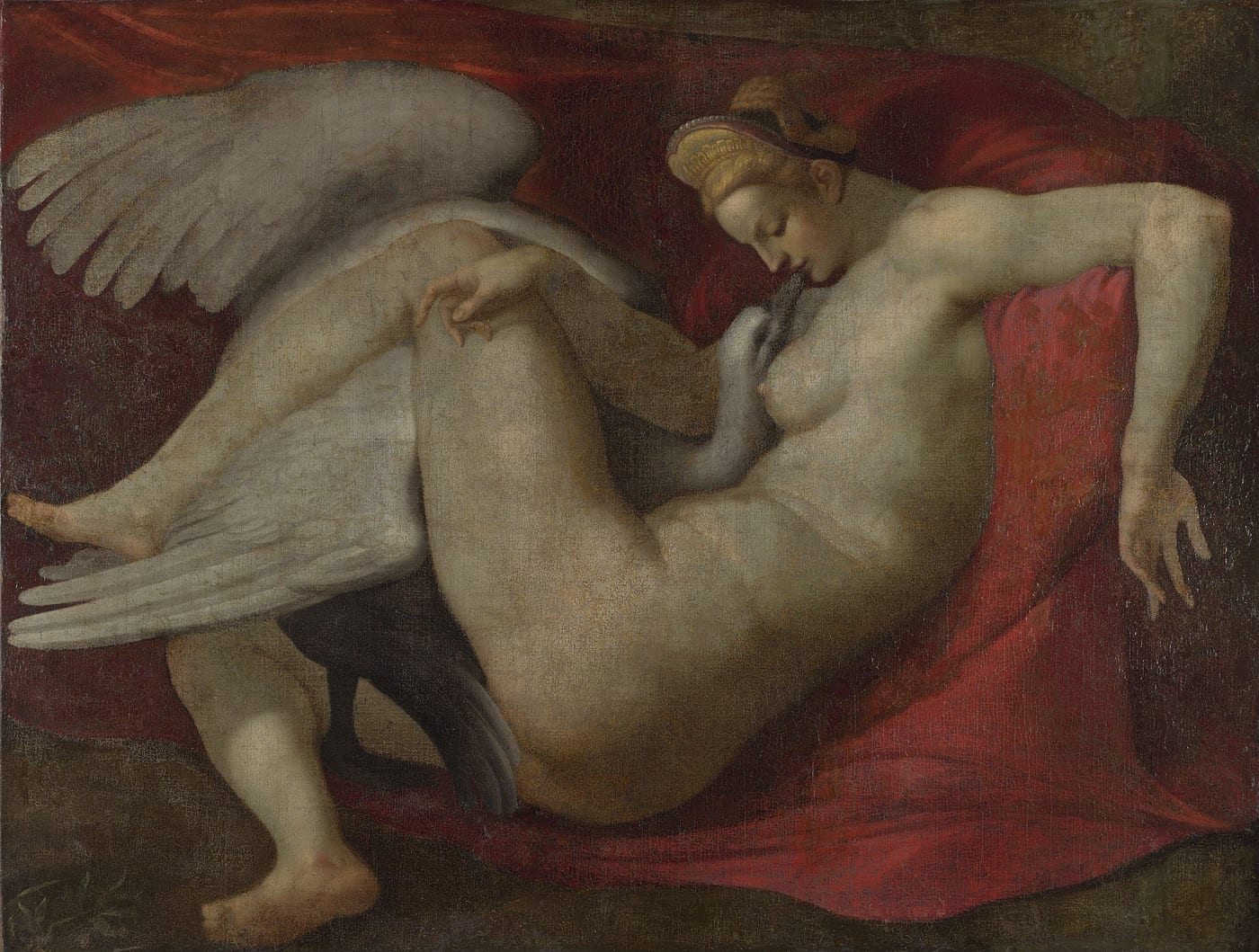
The Greek and Roman transformation-corpus provides the substrate for most Western literary engagement with animal-spirituality. Every Renaissance tapestry of Leda-and-the-swan, every Shakespearean animal-transformation (Midsummer Night’s Dream’s Bottom-as-ass echoes Apuleius), every modern English-language use of “Arachne” for spider-anything, traces back through this inheritance.
Key terms
- metamorphosis (μεταμόρφωσις)
- 'Transformation.' The Greek and Latin term for the mythological change of form, whether human-to-animal, animal-to-human, or human-to-plant.
- epiphany
- A god's appearance in a specific form. Zeus's swan-epiphany to Leda, his bull-epiphany to Europa, etc.
- apotheosis
- The elevation of a mortal to divine status; often involves transformation into an animal (Callisto → Great Bear constellation) or star.
- catasterism
- The placing of a figure among the stars as a constellation. Many Greek animal-constellations (Scorpius, Ursa Major) derive from catasterism narratives.
Frequently asked
- Who transforms into animals in Greek mythology?
- Zeus most frequently: swan (Leda), bull (Europa), eagle (Ganymede), cuckoo (Hera). Also humans transformed into animals: Arachne → spider (Ovid Met. 6), Io → cow (Ovid Met. 1), Callisto → bear (Ovid Met. 2), Actaeon → stag (Ovid Met. 3), Philomela and Procne → nightingale and swallow (Ovid Met. 6), Myrmidons (created from ants by Zeus, Ovid Met. 7). Ovid's Metamorphoses contains roughly 250 distinct transformation-narratives across its 15 books.
- What is Ovid's Metamorphoses?
- The Metamorphoses (c. 8 CE) is Ovid's 15-book Latin hexameter epic, containing roughly 250 distinct mythological narratives organized around the theme of transformation. It begins with the creation of the world and ends with the apotheosis of Julius Caesar. Frank Justus Miller's Loeb Classical Library edition (1916, revised G.P. Goold 1977) is the standard scholarly English; Stanley Lombardo's Hackett edition (2010) is the standard readable modern translation.
- What is The Golden Ass?
- Apuleius's Metamorphoses, commonly called The Golden Ass, is a 2nd-century CE Latin novel in which the protagonist Lucius is accidentally transformed into a donkey and must travel through a series of adventures before being restored to human form by the goddess Isis. It is the only Latin novel to survive complete from antiquity. P.G. Walsh's Oxford World's Classics translation (1994) is the standard.
- Is there a Roman animal-transformation tradition separate from the Greek?
- Roman authors inherited and extended the Greek tradition. Ovid's Metamorphoses (c. 8 CE) is the canonical compilation; his Fasti also contains transformation-narratives organized by the Roman calendar. Apuleius's Golden Ass (2nd century CE) extends the tradition into novel-form. The Romans added specific local traditions (the Lupa Capitolina she-wolf of Romulus and Remus, discussed on our wolf page) but largely preserved and elaborated the Greek inheritance.
Sources
- PRIMARYHomer, Odyssey (Books 4, 10 on Proteus and Circe) — Murray trans., Loeb Classical Library.
- PRIMARYOvid, Metamorphoses (15 books) — Miller trans., rev. Goold, Loeb Classical Library, 1977.
- PRIMARYOvid, Fasti — Frazer trans., Loeb Classical Library.
- PRIMARYApuleius, Metamorphoses (The Golden Ass) — Walsh trans., Oxford World's Classics, 1994.
- PRIMARYHesiod, Theogony — Most trans., Loeb Classical Library.
- PRIMARYApollodorus, Library — Frazer trans., Loeb Classical Library.
- PRIMARYPausanias, Description of Greece — Jones trans., Loeb Classical Library.
- PRIMARYPseudo-Eratosthenes, Catasterismi — Hard trans., Oxford World's Classics, 2015.