Spirit Animal
Seahorse Spirit Animal
Seahorse spirit animal meaning, traced from the modern patience-and-male-pregnancy reading back through Ted Andrews's Animal Speak to Poseidon's hippocampus in Homer and Pausanias, the Pictish sea-horse stone carvings of 6th–9th century Scotland, the traditional Chinese medicine tradition, and contemporary conservation status.
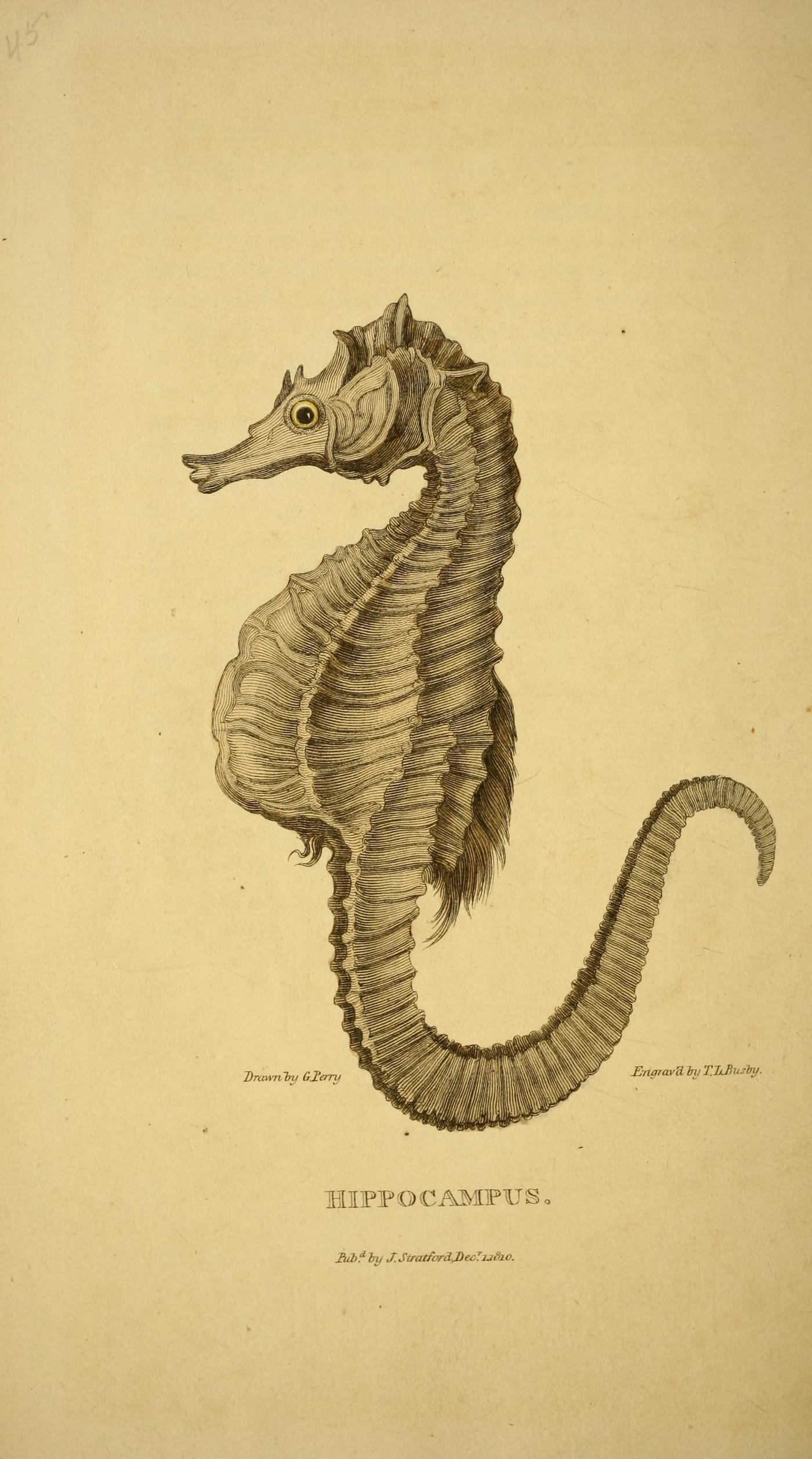
In modern pop-spiritual usage, the seahorse stands for patience, partnership, and the reproductive wonder of male pregnancy (only the male seahorse bears the young). That reading comes through Ted Andrews's Animal Speak (Llewellyn, 1993). The older traditions are specific. The Greek hippocampus (ἱππόκαμπος, 'horse-monster') is Poseidon's chariot-draught animal, described in Homer's Iliad 13.23–27 and depicted on Greek and Roman mosaics, Minoan-era seals, and Pictish stone carvings from 6th–9th century Scotland. Traditional Chinese medicine has used dried seahorses (海马, hǎi mǎ) for roughly two millennia, documented in the Ben Cao Gang Mu (1578). Conservation concern around this usage is current: all Hippocampus species are CITES Appendix II protected.
Homer’s Iliad Book 13, lines 23 through 27. Poseidon is leaving his palace under the sea at Aegae, where his gold-maned horses are stabled. He harnesses them, climbs into his chariot, and drives out across the waves so lightly that the axles stay dry. The horses Homer describes are hippocampi, horse-monsters with the forequarters of a horse and the coiled tail of a fish. They carry the god of the sea across the waters of his own domain.
This is the deepest documented seahorse tradition in Western mythology, and the Greek visual tradition of hippocampi carrying Nereids is one of the recurring motifs of Greek and Roman mosaic art for five hundred years. The real biological seahorse genus, Hippocampus (over 40 species), takes its Linnean name from this mythological creature.
The Pictish sea-horse
On standing stones across what is now northern Scotland, the Picts (c. 3rd–9th century CE) carved a recurring symbol that looks strikingly like a sea-horse: a horse-like head with a coiled tail. Aberlemno, Meigle, and other Pictish sites preserve examples. Isabel Henderson’s The Picts (Thames & Hudson, 1967) is the standard English-language overview. The specific religious or heraldic function of the Pictish sea-horse is debated; the symbol’s resemblance to the Greek hippocampus is probably convergent rather than derived from Mediterranean contact.
The Chinese medicinal tradition and a current conservation matter
Li Shizhen’s Bencao Gangmu (Compendium of Materia Medica, 1578) catalogs dried seahorse (hǎi mǎ, 海马) preparations as treatments for a range of conditions. The tradition is roughly two thousand years old in continuous practice and remains economically substantial today; the global trade in dried seahorses runs into tens of millions of individuals annually.
All Hippocampus species are protected under CITES Appendix II since 2004. Amanda Vincent’s Project Seahorse research at the University of British Columbia documents the trade and the population impacts. This is a real ethical tension for contemporary spirit-animal readers: the medicinal tradition is documented, long-standing, and economically significant for specific communities, and the conservation concern is also documented, long-standing, and significant. A honest article about the seahorse mentions both.
What Andrews 1993 carried forward
The modern pop-spiritual seahorse reading is the patience-partnership-male-pregnancy figure, drawn from the genuinely striking biology. Only the male seahorse bears the young. The female transfers eggs to the male’s specialized brood pouch; he carries and nourishes them for 10–45 days before release. The reading has real basis.
What Andrews did not include: the Greek Homeric tradition in any depth, the Pictish carving tradition, the Chinese medicinal tradition, or the contemporary conservation context. This page adds them.
Working with the Seahorse
If you want a regular practice rather than a one-time read, an oracle deck is the standard tool: you draw a card and sit with whatever animal comes up. The foundational modern spirit-animal oracle: 44 cards drawn from Sams's Seneca and other Indigenous teachings, with a guidebook that actually explains its sources. The deck most later ones are imitating.
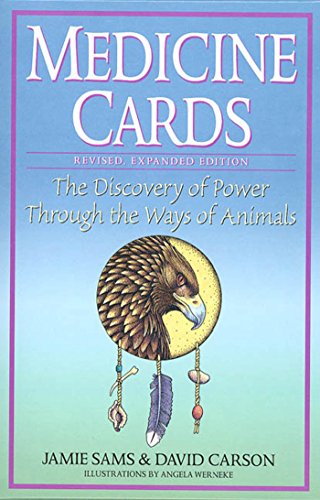
Medicine Cards
The foundational modern spirit-animal oracle: 44 cards drawn from Sams's Seneca and other Indigenous teachings, with a guidebook that actually explains its sources. The deck most later ones are imitating.
Compare the field in our ranked guide to spirit animal oracle decks, or browse decks, crystals, and journals in spirit animal gifts & tools.
Across traditions
Greek (Poseidon's hippocampus)
The hippocampus (Greek ἱππόκαμπος, 'horse-monster') is the sea-horse of Greek mythology, a creature with the forequarters of a horse and the coiled tail of a fish. Homer's Iliad 13.23–27 describes Poseidon's chariot drawn by hippocampi across the sea-surface. Pausanias, Description of Greece 2.1.7, records Poseidon's sanctuary at Isthmia with hippocampus imagery. Greek and Roman mosaics from the 2nd century BCE onward frequently show hippocampi carrying Nereids.
The real seahorse (genus Hippocampus, over 40 species) takes its Linnean genus name from the Greek mythological creature, with Rondelet and subsequent 16th-century natural historians formalizing the connection. The mythological hippocampus is larger and more dramatic than the real animal, but the Greek visual tradition clearly drew on observation of the small-seahorse body plan.
- PRIMARY Homer, Iliad 13.23–27 — Murray trans., Loeb Classical Library.
- PRIMARY Pausanias, Description of Greece 2.1.7 — Jones trans., Loeb Classical Library.
- PRIMARY Guillaume Rondelet, Libri de Piscibus Marinis (1554) — Lyon, 1554.
Pictish (the sea-horse stone carvings)
The Picts, the pre-Scottish inhabitants of what is now northern Scotland (c. 3rd–9th century CE), carved symbols on standing stones throughout their territory. The 'Pictish sea-horse' is one of the recurring symbols, appearing on stones at Aberlemno, Meigle, and elsewhere. The Pictish symbol is stylized: a horse-like head with a coiled tail, strongly reminiscent of the Greek hippocampus but reached through a separate visual tradition.
Isabel Henderson's The Picts (Thames & Hudson, 1967) and subsequent scholarship by Anna Ritchie and Jane Geddes treats the symbol corpus. The specific religious or heraldic function of the Pictish sea-horse remains debated; the sym carvings overall are understood as clan, identity, or ritual markers. The symbol's resemblance to the Greek hippocampus is probably convergent rather than derived.
- MUSEUM Pictish stone carvings at Aberlemno (churchyard and roadside stones) — Historic Environment Scotland.
- PEER-REVIEWED Isabel Henderson, The Picts — Thames & Hudson, 1967.
- PEER-REVIEWED Anna Ritchie, Picts — Historic Scotland, 1989.
Traditional Chinese medicine (hǎi mǎ)
Traditional Chinese medicine has used dried seahorses (hǎi mǎ, 海马, literally 'sea horse') for approximately two millennia. Li Shizhen's Bencao Gangmu (Compendium of Materia Medica, 1578) catalogs seahorse preparations as treatments for impotence, incontinence, kidney-yang deficiency, and respiratory conditions. Modern Chinese pharmacopeia continues to recognize the substance, and the global demand for dried seahorses (primarily for Chinese markets) runs into the tens of millions of individuals annually.
Conservation implications are serious. All Hippocampus species are protected under CITES Appendix II (since 2004), requiring export permits. Amanda Vincent's research at Project Seahorse (University of British Columbia) documents the trade and the population impacts. The medicinal tradition is alive and economically substantial; the conservation tradeoff is a real ethical matter for contemporary spirit-animal readers.
- PRIMARY Li Shizhen, Bencao Gangmu (1578) — Luo Xiwen trans., Foreign Languages Press, 2003.
- REFERENCE CITES Appendix II, Hippocampus spp. — Listed 2004.
- PEER-REVIEWED Amanda C.J. Vincent (Project Seahorse, University of British Columbia)
Ted Andrews (1993)
Andrews's 1993 seahorse is the patience-partnership-male-pregnancy figure drawn from the animal's genuinely striking biology (only the male bears the young, carried in a specialized brood pouch until release). The Greek hippocampus tradition is gestured at; the Pictish and Chinese medicinal traditions are absent. The conservation context is, unsurprisingly, absent from a 1993 text.
- REFERENCE Ted Andrews, Animal Speak — Llewellyn, September 1993.
Frequently asked
- What does a seahorse symbolize spiritually?
- In modern pop usage, patience, partnership, and the wonder of male pregnancy, the Andrews 1993 reading. Older traditions are specific. The Greek hippocampus is Poseidon's chariot-draught animal (Homer, Iliad 13.23–27; Pausanias 2.1.7). The Pictish sea-horse is a recurring symbol on 6th–9th century Scottish stones. Traditional Chinese medicine has used dried seahorses for roughly two millennia, documented in Li Shizhen's 1578 Bencao Gangmu. All Hippocampus species are now protected under CITES Appendix II, raising conservation questions for the medicinal tradition.
- Is the male seahorse really the one that gets pregnant?
- Yes. Seahorses are among a small number of animal species with male pregnancy. The female transfers eggs to the male's specialized brood pouch during mating; the male carries and nourishes the developing young for 10–45 days depending on species, then releases them. Amanda Vincent's Project Seahorse research at the University of British Columbia documents the biology. The striking reproductive system is the basis of most of the modern pop-spiritual 'partnership' reading of the seahorse.
- What is a hippocampus in Greek myth?
- The hippocampus (ἱππόκαμπος, 'horse-monster') is the sea-horse of Greek mythology, with the forequarters of a horse and the coiled tail of a fish. Homer's Iliad 13.23–27 describes Poseidon's chariot drawn by hippocampi. Pausanias 2.1.7 records Poseidon's sanctuary at Isthmia with hippocampus imagery. Greek and Roman mosaics from the 2nd century BCE onward frequently show hippocampi carrying Nereids. The real seahorse genus Hippocampus (over 40 species) takes its Linnean name from the mythological creature.
- Why are seahorses endangered?
- Primarily because of the global trade in dried seahorses for traditional Chinese medicine, plus bycatch in shrimp trawling and habitat loss. All Hippocampus species are protected under CITES Appendix II since 2004, requiring export permits. Amanda Vincent's Project Seahorse research documents the trade and population impacts. The tradeoff between the documented medicinal tradition (Li Shizhen's 1578 Bencao Gangmu and earlier sources) and contemporary conservation is a real ethical matter.
Sources
- PRIMARYHomer, Iliad 13.23–27 — Loeb Classical Library.
- PRIMARYPausanias, Description of Greece 2.1.7 — Loeb Classical Library.
- PRIMARYGuillaume Rondelet, Libri de Piscibus Marinis (1554) — Lyon.
- MUSEUMPictish stones at Aberlemno — Historic Environment Scotland.
- PEER-REVIEWEDIsabel Henderson, The Picts — Thames & Hudson, 1967.
- PEER-REVIEWEDAnna Ritchie, Picts — Historic Scotland, 1989.
- PRIMARYLi Shizhen, Bencao Gangmu (1578) — Luo Xiwen trans., Foreign Languages Press, 2003.
- REFERENCECITES Appendix II, Hippocampus spp.
- PEER-REVIEWEDProject Seahorse (Amanda Vincent, UBC)
- REFERENCETed Andrews, Animal Speak — Llewellyn, September 1993.