Spirit Animal
Rhinoceros Spirit Animal
Rhinoceros spirit animal meaning, traced from the modern ancient-power reading back through Ted Andrews's Animal Speak to Albrecht Dürer's 1515 woodcut of a rhinoceros he never saw, the Chinese xiniu medicinal tradition documented in the Bencao Gangmu, and the contemporary conservation context that is arguably more significant than any pre-modern spiritual reading.
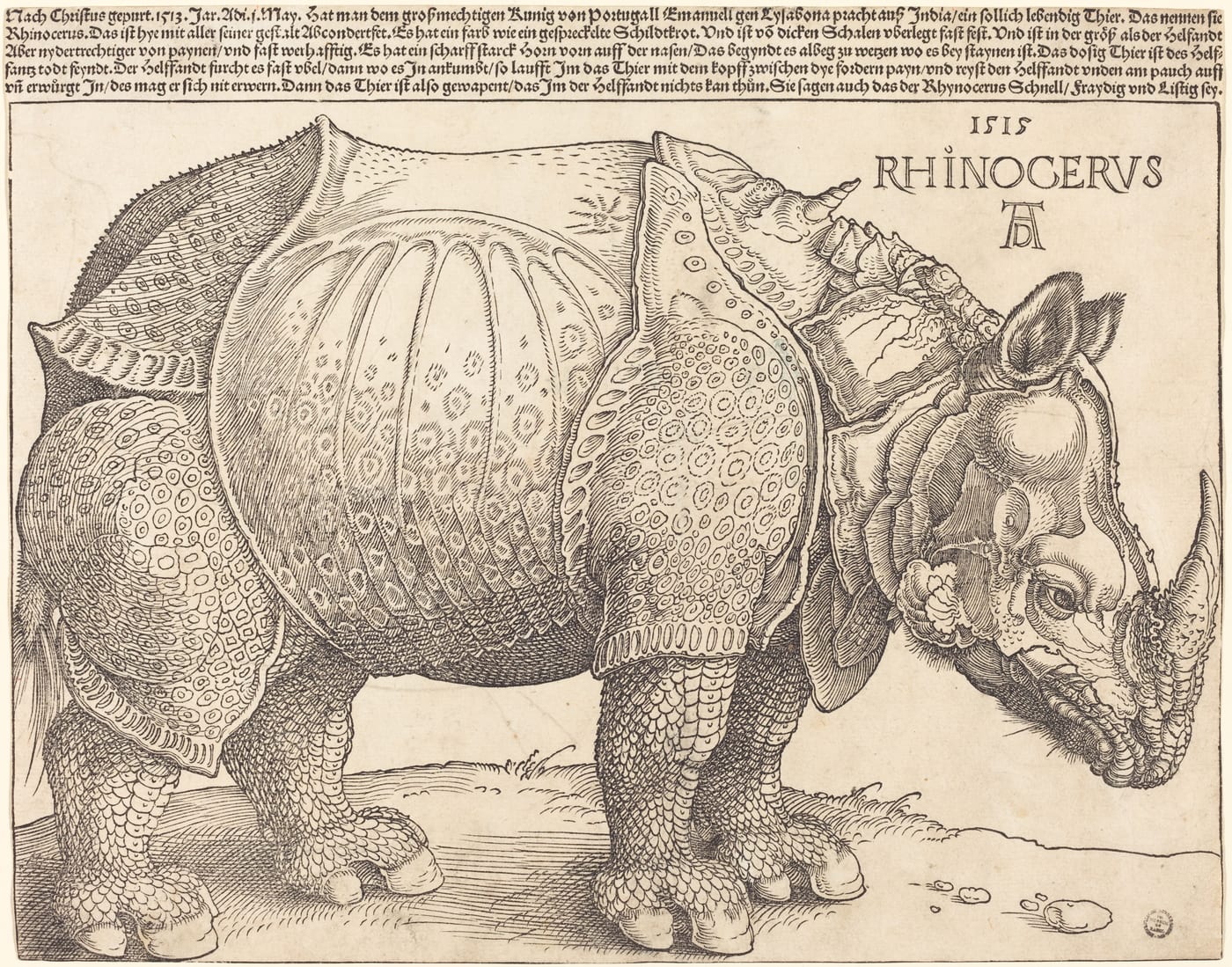
In modern American "spirit animal" usage, the rhinoceros stands for ancient power, grounded strength, and the no-nonsense moving-forward nature that refuses distraction. That reading comes through Ted Andrews's Animal Speak (Llewellyn, 1993). The rhino's pre-modern spiritual traditions are thinner than most animals in this catalog because it did not inhabit the Mediterranean or East Asian cores. The documented threads include Albrecht Dürer's famous 1515 woodcut of a rhinoceros he never saw, based on a 1514 description of an Indian rhinoceros gifted to King Manuel I of Portugal. Chinese traditional medicine has used rhino horn (xiniu jiao, 犀牛角) for centuries, documented in Li Shizhen's 1578 Bencao Gangmu. The contemporary context: all five rhino species are critically endangered or vulnerable, largely due to the rhino-horn trade. Any spiritual reading of this animal in 2026 has to address that.
On March 19, 2018, at the Ol Pejeta Conservancy in Kenya, a 45-year-old northern white rhinoceros named Sudan was euthanized due to multiple age-related complications. He was the last male of his species. Two females remain, his daughter Najin and granddaughter Fatu, both incapable of natural reproduction. The northern white rhinoceros is, in functional biological terms, extinct. Attempts to recover the species via stored semen and in vitro fertilization at the University of Padua are ongoing as of 2026 but have not yet produced viable embryos.
Any spiritual reading of the rhinoceros in 2026 that does not engage with this context is avoiding the point.
The thin pre-modern tradition
Dürer’s 1515 woodcut. Albrecht Dürer (1471–1528) never saw a living rhinoceros. His famous Rhinocerus of 1515 was based on a written description and a brief sketch of an Indian rhinoceros named Ganda, gifted to King Manuel I of Portugal in 1514 by the Sultan of Gujarat. The animal died in a shipwreck on its way to a further gift-destination (Pope Leo X). Dürer’s woodcut, with armor-plated skin, a second horn on the shoulder, and scales on the legs, is biologically inaccurate in nearly every detail. It was nonetheless reproduced across Europe for three centuries as the canonical rhinoceros image. Glynn Barratt’s The Rhinoceros (Thames & Hudson, 1999) treats the iconographic history.
Chinese xiniu medicinal tradition. Li Shizhen’s Bencao Gangmu (1578) catalogs rhino-horn preparations; the earlier Shen Nong Bencao Jing (1st–2nd century CE) contains foundational attestations. The tradition is long, continuous, and now the central driver of the illegal trade that has pushed the rhino to the brink. Contemporary Traditional Chinese Medicine professional bodies in Hong Kong and mainland China formally removed rhino-horn from recommended pharmacopeia in 2018.
African traditions. Less voluminously documented in surviving English-language scholarly literature than many other African cultural topics, reflecting both the historical under-documentation of East and Southern African oral traditions and the rhino’s general dangerousness. Credo Mutwa’s Indaba, My Children (1964) preserves some Southern African Bantu narratives, though Mutwa’s methodology has been contested.
The conservation present
All five rhino species (white, black, Indian, Javan, Sumatran) are Vulnerable, Endangered, or Critically Endangered per the IUCN Red List. The northern white rhinoceros subspecies functionally went extinct in 2018. Javan rhinos number fewer than 80 individuals; Sumatran rhinos fewer than 80; black rhinos about 6,400 after a severe 20th-century decline from roughly 70,000 in 1970. Conservation programs at Ol Pejeta (Kenya), Lewa (Kenya), and across Kruger (South Africa) work against poaching pressure that intensifies with the rhino-horn market.
The conservation context that cannot be ignored
Most animal entries spend most of their space on pre-modern documented spiritual traditions. The rhino entry spends significant space on the contemporary conservation crisis, because pretending the rhino is just “ancient power, grounded strength” while ignoring the poaching context would be both historically dishonest and ethically evasive. The modern pop-spiritual rhinoceros is a real reading; it is also a reading that has to share the page with what is actually happening to the animal.
The rhinoceros is not just a spirit animal. It is also a living species in genuine danger. A 2026 spiritual reading should hold both at once.
Working with the Rhinoceros
If you want a regular practice rather than a one-time read, an oracle deck is the standard tool: you draw a card and sit with whatever animal comes up. The foundational modern spirit-animal oracle: 44 cards drawn from Sams's Seneca and other Indigenous teachings, with a guidebook that actually explains its sources. The deck most later ones are imitating.
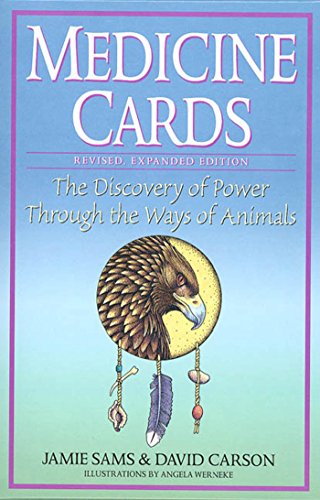
Medicine Cards
The foundational modern spirit-animal oracle: 44 cards drawn from Sams's Seneca and other Indigenous teachings, with a guidebook that actually explains its sources. The deck most later ones are imitating.
Compare the field in our ranked guide to spirit animal oracle decks, or browse decks, crystals, and journals in spirit animal gifts & tools.
Across traditions
Dürer's 1515 woodcut (the imagined rhinoceros)
Albrecht Dürer (1471–1528) never saw a living rhinoceros. In 1515 he produced a woodcut (Rhinocerus) based on a written description and a brief sketch of an Indian rhinoceros (named Ganda) that had been gifted to King Manuel I of Portugal in 1514 by the Sultan of Gujarat. The animal subsequently died in a shipwreck off Italy while being sent as a gift to Pope Leo X.
Dürer's woodcut shows the rhinoceros with armor-plated skin, a second horn on its shoulder, and scales on its legs, none of which match the actual animal. Nonetheless, the image was reproduced across Europe for the next three centuries as the canonical representation of the rhinoceros, appearing in natural-history encyclopedias and as the source image for copies in Bavarian and Roman fresco painting. Glynn Barratt's The Rhinoceros (Thames & Hudson, 1999) treats the iconographic afterlife.
- MUSEUM Albrecht Dürer, Rhinocerus (woodcut, 1515) — British Museum.
- PEER-REVIEWED Glynn Barratt, The Rhinoceros — Thames & Hudson, 1999.
Chinese (xiniu, medicinal horn)
Chinese traditional medicine has used rhinoceros horn (xīniú jiǎo, 犀牛角) for centuries. Li Shizhen's Bencao Gangmu (Compendium of Materia Medica, 1578) catalogs rhino-horn preparations as treatments for fever, toxin-clearance, and various kidney-yang conditions. The earlier Shen Nong Bencao Jing (1st–2nd century CE) contains the foundational attestations.
Contemporary pharmacological research (including the University of Hong Kong studies of the early 2000s) has not validated most traditional rhino-horn indications. The World Wildlife Fund and TRAFFIC document the current illegal trade, which has driven poaching-related population collapses in all five rhino species. The ethical tension between documented traditional-medicine heritage and documented conservation emergency is current and unresolved. Traditional Chinese Medicine professional bodies in Hong Kong and mainland China have, since 2018, formally removed rhino-horn from recommended pharmacopeia.
- PRIMARY Li Shizhen, Bencao Gangmu (1578) — Luo Xiwen trans., Foreign Languages Press, 2003.
- PRIMARY Shen Nong Bencao Jing (1st–2nd c. CE) — Yang Shou-zhong trans., Blue Poppy Press, 1998.
- REFERENCE TRAFFIC and WWF, rhinoceros-horn trade reports (ongoing)
- REFERENCE IUCN Red List, Rhinocerotidae assessments
African (Maasai, Shona, and the conservation present)
Sub-Saharan African rhino traditions are less voluminously documented in surviving English-language scholarly literature than many other African cultural topics, reflecting both the historical under-documentation of East and Southern African oral traditions and the rhino's general dangerousness, which limited casual human-animal contact. Maasai and Shona contemporary folklore preserves some rhino-material; Credo Mutwa's Indaba, My Children (Blue Crane, 1964) records South African Bantu rhino-narratives, though Mutwa's methodology has been contested.
The most significant current African rhino tradition is conservation-centered: Kenyan and South African anti-poaching programs, community conservancies including Lewa and Borana in Kenya and the Kruger National Park in South Africa, and the 2018 death of Sudan (the last male northern white rhinoceros) at Ol Pejeta Conservancy. Katherine Ellison's ongoing reporting for Smithsonian and National Geographic documents the contemporary struggle.
- REFERENCE Credo Mutwa, Indaba, My Children — Blue Crane, 1964 (contested methodology).
- REFERENCE Ol Pejeta Conservancy (Sudan memorial, Kenya)
- REFERENCE Lewa Wildlife Conservancy, Kenya
Ted Andrews (1993)
Andrews's 1993 rhino is the ancient-power, grounded-strength figure drawn generically from the animal's obvious mass and solitary habit. He does not address the conservation context, which in 1993 was already substantial but has since intensified significantly. A 21st-century spiritual reading of the rhino that does not acknowledge the poaching crisis is increasingly difficult to justify.
- REFERENCE Ted Andrews, Animal Speak — Llewellyn, September 1993.
Frequently asked
- What does a rhinoceros symbolize spiritually?
- In modern pop usage, ancient power, grounded strength, and focused pursuit, the Andrews 1993 reading. The pre-modern documented traditions are thinner than most animals in this catalog. The most substantive threads are Dürer's 1515 imagined woodcut (based on a rhinoceros he never saw), the Chinese xiniu medicinal tradition documented in Li Shizhen's 1578 Bencao Gangmu, and some Sub-Saharan African folklore (though less voluminously documented than many other African traditions). The contemporary conservation context is arguably more significant than any pre-modern reading: all five rhino species are critically endangered or vulnerable.
- Is Dürer's rhinoceros drawing accurate?
- No. Albrecht Dürer (1471–1528) never saw a living rhinoceros. His famous 1515 woodcut Rhinocerus was based on a written description and a brief sketch of an Indian rhinoceros (named Ganda) gifted to King Manuel I of Portugal in 1514. Dürer's woodcut shows the rhinoceros with armor-plated skin, a second horn on its shoulder, and scales on its legs, none of which match the actual animal. The image was reproduced across Europe for three centuries as the canonical representation despite the inaccuracies.
- What does Chinese tradition say about the rhino?
- Chinese traditional medicine has used rhinoceros horn (xīniú jiǎo, 犀牛角) for centuries. The foundational attestations are in the Shen Nong Bencao Jing (1st–2nd century CE), and Li Shizhen's Bencao Gangmu (1578) provides the fullest pre-modern treatment, with rhino-horn preparations for fever, toxin-clearance, and various kidney-yang conditions. Contemporary Traditional Chinese Medicine professional bodies in Hong Kong and mainland China have formally removed rhino-horn from recommended pharmacopeia since 2018, in response to the conservation crisis.
- Why is the rhinoceros endangered?
- Primarily because of the illegal trade in rhino horn, driven by demand in East and Southeast Asian markets. All five rhino species (white, black, Indian, Javan, and Sumatran) are classified as Vulnerable, Critically Endangered, or functionally extinct in the wild. The northern white rhinoceros functionally went extinct with the death of Sudan, the last male, at Ol Pejeta Conservancy in Kenya on March 19, 2018. WWF, TRAFFIC, and the IUCN Red List document the trade and population impacts. Spiritual readings of the rhinoceros in 2026 should engage with this context.
Sources
- MUSEUMAlbrecht Dürer, Rhinocerus (1515)
- PEER-REVIEWEDGlynn Barratt, The Rhinoceros — Thames & Hudson, 1999.
- PRIMARYLi Shizhen, Bencao Gangmu (1578) — Luo Xiwen trans., Foreign Languages Press, 2003.
- PRIMARYShen Nong Bencao Jing — Blue Poppy Press, 1998.
- REFERENCETRAFFIC (rhino-horn trade reports)
- REFERENCEIUCN Red List, Rhinocerotidae
- REFERENCECredo Mutwa, Indaba, My Children (contested) — Blue Crane, 1964.
- REFERENCEOl Pejeta Conservancy
- REFERENCETed Andrews, Animal Speak — Llewellyn, September 1993.