Spirit Animal
Penguin Spirit Animal
Penguin spirit animal meaning: an honest treatment. Penguins are a Southern Hemisphere family unknown to Old World ancient civilizations. Their spiritual-cultural tradition is almost entirely post-1520 (Magellan) and largely 20th-century. Māori kororā and Antarctic exploration literature are the main threads.
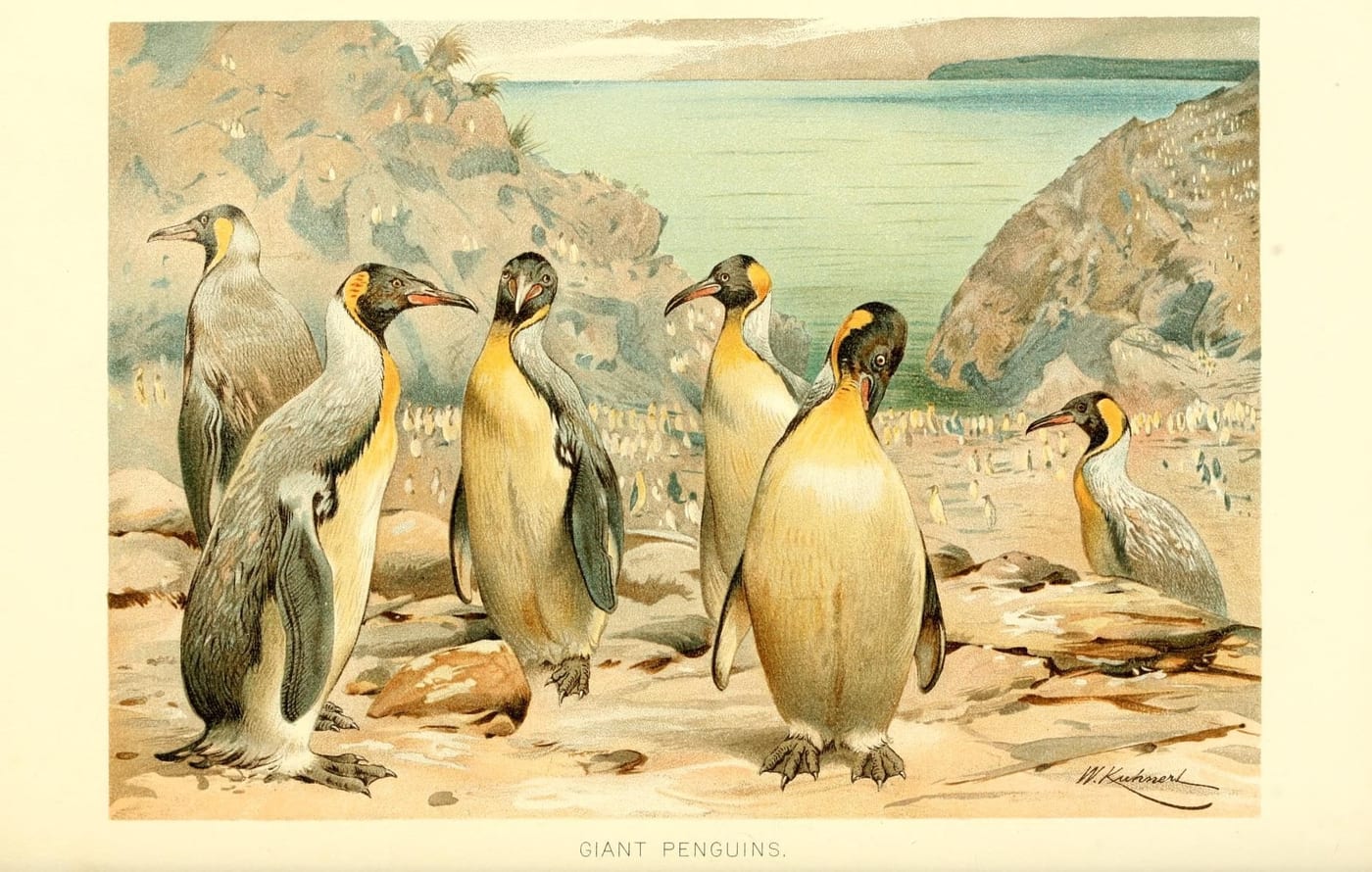
In modern pop-spiritual usage, the penguin stands for community, devoted partnership (the 'penguins mate for life' reading, exaggerated for most species), resilience in harsh conditions, and dignified adaptation. That reading is genuinely recent. Penguins are a Southern Hemisphere family (Spheniscidae) unknown to Old World ancient civilizations before the Age of Discovery. Vasco da Gama's 1497 voyage produced the first European encounter; Magellan's 1519–22 circumnavigation named the Magellanic penguin. Antonio Pigafetta's journal (1524) is the earliest detailed European description. Māori kororā (little blue penguin) traditions, discussed by Te Rangi Hīroa, are the closest thing to a sustained Indigenous association. Most of the modern cultural-spiritual weight comes from Antarctic exploration literature (Apsley Cherry-Garrard 1922) and 21st-century documentary film (March of the Penguins, 2005).
In June 1911, three British men left Scott’s base at Cape Evans on Ross Island, Antarctica, and walked 60 miles in midwinter darkness, in temperatures as low as -77°F, to obtain three emperor penguin eggs from the Cape Crozier rookery. The journey took five weeks. The eggs were acquired for a then-current scientific theory, since abandoned, that penguins were an evolutionary link to reptiles and that their embryology might show it. One of the three men, Henry Bowers, died the following year on Scott’s return from the South Pole. Edward Wilson died with him. Apsley Cherry-Garrard, the third, survived and wrote The Worst Journey in the World (1922). The “worst journey” of the title refers specifically to that five-week penguin-egg trip.
That journey, and the book that came out of it, did more to shape the modern Western cultural image of the penguin than any ancient tradition, because no ancient tradition existed.
The honest facts
Penguins are a Southern Hemisphere family. They were unknown to Old World civilizations before the 15th–16th century Age of Discovery. Pre-contact Mediterranean, Near Eastern, Indian, Chinese, and sub-Saharan African religious and literary traditions contain no penguin material. Vasco da Gama’s 1497 voyage produced the first European encounter (African penguin). Antonio Pigafetta’s 1524 journal of Magellan’s circumnavigation contains the earliest detailed description, observed at Puerto San Julián in Patagonia. Every Western-cultural penguin is downstream of these contact moments.
The word “penguin” has its own small twist: it appears to derive from Welsh pen gwyn (“white head”), originally applied to the now-extinct great auk of the North Atlantic. When Southern Hemisphere explorers encountered the flightless sea-birds we now call penguins, they transferred the name. Tim Birkhead’s The Great Auk (Princeton, 2022) treats the etymology.
The Māori kororā
The only sustained Indigenous penguin association in the documented record is Māori. The kororā (little blue penguin) appears in coastal folklore and in specific iwi regional traditions. Te Rangi Hīroa’s The Coming of the Maori (1949) covers it. The kororā does not occupy the major mythic-theological position the whale, shark, or owl do in Māori tradition; it is a present-but-peripheral figure. Colonies at Oamaru and elsewhere remain culturally significant to local iwi.
The 20th-century reading
Cherry-Garrard 1922 established the emperor penguin as the canonical symbol of polar resilience. Luc Jacquet’s 2005 March of the Penguins reached global box office of over $127 million and won the 2006 Academy Award for Best Documentary Feature, shaping the “penguins mate for life” reading (exaggerated; serial monogamy is documented but lifetime pair-bonds are not the rule). Gerald Kooyman’s The Emperor Penguin (Princeton, 2023) gives the actual biology.
Andrews’s 1993 penguin anticipated the film by twelve years but captured the cluster that was already forming.
Why the traditions are structured this way
Because the honest editorial move with a penguin-article is to say the tradition is entirely modern and to document what that modern tradition actually rests on. Which is, substantially, one 1922 book and one 2005 film. That is not nothing. It is just not ancient, and pretending otherwise would fail the site’s source-integrity standard.
Across traditions
Early European contact (Pigafetta 1524, Magellanic penguin)
Penguins are a Southern Hemisphere family (Spheniscidae) of 18 species, all flightless, distributed from the Galápagos (on the equator) south to Antarctica. Pre-contact Old World civilizations had no penguin tradition because they had no penguins. Vasco da Gama's 1497 voyage around the Cape of Good Hope produced the first documented European encounter; the African penguin (Spheniscus demersus) was initially called the 'Cape penguin' in Portuguese accounts.
Antonio Pigafetta's journal of Magellan's 1519–22 circumnavigation, Relazione del primo viaggio intorno al mondo (ed. Andrea da Mosto, 1894), provides the earliest detailed European description of penguins, observed at Puerto San Julián in Patagonia. The Magellanic penguin (Spheniscus magellanicus) takes its English name from this encounter. The word 'penguin' itself appears to derive from the Welsh pen gwyn ('white head'), originally applied to the now-extinct great auk of the North Atlantic and subsequently transferred to the Southern Hemisphere flightless sea-birds.
- PRIMARY Antonio Pigafetta, Relazione del primo viaggio intorno al mondo — ed. da Mosto, Reale Società Geografica Italiana, Rome, 1894.
- PEER-REVIEWED Tim Birkhead, The Great Auk: The Extinction of the Original Penguin — Princeton University Press, 2022.
Māori (kororā, the little blue penguin)
The Māori tradition of the kororā (little blue penguin, Eudyptula minor) is the most substantial documented Indigenous penguin association. Te Rangi Hīroa (Peter Buck), the Māori physician-anthropologist who served as director of the Bishop Museum in Honolulu, discussed kororā in the context of Māori ocean and shoreline ecology in The Coming of the Maori (Māori Purposes Fund Board, 1949). Elsdon Best's The Maori (1924) records related coastal-animal material.
The kororā does not occupy a major mythic-theological role in the documented Māori corpus the way the whale (Paikea), the shark (mako), or the owl (ruru) do. The bird is present in coastal folklore and in specific iwi regional traditions. Colonies at Oamaru and other New Zealand sites remain culturally significant to local iwi today.
- PRIMARY Te Rangi Hīroa (Peter Buck), The Coming of the Maori — Māori Purposes Fund Board, 1949.
- PRIMARY Elsdon Best, The Maori — Board of Maori Ethnological Research, 1924.
Antarctic exploration (Cherry-Garrard 1922)
Apsley Cherry-Garrard's The Worst Journey in the World (Constable, 1922) is the canonical English-language Antarctic-exploration memoir. Cherry-Garrard was a member of Robert Falcon Scott's 1910–13 Terra Nova Expedition. The book's title refers specifically to the Winter Journey of 1911, during which Cherry-Garrard, Edward Wilson, and Henry Bowers traveled 60 miles in Antarctic midwinter darkness to obtain three emperor penguin eggs from Cape Crozier, following a then-current scientific theory about penguin embryology.
The expedition produced one of the most harrowing journeys in polar history. The eggs were deposited at the Natural History Museum in London, where they remain. Cherry-Garrard's memoir, Scott's own posthumous Scott's Last Expedition (1913), and subsequent Antarctic-science writing established the emperor penguin as the canonical symbol of resilience in extreme environments.
- PRIMARY Apsley Cherry-Garrard, The Worst Journey in the World — Constable, 1922.
- PRIMARY Robert Falcon Scott, Scott's Last Expedition — Smith, Elder & Co., 1913.
- MUSEUM Natural History Museum, London (Cape Crozier emperor penguin eggs)
21st-century pop culture (March of the Penguins)
Luc Jacquet's 2005 documentary La Marche de l'empereur (English: March of the Penguins), narrated by Morgan Freeman in the English release, won the 2006 Academy Award for Best Documentary Feature and grossed over $127 million worldwide. The film's depiction of emperor penguin breeding (the long inland march, the partner handoff of the egg, the shared incubation) shaped the global pop-spiritual penguin-as-devoted-partner reading.
The 'penguins mate for life' claim is an exaggeration. Serial monogamy (same partner in consecutive seasons) is documented but lifetime pair-bonds are not the rule. Gerald Kooyman's The Emperor Penguin: A Natural and Social History (Princeton University Press, 2023) gives the actual biology. Nonetheless, the film's enormous cultural reach made the 'penguins mate for life' reading a standard feature of modern pop-spiritual discourse.
- REFERENCE Luc Jacquet (dir.), La Marche de l'empereur (2005) — National Geographic Films / Warner Independent Pictures.
- PEER-REVIEWED Gerald Kooyman, The Emperor Penguin: A Natural and Social History — Princeton University Press, 2023.
Ted Andrews (1993)
Andrews's 1993 Animal Speak predates March of the Penguins by twelve years but captures the community-partnership-resilience cluster already forming in 20th-century Western culture around penguins. His synthesis is downstream of Antarctic-exploration literature rather than any ancient tradition. The Māori kororā is absent.
- REFERENCE Ted Andrews, Animal Speak — Llewellyn, September 1993.
Frequently asked
- What does a penguin symbolize spiritually?
- In modern pop usage, community, devoted partnership, and resilience in harsh conditions, the Andrews 1993 reading. The reading has no deep ancient tradition because penguins are a Southern Hemisphere family unknown to Old World civilizations before the 15th–16th century Age of Discovery. The modern symbolic weight is almost entirely post-contact European exploration literature (Pigafetta 1524, Cherry-Garrard 1922) and 21st-century documentary film (March of the Penguins, 2005). Māori kororā traditions are the closest thing to a sustained Indigenous association.
- Do penguins really mate for life?
- Some species show serial monogamy (reproducing with the same partner in consecutive seasons), but 'mate for life' is an exaggeration popularized by Luc Jacquet's 2005 documentary March of the Penguins. Emperor penguin pair-bond fidelity is roughly 15% year-to-year according to Gerald Kooyman's The Emperor Penguin: A Natural and Social History (Princeton, 2023). The documentary's enormous cultural reach made the 'penguins mate for life' reading a standard feature of pop-spiritual penguin discourse, but it does not hold up to the actual biology.
- What is 'The Worst Journey in the World'?
- Apsley Cherry-Garrard's 1922 Antarctic-exploration memoir, narrating the Winter Journey of 1911 during Scott's Terra Nova Expedition. Cherry-Garrard, Edward Wilson, and Henry Bowers traveled 60 miles in Antarctic midwinter darkness to obtain three emperor penguin eggs from Cape Crozier, following a then-current scientific theory about penguin embryology. The eggs were deposited at the Natural History Museum in London, where they remain. The book is one of the canonical English-language polar-exploration memoirs.
- Why is it called a penguin?
- The word appears to derive from Welsh pen gwyn ('white head'), originally applied to the now-extinct great auk of the North Atlantic. When Southern Hemisphere explorers first encountered the flightless sea-birds we now call penguins, they noted the superficial resemblance to the great auk and transferred the name. Tim Birkhead's The Great Auk (Princeton University Press, 2022) treats the etymology and the transfer in detail.
Sources
- PRIMARYAntonio Pigafetta, Relazione del primo viaggio intorno al mondo — ed. da Mosto, 1894.
- PEER-REVIEWEDTim Birkhead, The Great Auk — Princeton University Press, 2022.
- PRIMARYTe Rangi Hīroa, The Coming of the Maori — Māori Purposes Fund Board, 1949.
- PRIMARYElsdon Best, The Maori — 1924.
- PRIMARYApsley Cherry-Garrard, The Worst Journey in the World — Constable, 1922.
- PRIMARYRobert Falcon Scott, Scott's Last Expedition — Smith, Elder & Co., 1913.
- MUSEUMNatural History Museum, London
- REFERENCELuc Jacquet, La Marche de l'empereur (2005)
- PEER-REVIEWEDGerald Kooyman, The Emperor Penguin — Princeton University Press, 2023.
- REFERENCETed Andrews, Animal Speak — Llewellyn, September 1993.