Spirit Animal
Peacock Spirit Animal
Peacock spirit animal meaning, traced from the modern beauty-and-pride reading back through Ted Andrews's Animal Speak to Kartikeya's mount in South Indian Tamil tradition, Hera-Juno's Argus-eyed peacock in Ovid's Metamorphoses, the Yazidi Tawûsê Melek, and Byzantine Christian resurrection iconography.
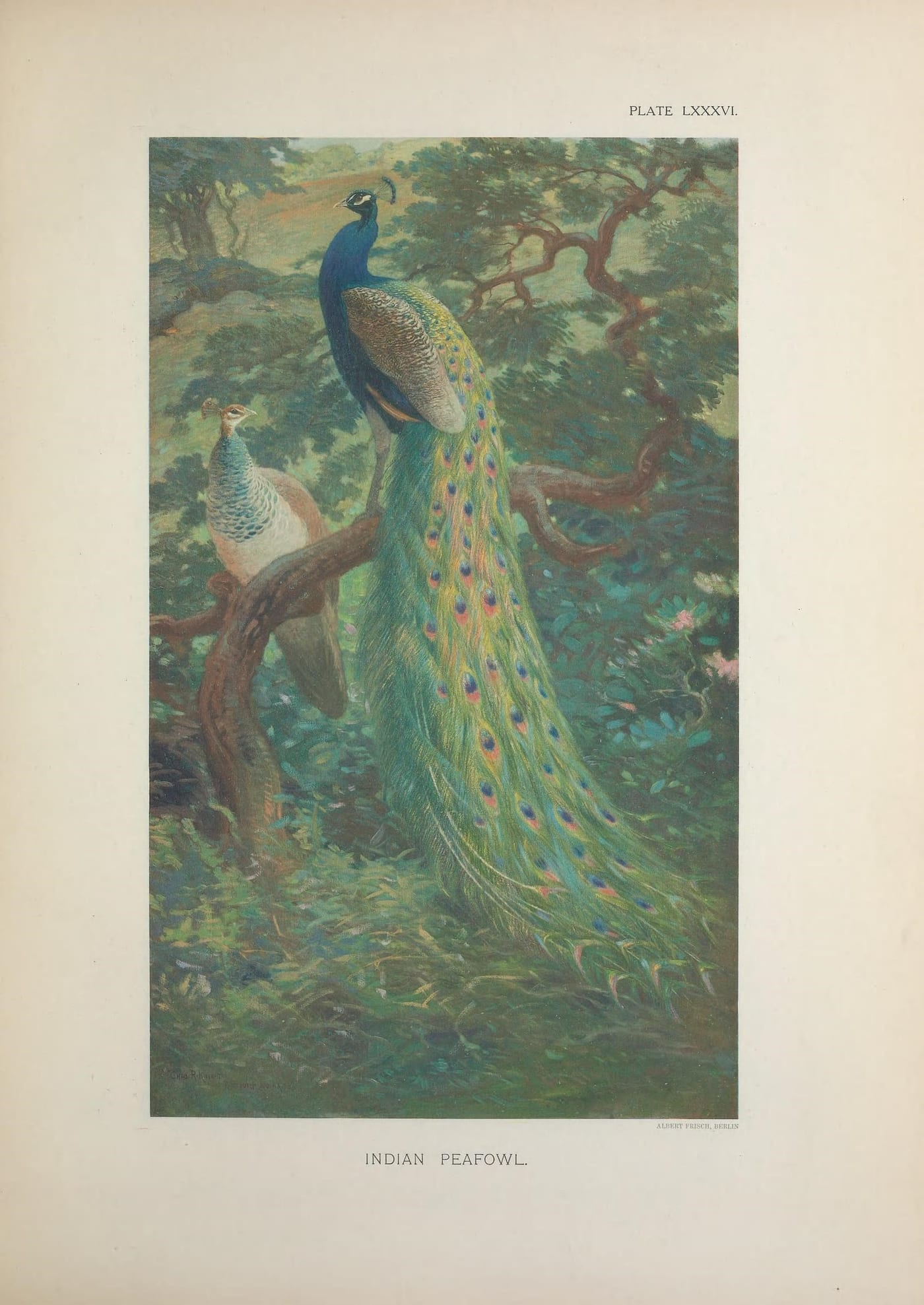
In modern American "spirit animal" usage, the peacock stands for beauty, pride, renewal, and a certain self-display that can tip toward vanity. That reading comes through Ted Andrews's Animal Speak (Llewellyn, 1993). The older traditions are precise. Kartikeya (Murugan in Tamil Nadu) rides a peacock in South Indian iconography, and his six-faced Skanda-form is the martial general of the Hindu pantheon. Hera (Juno in Rome) transferred the hundred eyes of the slain giant Argus to the peacock's tail, per Ovid's Metamorphoses 1.722. The Yazidi religion's supreme angel is Tawûsê Melek, the Peacock Angel, whose identity and image have been a source of centuries of Muslim and Christian misunderstanding. And in Byzantine Christian iconography, the peacock (believed by Pliny and later medieval bestiaries to have incorruptible flesh) became a symbol of the resurrection.
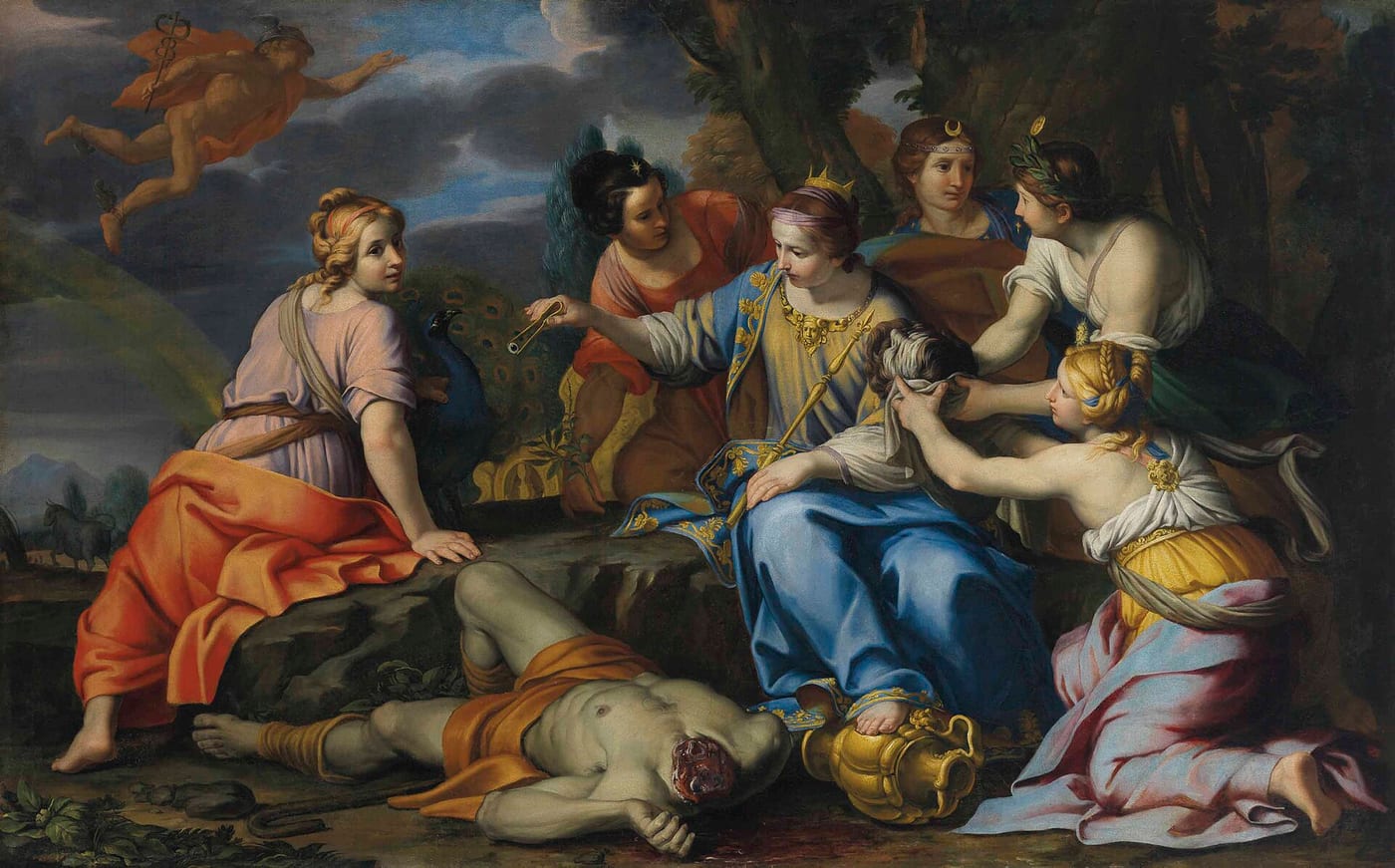
Ovid’s Metamorphoses, Book 1, lines 622 through 723. Zeus has taken the nymph Io as a lover, and to hide her from his wife Hera he has transformed her into a white cow. Hera is not fooled. She demands the cow as a gift, ties it up in a grove, and sets the giant Argus, a creature with a hundred eyes, to guard it. Argus never fully sleeps; only half his eyes close at a time. Hermes, on Zeus’s orders, arrives disguised as a shepherd, plays a pipe, tells a long, deliberately boring story about the origin of the pan-pipe, and puts all hundred eyes to sleep at once. Then he kills Argus. Hera, when she finds out, takes Argus’s hundred eyes and places them on the tail of her sacred bird, the peacock, so they are never forgotten.
Every time you look at a peacock’s tail, you are looking at an Ovidian monument to a murdered giant.
The traditions, each with its own logic
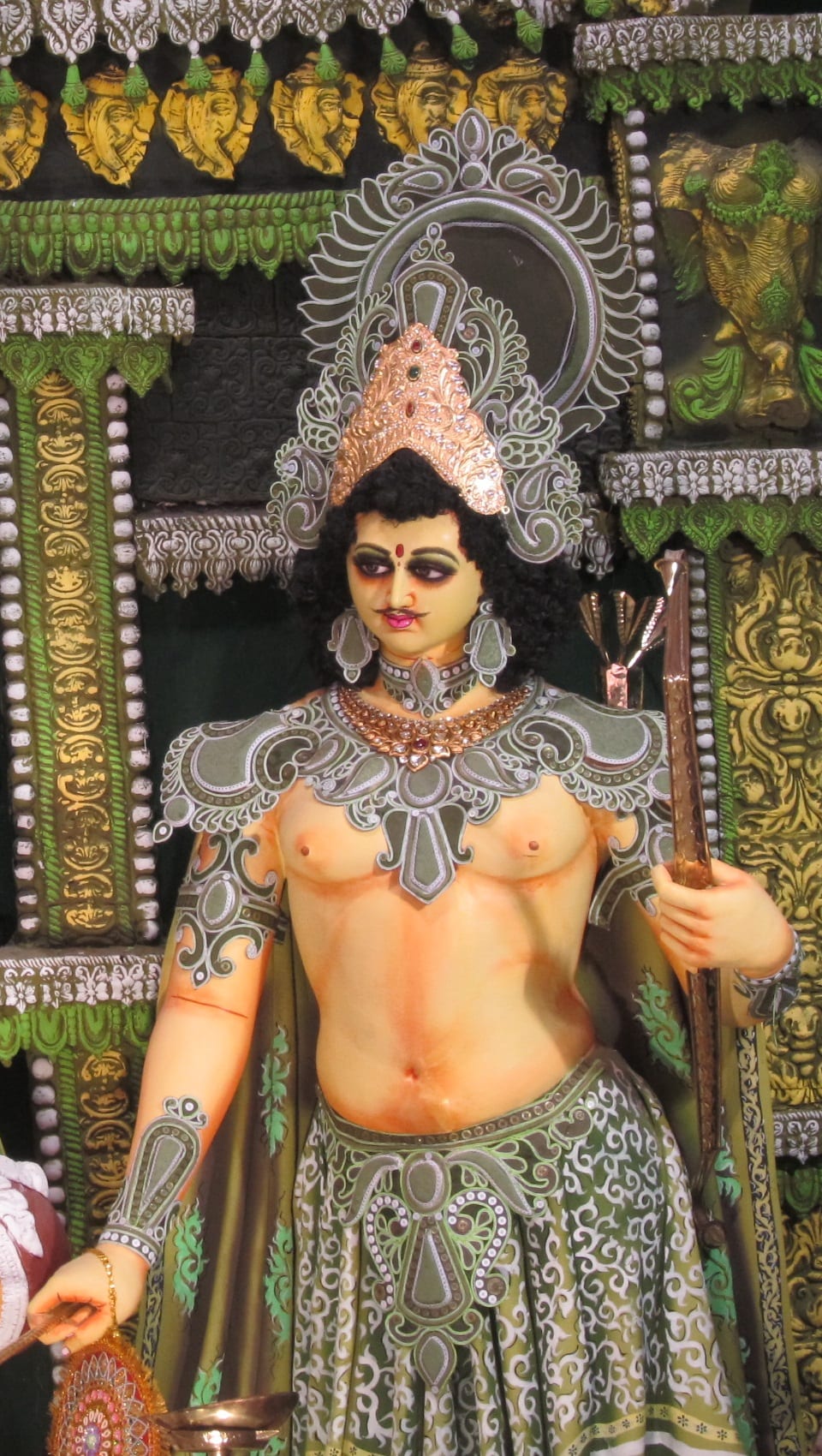
Kartikeya-Murugan. Hindu, South Indian, Tamil. Rides a peacock, wields a sacred spear (vel), commands the armies of the devas. Six major Tamil temples (the Arupadai Veedu) are dedicated to him. Annual festivals including Thaipusam draw hundreds of thousands of pilgrims, some of whom carry elaborate kavadi arches decorated with peacock feathers up to the temple.
Hera-Juno. Argus’s hundred eyes on the tail. The peacock as the queen of heaven’s sacred bird, transferred into Roman Juno iconography, then into early Christian Mary iconography, then into medieval bestiary traditions that layered on the “incorruptible flesh” claim from Pliny. By the Middle Ages, the peacock is carrying more theological weight than almost any other bird in Christian Europe.
Tawûsê Melek. Yazidi. The supreme Peacock Angel of a distinct Kurdish monotheistic tradition that predates Islam in the Kurdish region. Chief of seven angels entrusted with the world. His image on the bronze Sanjaq standard is paraded through Yazidi communities in specific ritual circuits. The Yazidi have suffered catastrophic persecution, including the 2014 Sinjar genocide, and the community’s survival is itself a contemporary global ethical matter. Nadia Murad, a Yazidi survivor, is a Nobel laureate (2018). Writing about the Peacock Angel without naming the Yazidi specifically is a flattening the tradition cannot afford.
Byzantine Christian resurrection. The peacock on the sarcophagus, on the mosaic, on the baptismal font. Pliny claimed the flesh was incorruptible. The tail was believed to regrow each year. Both were read as figures for resurrection.
What the four share and what they don’t
What they share: each treats the peacock as a bird associated with divine sovereignty, kingship, or the boundary between life and something beyond it. None of them treats the peacock as a figure of vanity or frivolous display.
What they don’t share: Murugan’s peacock is a warrior’s mount. Hera’s peacock carries the memory of a murdered giant. Tawûsê Melek is an angel whose identity is theologically foundational to an entire religion. The Byzantine peacock is a metaphor for resurrection. Four different weights.
The 1993 pop reading, named plainly
Ted Andrews’s peacock is the beauty-and-renewal figure, cleaned up from the Greek-Roman-Christian strand for personal-spirit use. The Tamil Murugan tradition and the Yazidi Tawûsê Melek tradition are absent from nearly every popular account.
Across traditions
Hindu / Tamil (Kartikeya-Murugan, the peacock mount)
Kartikeya (also Skanda, Subrahmanya, and in Tamil Nadu Murugan) is the six-faced warrior-god of the Hindu pantheon, the son of Shiva and Parvati, and the general of the devas against the asura Tarakasura. His vahana (mount) is the peacock, Paravani, on which he rides in the Skanda Purana (composed c. 8th century CE in its current form) and across South Indian temple sculpture from the 7th-century Pallava dynasty forward.
In Tamil devotion, Murugan is the central deity of the six major Arupadai Veedu ("six abodes") temples in Tamil Nadu: Palani, Tiruchendur, Swamimalai, Tirupparankundram, Tiruttani, and Pazhamudircholai. Fred Clothey's The Many Faces of Murukan: The History and Meaning of a South Indian God (Mouton, 1978) is the definitive English-language treatment.
- PRIMARY Skanda Purana — Bhatt & Shastri trans., Motilal Banarsidass, 1950–2003.
- PEER-REVIEWED Fred W. Clothey, The Many Faces of Murukan: The History and Meaning of a South Indian God — Mouton, 1978.
- REFERENCE Palani Murugan Temple, Tamil Nadu
Greek / Roman (Hera-Juno, Argus-eyed)
Ovid's Metamorphoses 1.622–723 (c. 8 CE) narrates the origin of the peacock's tail. Hera (Juno) set the hundred-eyed giant Argus to guard Io after Zeus transformed her into a cow. Hermes, sent by Zeus, killed Argus. Hera transferred his hundred eyes to the feathers of her sacred bird, the peacock. The tradition carried into Roman iconography: Juno's Capitoline cult statue sometimes showed her with peacocks; Ovid's Fasti 6.283 adds a parallel strand.
The peacock's association with Hera-Juno as the queen of heaven carried into early Christian iconography, where it transferred onto Mary. Medieval bestiaries including the Physiologus (c. 2nd century CE in its earliest form) added the detail that peacock flesh was incorruptible, which led to the peacock becoming a standard Byzantine Christian symbol of the resurrection, visible on countless sarcophagi and mosaics.
- PRIMARY Ovid, Metamorphoses 1.622–723 — Miller trans., Loeb Classical Library.
- PRIMARY Ovid, Fasti 6.283 — Frazer trans., Loeb Classical Library.
- PRIMARY Physiologus (2nd c. CE) — Curley trans., University of Chicago Press, 2009.
- PRIMARY Pliny the Elder, Natural History 10.22 (peacock), 10.51 (incorruptibility) — Rackham trans., Loeb Classical Library.
Yazidi (Tawûsê Melek, the Peacock Angel)
Tawûsê Melek (Kurdish: Tawûsî Melek, "Peacock Angel") is the supreme angel of Yazidi religion, a distinct monotheistic tradition with roots in pre-Islamic Kurdish spirituality and elements drawn from Zoroastrianism, Sufi Islam, and ancient Mesopotamian religion. In Yazidi theology, Tawûsê Melek is the chief of seven angels to whom God entrusted the world; his association with the peacock is iconographic rather than narrative, represented in the Sanjaq, a bronze peacock-shaped standard paraded ritually among Yazidi communities.
The Yazidi community has suffered centuries of violent persecution, most recently in the 2014 ISIS genocide at Sinjar that killed thousands and enslaved over 6,000 Yazidi women and children. Nadia Murad, co-recipient of the 2018 Nobel Peace Prize, is Yazidi. Standard treatments: Philip Kreyenbroek, Yezidism: Its Background, Observances and Textual Tradition (Mellen, 1995); Christine Allison, The Yezidi Oral Tradition in Iraqi Kurdistan (Curzon, 2001).
- PEER-REVIEWED Philip G. Kreyenbroek, Yezidism: Its Background, Observances and Textual Tradition — Edwin Mellen Press, 1995.
- PEER-REVIEWED Christine Allison, The Yezidi Oral Tradition in Iraqi Kurdistan — Curzon Press, 2001.
- PRIMARY Nadia Murad, The Last Girl: My Story of Captivity, and My Fight Against the Islamic State — Tim Duggan Books, 2017.
Byzantine Christian (the peacock of resurrection)
In Byzantine Christian iconography, the peacock is a symbol of the resurrection and of immortal life. The reading rests on two claims: Pliny's Natural History 10.51 (and the medieval bestiaries that followed) held that peacock flesh does not corrupt after death; and the shedding-and-regrowth of the peacock's tail feathers each year was read allegorically as a figure for resurrection.
Peacocks appear on Early Christian sarcophagi (Rome, Ravenna, and across the Byzantine East), on the capitals of 6th-century mosaic churches including San Vitale in Ravenna, and on baptismal fonts. The symbolism persisted into medieval Western art and is still visible in Orthodox iconography today.
- PRIMARY Pliny the Elder, Natural History 10.51 — Loeb Classical Library.
- MUSEUM San Vitale, Ravenna (mosaic program, 546–548 CE) — UNESCO World Heritage Site.
- PEER-REVIEWED Louis Réau, Iconographie de l'art chrétien — PUF, 1955–59.
Ted Andrews (1993)
Andrews's 1993 peacock is the Greek-Roman-plus-Christian figure softened into a personal-spirit keyword: beauty, renewal, dignified pride, resurrection. He gestures at the Murugan tradition without specific texts. The Yazidi Tawûsê Melek is absent, which, given the recent genocidal violence the Yazidi community has suffered, makes the absence worth naming.
- REFERENCE Ted Andrews, Animal Speak — Llewellyn, September 1993.
Frequently asked
- What does a peacock symbolize spiritually?
- In modern pop usage, beauty, renewal, dignified pride, and a touch of vanity, the reading set by Andrews 1993. Older traditions are specific. Kartikeya (Murugan) rides a peacock in Tamil and South Indian tradition, with six major Arupadai Veedu temples dedicated to him. Hera-Juno transferred the hundred eyes of the slain giant Argus to the peacock's tail (Ovid, Metamorphoses 1.622–723). The Yazidi Tawûsê Melek is the supreme Peacock Angel. And Byzantine Christian iconography reads the peacock as a symbol of the resurrection.
- Why does Murugan ride a peacock?
- Kartikeya-Murugan's mount (vahana) is the peacock Paravani, a gift from Shiva in the Skanda Purana narrative. The peacock is depicted with Murugan in South Indian temple sculpture from the 7th-century Pallava dynasty forward. Murugan is the son of Shiva and Parvati, the general of the devas, and the central deity of the six Arupadai Veedu ('six abodes') temples in Tamil Nadu. Fred Clothey's The Many Faces of Murukan (Mouton, 1978) is the scholarly standard.
- Who is the Peacock Angel?
- Tawûsê Melek, the Peacock Angel, is the supreme angel of Yazidi religion, a monotheistic Kurdish tradition with elements drawn from Zoroastrianism, Sufi Islam, and pre-Islamic Mesopotamian religion. He is the chief of seven angels to whom God entrusted the world. The bronze peacock-shaped Sanjaq standard is paraded ritually among Yazidi communities. The community has suffered severe persecution, most recently in the 2014 ISIS Sinjar genocide.
- Why is the peacock a Christian resurrection symbol?
- Because Pliny's Natural History 10.51 and the medieval bestiaries that followed held that peacock flesh does not corrupt after death, and because the annual shedding-and-regrowth of the peacock's tail was read allegorically as a figure for resurrection. The imagery appears on Early Christian sarcophagi across Rome and Ravenna, in 6th-century mosaics including San Vitale, and on baptismal fonts, and persists in Orthodox iconography today.
Sources
- PRIMARYSkanda Purana — Motilal Banarsidass, 1950–2003.
- PEER-REVIEWEDFred W. Clothey, The Many Faces of Murukan — Mouton, 1978.
- PRIMARYOvid, Metamorphoses 1.622–723 — Loeb Classical Library.
- PRIMARYOvid, Fasti 6.283 — Loeb Classical Library.
- PRIMARYPliny, Natural History 10.22, 10.51 — Loeb Classical Library.
- PRIMARYPhysiologus (Curley trans., 2009)
- PEER-REVIEWEDPhilip Kreyenbroek, Yezidism — Edwin Mellen Press, 1995.
- PEER-REVIEWEDChristine Allison, The Yezidi Oral Tradition in Iraqi Kurdistan — Curzon, 2001.
- PRIMARYNadia Murad, The Last Girl — Tim Duggan Books, 2017.
- MUSEUMSan Vitale, Ravenna mosaic program (546–548 CE)
- PEER-REVIEWEDLouis Réau, Iconographie de l'art chrétien — PUF, 1955–59.
- REFERENCETed Andrews, Animal Speak — Llewellyn, September 1993.