Spirit Animal
Otter Spirit Animal
Otter spirit animal meaning, traced from the modern playfulness reading back through Ted Andrews's Animal Speak to the sacred otter of the Zoroastrian Avesta Vendidad 14, the Anishinaabe Nigig clan and the Midewiwin otter-skin medicine bag, the Scottish Hebridean otter-king folklore, and the Japanese kawauso yōkai.
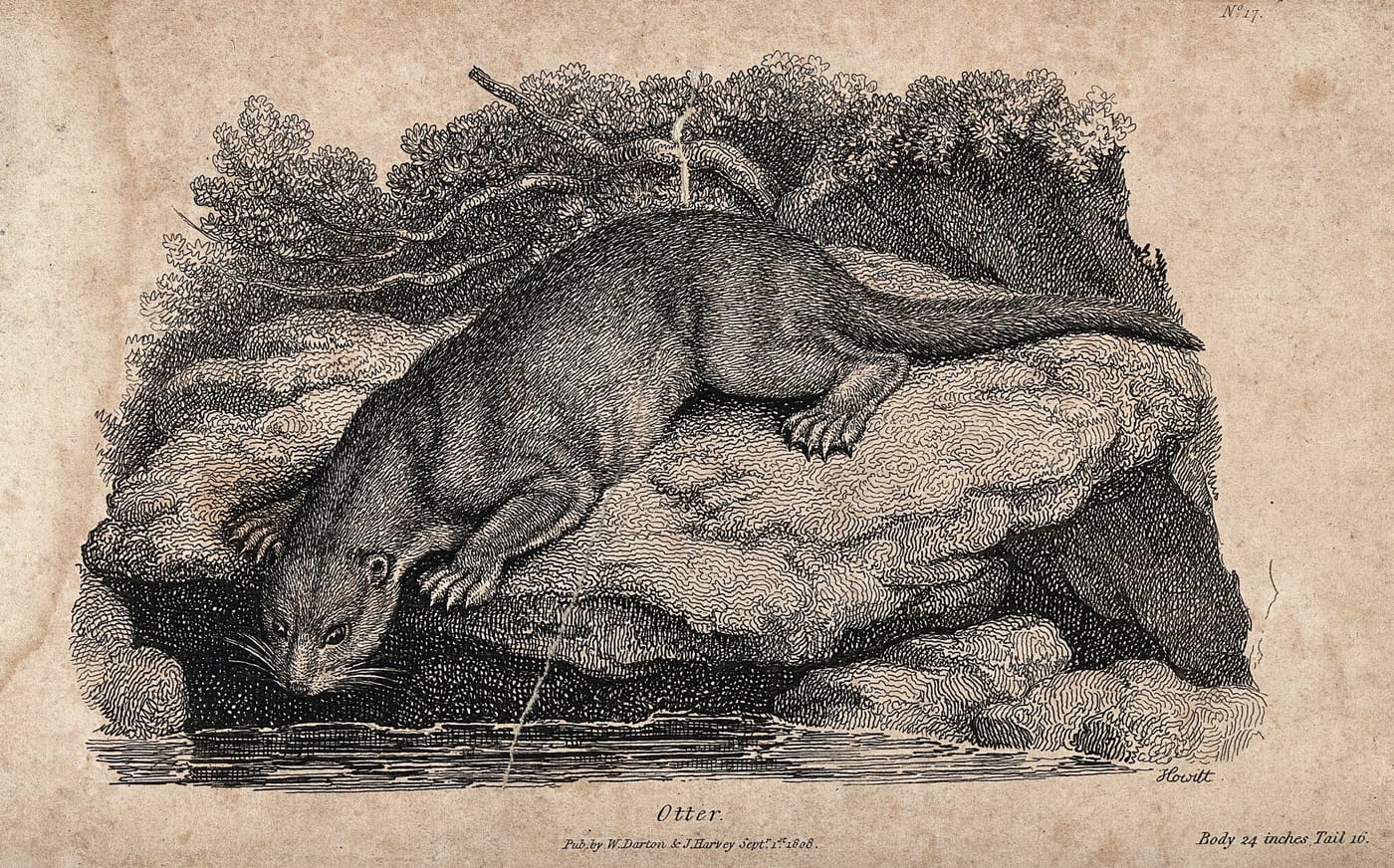
In modern American "spirit animal" usage, the otter stands for playfulness, curiosity, and the joyful relationship between work and rest. That reading comes through Ted Andrews's Animal Speak (Llewellyn, 1993). The older traditions are specific. The Zoroastrian Avesta's Vendidad 14 catalogs the elaborate ritual penalties for killing an otter (udra), which was held to be among the most sacred of animals. The Anishinaabe Nigig (otter) clan is one of the five original Ojibwe doodemag per William Warren (see our traditions page), and the otter-skin medicine bag (mitigwakik) is the principal Midewiwin ritual object. Scottish Hebridean folklore preserves the otter-king tradition, with John Gregorson Campbell's 1900 Superstitions of the Highlands and Islands recording specific encounter narratives. The Japanese kawauso (川獺) is an Edo-era yōkai shape-shifter.
A Parsi priest in the early 20th century, finding a dead otter, would have to initiate one of the most elaborate ritual-penalty sequences in any ancient legal text. Chapter 14 of the Zoroastrian Vendidad runs through thousands of specific acts of atonement: providing bundles of sacred firewood, killing precise numbers of “evil” creatures (snakes, mice, flies), supplying dairy and bread to priests, reciting specific verses. The offense of killing an otter was not minor. It damaged Ahura Mazda’s created cosmos at a specific point, and the repair took work.
That is the scale at which one ancient civilization took the otter. Almost no modern spirit-animal article mentions it.
The traditions, by scale of documentation
The Zoroastrian sacred otter. Vendidad 14, in James Darmesteter’s 1880 translation (Sacred Books of the East 4). The penalties for killing an otter are among the most elaborate in any ancient religious legal code. Mary Boyce’s three-volume A History of Zoroastrianism (Brill, 1975–91) is the scholarly standard.

Anishinaabe Nigig and the Midewiwin bag. Nigig (otter) is one of the five original Ojibwe doodemag per Warren’s 1885 History of the Ojibway People. The otter-skin medicine bag is the principal Midewiwin ritual object; each of the society’s levels involves its specific use. Johnston’s Ojibway Heritage (1976) and Landes’s Ojibwa Religion and the Midéwiwin (1968) are the standard English-language treatments.
The Scottish otter-king. Hebridean Gaelic folklore. The rìgh nan dòbhran, a white or albino otter whose pelt grants invulnerability. John Gregorson Campbell’s Superstitions of the Highlands and Islands (MacLehose, 1900) is the earliest detailed English-language record.
The Japanese kawauso. Edo-era yōkai shape-shifter, from Toriyama Sekien’s 1779 Konjaku Gazu Zoku Hyakki. The Japanese river otter (Lutra nippon) was declared extinct in 2012, which has given the tradition a contemporary elegiac weight.
What Andrews 1993 makes of all this
Very little of the above. The pop-spiritual otter reading is the sea-otter playing-on-its-back figure, with “play, curiosity, joy in work” as keywords. The four ancient traditions are more interesting, each in its own way.
Reading them widens the animal considerably.
Across traditions
Zoroastrian (Avesta Vendidad 14)
The Vendidad (Videvdad, the "Law Against the Demons"), one of the surviving books of the Zoroastrian Avesta, devotes its entire Chapter 14 to the ritual penalties for killing an otter (udra). The penalties are among the most elaborate in any ancient religious legal text: thousands of specific acts of atonement, from providing firewood and sacred twigs to killing specific numbers of 'evil' creatures (snakes, mice, flies). The otter's status is tied to its association with Ahura Mazda's water-creation; killing an otter is understood to injure the created cosmos itself.
Mary Boyce's A History of Zoroastrianism (Brill, 1975–91, 3 vols.) is the standard scholarly treatment. The text of Vendidad 14 is translated in James Darmesteter's Zend-Avesta Part I (Sacred Books of the East 4, Clarendon Press, 1880; reissued Motilal Banarsidass). Contemporary Parsi communities in Mumbai and Gujarat continue to treat the passage as authoritative, though the otter is now locally extinct in most Parsi-inhabited regions.
- PRIMARY Vendidad 14 (Avesta) — Darmesteter trans., Sacred Books of the East 4, Clarendon Press, 1880.
- PEER-REVIEWED Mary Boyce, A History of Zoroastrianism (3 vols.) — Brill, 1975–91.
Anishinaabe (Nigig and the Midewiwin otter-skin bag)
Nigig (otter) is one of the five original Ojibwe doodemag recorded in William W. Warren's History of the Ojibway People (Minnesota Historical Society, 1885; reissued 2009). See our Anishinaabe doodem page for the broader clan-system context. The otter-skin medicine bag (mitigwakik or pinjigosaan) is the principal ritual object of the Midewiwin, the Grand Medicine Society; each level of Midewiwin initiation involves the specific use of otter-medicine.
Ruth Landes's Ojibwa Religion and the Midéwiwin (University of Wisconsin Press, 1968), based on her 1930s fieldwork at Manitou Rapids, is a standard English-language treatment. Basil Johnston's Ojibway Heritage (University of Nebraska Press, 1976) covers the doodem and Midewiwin material in a way accessible to general readers. The otter's role in the Midewiwin is tied to its real biological ability to move between surface air and deep water, a capacity the Midewiwin reads as the initiate's own spiritual passage.
- PRIMARY William W. Warren, History of the Ojibway People — Minnesota Historical Society, 1885.
- PEER-REVIEWED Ruth Landes, Ojibwa Religion and the Midéwiwin — University of Wisconsin Press, 1968.
- PRIMARY Basil Johnston, Ojibway Heritage — University of Nebraska Press, 1976.
Scottish / Hebridean (otter-king folklore)
Scottish Gaelic folklore, particularly in the Hebrides, preserves the tradition of the rìgh nan dòbhran (king of the otters), a singular white or albino otter whose pelt was believed to render the wearer invulnerable and to grant wishes. John Gregorson Campbell's Superstitions of the Highlands and Islands of Scotland (MacLehose, 1900) and Witchcraft and Second Sight in the Highlands and Islands (1902) preserve the earliest detailed English-language records from named informants.
The folklore is likely connected to the older Celtic shape-shifting-otter tradition (Fionn mac Cumhaill's nephew Enna is transformed into an otter in some versions of the Fianna cycle) but the specific otter-king narrative is regional-Hebridean. Alexander Carmichael's Carmina Gadelica (6 vols., 1900–71) preserves associated Gaelic incantations.
- PRIMARY John Gregorson Campbell, Superstitions of the Highlands and Islands of Scotland — MacLehose, 1900.
- PRIMARY John Gregorson Campbell, Witchcraft and Second Sight in the Highlands and Islands — MacLehose, 1902.
- PRIMARY Alexander Carmichael, Carmina Gadelica — Scottish Academic Press, 1900–71 (6 vols.).
Japanese (kawauso yōkai)
The kawauso (川獺, "river-otter") of Japanese folklore is an Edo-era yōkai shape-shifter who takes human form to deceive travelers, particularly at dusk along riverbanks. The tradition is documented in Toriyama Sekien's Konjaku Gazu Zoku Hyakki (1779) and in earlier regional collections. The Japanese river otter (Lutra nippon) was declared extinct in 2012, the first native Japanese mammal extinction of the 20th century, which has given the kawauso tradition a new and somber contemporary valence.
Michael Dylan Foster's The Book of Yōkai (University of California Press, 2015) is the standard English-language treatment of kawauso alongside the broader Japanese yōkai tradition.
- PRIMARY Toriyama Sekien, Konjaku Gazu Zoku Hyakki (1779) — Alt trans., University Press of Mississippi, 2017.
- PEER-REVIEWED Michael Dylan Foster, The Book of Yōkai — University of California Press, 2015.
- REFERENCE IUCN Red List, Japanese river otter (Lutra nippon) — Extinct
Ted Andrews (1993)
Andrews's 1993 otter is the playfulness-curiosity-joy-in-work figure drawn from the sea-otter's famous playful behavior, softened into a personal-spirit keyword. The Zoroastrian Vendidad tradition, the Anishinaabe Midewiwin tradition, the Scottish otter-king folklore, and the Japanese kawauso tradition are all absent or at best gestured at.
- REFERENCE Ted Andrews, Animal Speak — Llewellyn, September 1993.
Frequently asked
- What does an otter symbolize spiritually?
- In modern pop usage, playfulness, curiosity, and joyful work, the Andrews 1993 reading. Older traditions are specific. The Zoroastrian Avesta's Vendidad 14 prescribes elaborate ritual penalties for killing an otter, which was considered sacred. The Anishinaabe Nigig is one of the five original Ojibwe clans (Warren 1885), and the otter-skin medicine bag is the principal Midewiwin ritual object. Scottish Hebridean folklore tells of the otter-king whose pelt grants invulnerability. And the Japanese kawauso is an Edo-era shape-shifter yōkai.
- Why is the otter sacred in Zoroastrianism?
- Because of the otter's association with Ahura Mazda's water-creation. The Avesta's Vendidad (Videvdad, 'Law Against the Demons') Chapter 14 is entirely devoted to the ritual penalties for killing an otter (udra), with thousands of specific acts of atonement required. The status is among the most elaborate in any ancient religious legal text. James Darmesteter's 1880 translation (Sacred Books of the East 4) is the standard English source; Mary Boyce's A History of Zoroastrianism (Brill, 1975–91) is the standard scholarly treatment.
- What is the Midewiwin otter-skin bag?
- The otter-skin medicine bag (mitigwakik or pinjigosaan) is the principal ritual object of the Midewiwin, the Grand Medicine Society of the Anishinaabe. Each level of Midewiwin initiation involves the specific ritual use of otter-medicine. The otter's ability to move between surface air and deep water is read as a model for the initiate's own spiritual passage. Basil Johnston's Ojibway Heritage (University of Nebraska Press, 1976) and Ruth Landes's Ojibwa Religion and the Midéwiwin (University of Wisconsin Press, 1968) are the standard treatments.
- What is the Scottish otter-king?
- The rìgh nan dòbhran (king of the otters) is a figure of Scottish Gaelic folklore, particularly in the Hebrides. A singular white or albino otter whose pelt was believed to render the wearer invulnerable and to grant wishes. John Gregorson Campbell's Superstitions of the Highlands and Islands of Scotland (MacLehose, 1900) preserves the earliest detailed English-language records. The folklore is likely connected to older Celtic shape-shifting-otter traditions.
Sources
- PRIMARYVendidad 14 (Avesta) — Darmesteter trans., Sacred Books of the East 4, 1880.
- PEER-REVIEWEDMary Boyce, A History of Zoroastrianism — Brill, 1975–91.
- PRIMARYWilliam W. Warren, History of the Ojibway People — Minnesota Historical Society, 1885.
- PEER-REVIEWEDRuth Landes, Ojibwa Religion and the Midéwiwin — University of Wisconsin Press, 1968.
- PRIMARYBasil Johnston, Ojibway Heritage — University of Nebraska Press, 1976.
- PRIMARYJohn Gregorson Campbell, Superstitions of the Highlands and Islands of Scotland — MacLehose, 1900.
- PRIMARYAlexander Carmichael, Carmina Gadelica — Scottish Academic Press, 1900–71.
- PRIMARYToriyama Sekien, Konjaku Gazu Zoku Hyakki (1779) — Alt trans., UPM, 2017.
- PEER-REVIEWEDMichael Dylan Foster, The Book of Yōkai — University of California Press, 2015.
- REFERENCEIUCN Red List, Japanese river otter (extinct)
- REFERENCETed Andrews, Animal Speak — Llewellyn, September 1993.