Spirit Animal
Octopus Spirit Animal
Octopus spirit animal meaning, traced from the modern intelligence-and-adaptability reading back through Ted Andrews's Animal Speak to Minoan octopus pottery (c. 1500 BCE), the Ainu Akkorokamui, Hawaiian Kanaloa, and the Fijian octopus-god Rokobakaniceva who defeated the shark.
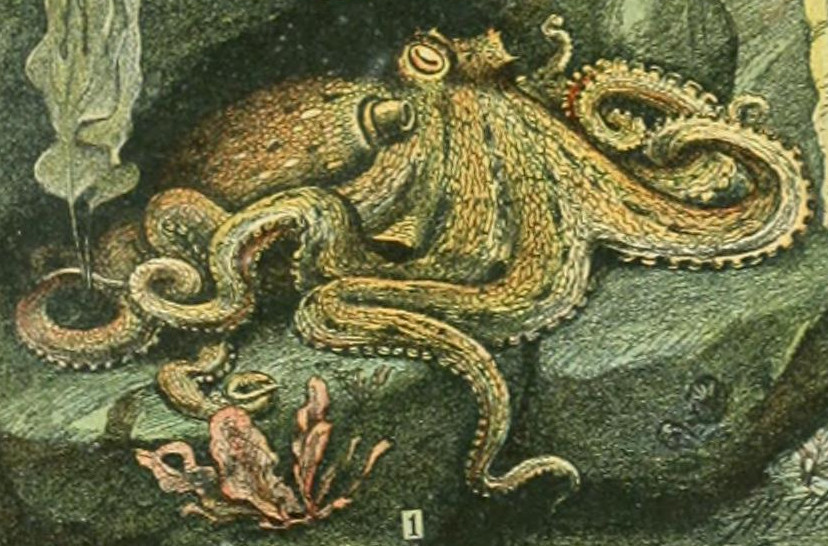
In modern American "spirit animal" usage, the octopus stands for intelligence, adaptability, shape-shifting, and the capacity to move across categories (the word 'octopus' in contemporary English often means precisely this, metaphorically). That reading comes through Ted Andrews's Animal Speak (Llewellyn, 1993). The older traditions are specific. Minoan Crete produced some of the most striking octopus pottery in world history, c. 1500 BCE, now in the Heraklion Museum. The Ainu of Hokkaidō preserve the Akkorokamui tradition, a giant octopus-spirit of Funka Bay. Hawaiian religion names Kanaloa, the god of the ocean, with octopus iconography in some contexts. And the Fijian Rokobakaniceva is the Kadavu octopus-god who, in iTaukei tradition, defeated the shark-god Dakuwaqa in their contest (see our shark page).
The octopus is the one animal where the modern pop-spiritual reading and the contemporary science are genuinely aligned. The octopus really is cognitively unusual. It solves problems. It uses tools. It recognizes individual humans. Peter Godfrey-Smith’s Other Minds (FSG, 2016) is the most serious recent philosophical treatment. Sy Montgomery’s The Soul of an Octopus (2015) is the most accessible popular one. The 2020 Netflix documentary My Octopus Teacher won the Academy Award for Best Documentary Feature. The octopus’s brain is distributed across its eight arms; each arm has a degree of independent cognition. No other widely-kept aquarium animal has that kind of architecture.
So the Andrews 1993 reading of the octopus as intelligent, adaptable, and shape-shifting has science behind it. What it lacks is the four specific older traditions.
Four traditions, with different scales of evidence
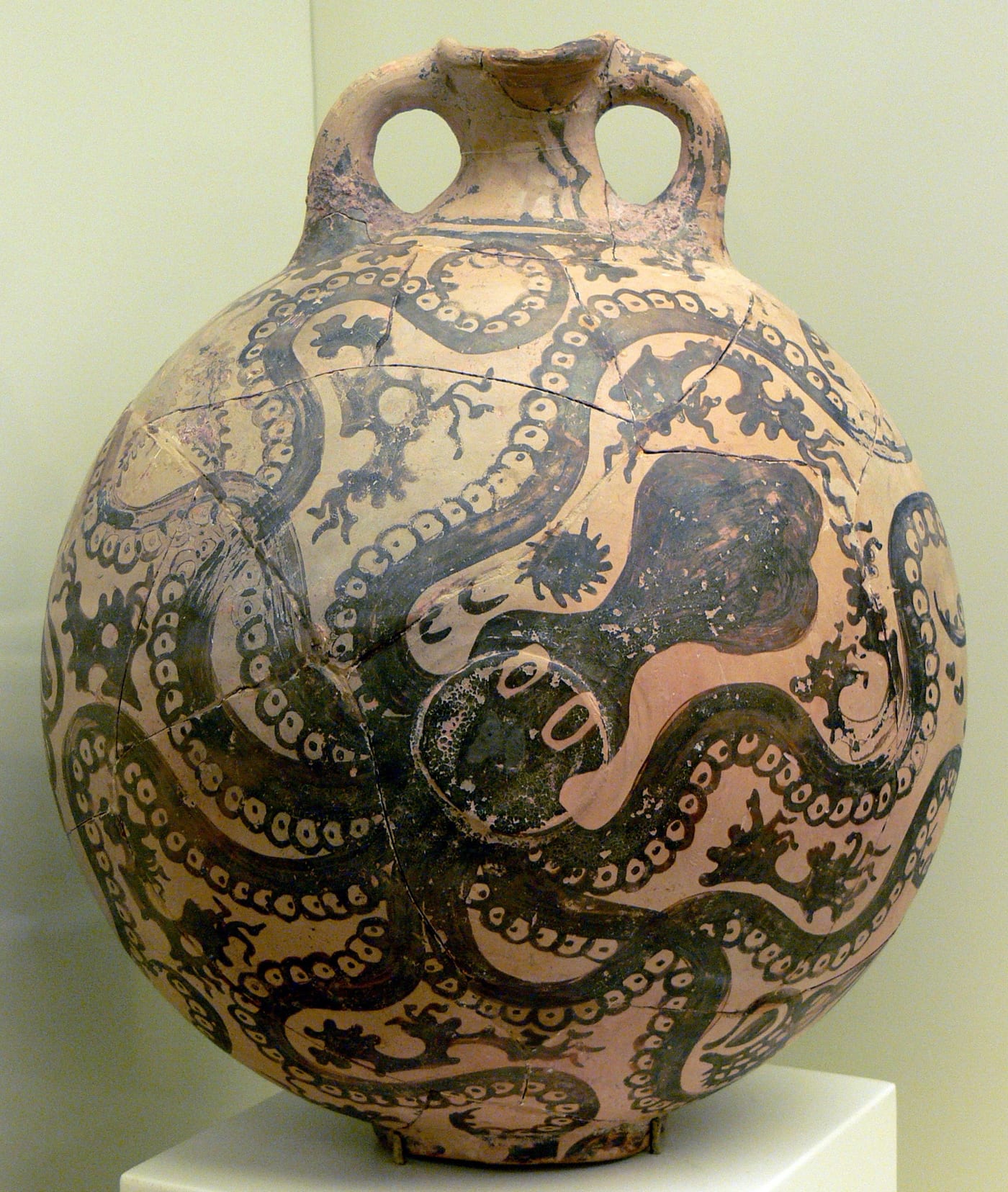
Minoan octopus pottery. Late Minoan IB period, c. 1500–1450 BCE. The Marine Style pottery depicts octopi naturalistically, their arms curving around the vase shape. The Palaikastro stirrup jar is iconic. We have no readable Minoan religious texts, so the imagery speaks for itself: whatever the Minoans thought the octopus was, they attended to it with extraordinary artistic seriousness.
Akkorokamui. Ainu, Funka Bay, Hokkaidō. A 120-meter red cephalopod spirit whose presence turned bay waters red. John Batchelor’s 1901 The Ainu and Their Folk-Lore preserves the core account. Akkorokamui is credited with both healing powers and disfigurement-powers. In contemporary Japanese pop culture the figure travels alongside other yōkai, but Batchelor’s Ainu source is the primary layer.
Kanaloa and the he’e. Hawaiian. Kanaloa, one of the four major Hawaiian gods, is the god of the deep ocean, currents, and voyaging. Octopus (he’e) manifestations appear in some oral traditions, though Kanaloa’s primary iconography is aniconic. The octopus was an ‘aumakua for specific Hawaiian families, a relationship documented by Beckwith (1940) and Pukui (1972).
Rokobakaniceva. Fijian, specifically Kadavu. The octopus-god who defeated the shark-god Dakuwaqa in their contest over the Kadavu reef, forcing the shark to promise never to eat humans there. This is the Pacific tradition’s clearest statement of the octopus as an intelligence-prevails-over-size figure, and it is almost never in Western spirit-animal writing. It is referenced on our shark page from the opposite direction.
What the pop reading captures and what it misses
Captures: the intelligence and adaptability. Those are real, empirically measurable, and ancient. The Minoan pottery already documents that the octopus was attended to with unusual artistic care 3,500 years ago.
Misses: the specific theological and ethnographic weight of Akkorokamui, Kanaloa, and Rokobakaniceva. Each of these is a specific being in a specific tradition with specific narrative logic. Flattening them into a generic “shape-shifter” keyword loses what each tradition was doing with the animal.
The octopus is an animal where science and ancient tradition both deserve the floor. The tradition sections above give them to both.
Across traditions
Minoan (Knossos pottery, c. 1500 BCE)
Minoan Crete produced some of the most striking octopus imagery in world art history. The "Marine Style" pottery of the Late Minoan IB period (c. 1500–1450 BCE) features large octopi, their arms curving naturalistically around the shape of the vase, sometimes accompanied by fish and seaweed. The best-known surviving examples are in the Heraklion Archaeological Museum on Crete; the "octopus stirrup jar" from Palaikastro is the iconic piece.
The imagery is not narrative (we have no readable Minoan religious texts; the Linear A script is undeciphered). What survives is the depth of the artistic attention: hundreds of surviving octopus vessels, consistently sophisticated in their observation of real octopus anatomy and movement. Sinclair Hood's The Arts in Prehistoric Greece (Penguin, 1978) and J. Lesley Fitton's Minoans (British Museum Press, 2002) are the standard treatments.
- MUSEUM Marine Style octopus stirrup jar (LM IB), Heraklion Archaeological Museum — c. 1500–1450 BCE.
- PEER-REVIEWED Sinclair Hood, The Arts in Prehistoric Greece — Penguin, 1978.
- PEER-REVIEWED J. Lesley Fitton, Minoans — British Museum Press, 2002.
Ainu (Akkorokamui of Funka Bay)
Akkorokamui (アッコロカムイ) is a giant octopus-spirit of the Ainu tradition, associated with Funka Bay in southwestern Hokkaidō. The earliest extended English-language documentation is John Batchelor's The Ainu and Their Folk-Lore (Religious Tract Society, 1901), which records the Ainu account of Akkorokamui as a red cephalopod 120 meters long whose presence turned the bay's water red. Ainu tradition attributes both healing powers and disfigurement-powers to Akkorokamui, depending on the relationship.
The Akkorokamui image travels. It appears in modern Shintō practice at shrines including Ko-shinto shrine in Atsuta, and in contemporary Japanese pop culture (video games, anime) where it has been picked up alongside other yōkai figures. The Ainu context is the primary source; later Japanese adoptions are the secondary layer.
- PRIMARY John Batchelor, The Ainu and Their Folk-Lore — Religious Tract Society, 1901.
- PEER-REVIEWED Michael Dylan Foster, The Book of Yōkai — University of California Press, 2015.
Hawaiian (Kanaloa)
Kanaloa is one of the four major Hawaiian gods (alongside Kāne, Kū, and Lono), the god of the ocean, specifically of deep ocean waters, currents, and the voyaging traditions that crossed the Pacific. The Kumulipo, the Hawaiian creation chant, places Kanaloa among the earliest emergent gods. In some oral traditions, Kanaloa manifests in octopus form (he'e), though he is not primarily an octopus-god; his iconography is largely aniconic.
Martha Beckwith's Hawaiian Mythology (University of Hawai'i Press, 1940) and Mary Kawena Pukui's Nānā I Ke Kumu (Queen Liliʻuokalani Children's Center, 1972) document the Kanaloa tradition. The octopus (he'e) was an 'aumakua for specific Hawaiian families, separate from the Kanaloa association but sometimes overlapping.
- PRIMARY Kumulipo — Liliʻuokalani trans., 1897.
- PEER-REVIEWED Martha Beckwith, Hawaiian Mythology — University of Hawai'i Press, 1940.
- PRIMARY Mary Kawena Pukui, Nānā I Ke Kumu — Queen Liliʻuokalani Children's Center, 1972.
Fijian (Rokobakaniceva of Kadavu)
Rokobakaniceva is the octopus-god of Kadavu Island in the Fijian iTaukei tradition, and the defeater of the shark-god Dakuwaqa (see our shark page). The foundational narrative has the shark-god Dakuwaqa approaching Kadavu waters to assert dominance; the octopus-god Rokobakaniceva wraps eight arms around him, pins him, and forces him to promise never to eat humans in Kadavu waters. The tradition is alive on Kadavu Island today.
A.M. Hocart's Lau Islands, Fiji (Bishop Museum Bulletin 62, 1929) and Asesela Ravuvu's Vaka i Taukei (University of the South Pacific, 1983) are the standard scholarly treatments. The Kadavu octopus-god is one of the clearest cases in Pacific traditional religion of the octopus depicted as a being whose intelligence allowed it to outmaneuver a larger and more fearsome apparent predator.
- PRIMARY A.M. Hocart, Lau Islands, Fiji — Bishop Museum Bulletin 62, 1929.
- PRIMARY Asesela Ravuvu, Vaka i Taukei — University of the South Pacific, 1983.
Contemporary cognition research (Godfrey-Smith, Montgomery)
The modern "intelligence and adaptability" reading of the octopus is uniquely well-supported by recent cognitive science. Peter Godfrey-Smith's Other Minds: The Octopus, the Sea, and the Deep Origins of Consciousness (Farrar, Straus and Giroux, 2016) and Sy Montgomery's The Soul of an Octopus (Atria, 2015) document the octopus's genuine problem-solving capacity, tool use, and recognition of individual humans. The 2020 Netflix documentary My Octopus Teacher (Pippa Ehrlich and James Reed, winner of the 2021 Academy Award for Best Documentary Feature) brought the subject to a wide audience.
This is the rare case where the pop-spiritual reading of an animal is aligned with the contemporary science. The octopus is, in empirical measure, an unusually cognitively complex animal. The Andrews 1993 intelligence reading is not wrong; it is just incomplete without the deeper traditions in the sections above.
- PEER-REVIEWED Peter Godfrey-Smith, Other Minds: The Octopus, the Sea, and the Deep Origins of Consciousness — Farrar, Straus and Giroux, 2016.
- REFERENCE Sy Montgomery, The Soul of an Octopus — Atria, 2015.
- REFERENCE My Octopus Teacher (dir. Pippa Ehrlich & James Reed, Netflix, 2020)
Ted Andrews (1993)
Andrews's 1993 octopus is the intelligence-and-adaptability figure, a reading that has only become better-supported by contemporary cognitive science. He gestures at the Minoan pottery briefly. The Ainu Akkorokamui, Hawaiian Kanaloa, and Fijian Rokobakaniceva traditions are absent. The resulting synthesis is not wrong but thin.
- REFERENCE Ted Andrews, Animal Speak — Llewellyn, September 1993.
Frequently asked
- What does an octopus symbolize spiritually?
- In modern pop usage, intelligence, adaptability, shape-shifting, and mystery, the Andrews 1993 reading. The deep traditions are specific. Minoan Crete produced striking octopus pottery c. 1500 BCE. The Ainu Akkorokamui is a giant octopus-spirit of Funka Bay (Batchelor 1901). Hawaiian Kanaloa is the god of the deep ocean; the he'e (octopus) is an 'aumakua for specific families. The Fijian Rokobakaniceva of Kadavu is the octopus-god who defeated the shark-god Dakuwaqa. And contemporary cognitive science (Godfrey-Smith 2016) genuinely supports the intelligence reading.
- What is Akkorokamui?
- Akkorokamui is a giant octopus-spirit of the Ainu tradition, associated with Funka Bay in southwestern Hokkaidō. John Batchelor's The Ainu and Their Folk-Lore (1901) records the Ainu account of a 120-meter red cephalopod whose presence turned the bay's water red. Ainu tradition attributes both healing and disfigurement powers to Akkorokamui. The figure has been picked up in modern Japanese pop culture alongside other yōkai, but the Ainu source is the primary tradition.
- Is Kanaloa an octopus god?
- Kanaloa is one of the four major Hawaiian gods (alongside Kāne, Kū, and Lono), the god of the deep ocean, currents, and voyaging. The Kumulipo places him among the earliest emergent gods. In some oral traditions, Kanaloa manifests in octopus (he'e) form, though he is not primarily an octopus-god and his iconography is largely aniconic. The octopus was also an 'aumakua (family ancestral guardian) for specific Hawaiian families.
- Why are octopi considered intelligent?
- Because they genuinely are, in measurable cognitive terms. Octopi solve puzzles, use tools, recognize individual humans, and manipulate objects with coordinated multi-limb strategies. Peter Godfrey-Smith's Other Minds (2016) and Sy Montgomery's The Soul of an Octopus (2015) are the accessible scholarly treatments. The 2020 Netflix documentary My Octopus Teacher won the Academy Award for Best Documentary Feature. Among invertebrates, the octopus's cognitive complexity is unmatched; among vertebrates, only a handful of mammals and birds are comparably studied.
Sources
- MUSEUMMarine Style octopus stirrup jar, Heraklion Archaeological Museum — c. 1500 BCE.
- PEER-REVIEWEDSinclair Hood, The Arts in Prehistoric Greece — Penguin, 1978.
- PEER-REVIEWEDJ. Lesley Fitton, Minoans — British Museum Press, 2002.
- PRIMARYJohn Batchelor, The Ainu and Their Folk-Lore — Religious Tract Society, 1901.
- PEER-REVIEWEDMichael Dylan Foster, The Book of Yōkai — UC Press, 2015.
- PRIMARYKumulipo (Liliʻuokalani trans.)
- PEER-REVIEWEDMartha Beckwith, Hawaiian Mythology — University of Hawai'i Press, 1940.
- PRIMARYMary Kawena Pukui, Nānā I Ke Kumu — 1972.
- PRIMARYA.M. Hocart, Lau Islands, Fiji — Bishop Museum Bulletin 62, 1929.
- PRIMARYAsesela Ravuvu, Vaka i Taukei — University of the South Pacific, 1983.
- PEER-REVIEWEDPeter Godfrey-Smith, Other Minds — FSG, 2016.
- REFERENCESy Montgomery, The Soul of an Octopus — Atria, 2015.
- REFERENCEMy Octopus Teacher (Netflix, 2020)
- REFERENCETed Andrews, Animal Speak — Llewellyn, September 1993.