Spirit Animal
Lion Spirit Animal
Lion spirit animal meaning, traced from the modern courage-and-royalty reading back through Ted Andrews's Animal Speak to Sumerian Inanna and her seven lions, the Egyptian Sekhmet, the Hebrew Bible's Samson and the Lion of Judah, and the Buddhist singha temple guardian.
In modern American "spirit animal" usage, the lion stands for courage, leadership, sovereignty, and pride (sometimes the constructive kind, sometimes the warning kind). That reading descends through Ted Andrews's Animal Speak (Llewellyn, 1993). The older traditions treat the lion with more weight. Sumerian Inanna rides seven lions into battle, per her hymns in the Enheduanna corpus (c. 2300 BCE). The Egyptian Sekhmet is the lioness-headed goddess of plague and war. The Hebrew Bible's Samson kills a lion with his bare hands (Judges 14); the 'Lion of Judah' is the tribal emblem that carries through to Revelation 5:5 and becomes the heraldic lion of every later Christian kingdom. The Buddhist singha (the temple-guardian lion) flanks the gate of every serious monastic complex from Sri Lanka to Japan.
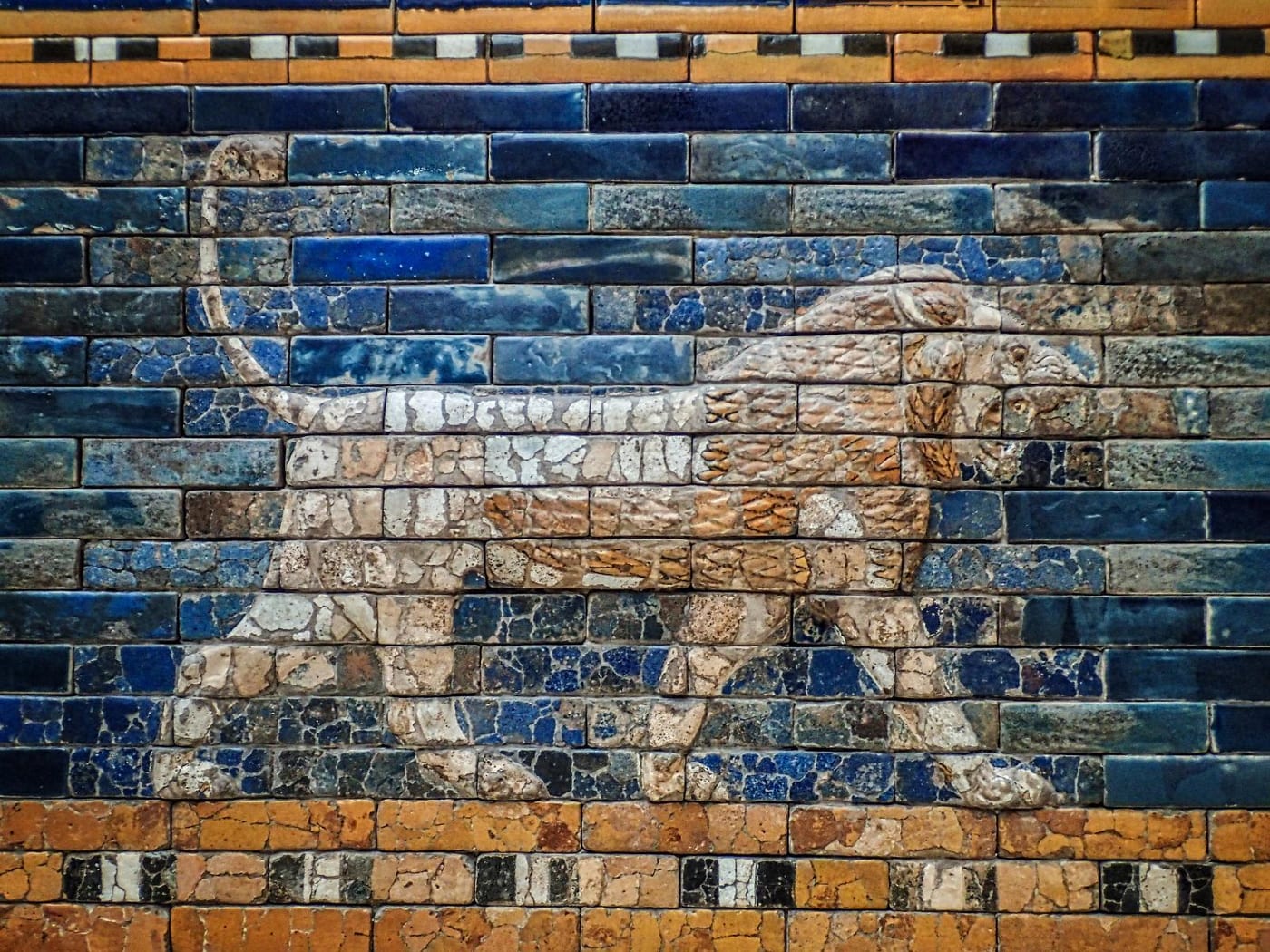
If you walk into the Pergamon Museum in Berlin and turn the corner into the Processional Way of Babylon, you meet the lions before you meet anything else. Glazed blue-and-yellow brick, life-size, walking toward you, one after another, all the way down the reconstructed corridor. They were set there around 575 BCE by Nebuchadnezzar II, on the road to the temple of Marduk. Each one is an Ishtar-lion, the war-goddess’s attribute animal. A thousand years before them, Enheduanna, the priestess-poet who is the first signed author in world literature, called the goddess “the lady of the battle-cry” and put her on a lion-drawn chariot. A thousand years after them, the lion was still the heraldic animal of every Mesopotamian ruler, and it would travel west through Persia and Greece into the imperial imagery of Rome, Byzantium, and medieval Europe.
The lion is, among all the animals this site treats, possibly the one with the longest continuous stretch of sacred-royal association in human history. Close to five thousand years without a real break.
The pop reading is a rewrite of the royal reading
Ted Andrews’s 1993 lion is the courage-and-sovereignty lion, softened for personal-spiritual use. Leadership. The inner king. Pride (with a small warning note about the kind of pride that is destructive). Strip the personal-spirit framing and you have the same lion that Mesopotamian, Egyptian, biblical, and Christian heraldic traditions used for five millennia as the emblem of the ruler. Andrews inherited it. Most spirit-animal articles about the lion today are inheriting it from Andrews without naming the chain.
The four layers under the synthesis
Inanna-Ishtar. The oldest documented strand. A war-and-love goddess whose signature was the lion. Her hymns are older than Homer by more than a thousand years. Her gate at Babylon still stands (reconstructed) in Berlin.
Sekhmet. The lioness-headed destroyer-goddess of Egypt. Her myth says the gods had to stop her from annihilating humanity by getting her drunk on dyed beer. Amenhotep III, around 1380 BCE, commissioned something like seven hundred black stone statues of her for his mortuary temple at Thebes. They are scattered today across the great Western museums, each one nearly identical, a lioness-headed woman holding an ankh. She is one of the most mass-produced single religious images in ancient Egyptian art.
The Lion of Judah. Jacob blesses his son Judah with the image of a lion’s whelp (Genesis 49:9). A thousand years later the image is the tribal sigil of the royal house of Israel. A thousand years after that, Revelation 5:5 calls the risen Christ the Lion of the tribe of Judah. Every heraldic lion on every later European coat of arms, from England’s three-lions to the Flemish Leo Belgicus, descends from this biblical-royal chain.
The Buddhist singha. The lion the Western reader almost never hears about. The Buddha is called Shakyasimha, Lion of the Shakya clan, from the earliest Pāli layer. His teaching is the lion’s roar. The Ashokan pillar at Sarnath, with its four lions back to back above a wheel, is the national emblem of India. The stone komainu lions that flank the gate of every serious Shintō-Buddhist shrine in Japan are descendants of this Indian-Buddhist transmission, filtered through China and Korea.
What this adds up to
If you are reaching for the lion as a spiritual figure in 2026, you are reaching into a tradition that is older, more imperially loaded, and more globally cross-cultural than almost any other in this genre. The “courage” reading is not wrong. It is a shallow top-layer of a very deep thing. Reading Enheduanna, looking at the Ishtar Gate, reading Judges 14 and Revelation 5 in parallel, looking at the Ashokan Sarnath capital, gives you the tradition’s actual weight. That is the work this site is here to make available.
Across traditions
Sumerian / Akkadian (Inanna-Ishtar)
Inanna, the Sumerian goddess of love, war, and the morning star, rides a lion or a team of lions in her iconography and hymns. Enheduanna's Exaltation of Inanna (c. 2300 BCE), composed by the daughter of Sargon of Akkad and the earliest signed author in world literature, calls her "the lady of the battle-cry" and places her on a war-lion. Her Akkadian form Ishtar appears on the Ishtar Gate of Babylon (c. 575 BCE, now reconstructed at the Pergamon Museum in Berlin), whose processional way is lined with glazed-brick lions.
This is the deepest documented tradition of lion-divinity in the ancient Near East. The lion is the goddess's mount, her attribute, and her sign of sovereignty in a culture whose political imagery shaped every later Near Eastern and Mediterranean kingdom.
- PRIMARY Enheduanna, Exaltation of Inanna (Nin-me-šar-ra) — Hallo & van Dijk trans., Yale University Press, 1968.
- MUSEUM Ishtar Gate processional way, Pergamon Museum — Neo-Babylonian, c. 575 BCE.
- PEER-REVIEWED Thorkild Jacobsen, The Harps That Once... Sumerian Poetry in Translation — Yale University Press, 1987.
Egyptian (Sekhmet)
Sekhmet ("the Powerful One") is the lioness-headed goddess of war, plague, and the scorching desert sun, the destructive face of Hathor. The myth of Ra's sending Sekhmet-as-Hathor to destroy humanity, narrated on the walls of the Tomb of Seti I (c. 1290 BCE) and in the Book of the Heavenly Cow, is foundational Egyptian theology. Hundreds of black granodiorite Sekhmet statues, commissioned by Amenhotep III (r. c. 1386–1349 BCE) and now scattered across museums from the Louvre to the British Museum to the Met, survive from the mortuary complex at Kom el-Hettan.
Sekhmet is not a gentle lion. She is the annihilating fever that ends plagues by first spreading them, an ambivalent force the Egyptians treated with ritual caution every year.
- PRIMARY Book of the Heavenly Cow — Piankoff trans., Bollingen XL.5, 1955.
- PRIMARY Tomb of Seti I (KV17), Book of the Heavenly Cow inscription — Valley of the Kings, c. 1290 BCE.
- MUSEUM British Museum, Sekhmet statues (Amenhotep III mortuary complex)
Hebrew Bible (Samson and the Lion of Judah)
The lion moves through the Hebrew Bible as both threat and emblem. Judges 14 has Samson tearing a lion apart with his bare hands on his way to Timnath, a scene that became one of the most depicted in later Christian art. Jacob's blessing of his sons in Genesis 49:9 calls Judah "a lion's whelp," and from that verse descends the "Lion of Judah" tribal emblem that reappears in Revelation 5:5 as the christological image of Christ himself.
Daniel 6 puts Daniel in a literal lion's den overnight; the Book of Proverbs and the Psalms return repeatedly to the lion as metaphor for the powerful or the dangerous. By the Solomonic temple (1 Kings 7:29, c. 950 BCE), lions are carved into the bronze stands of the wash-basins. The Hebrew Bible's lion is both a menace and the heraldic emblem of Israelite royalty.
- PRIMARY Judges 14:5–9 (Hebrew Bible) — BHS Masoretic text; JPS 1985 English trans.
- PRIMARY Genesis 49:9 (Jacob's blessing) — BHS; JPS 1985 trans.
- PRIMARY Revelation 5:5 (Lion of Judah) — NA28 Greek; NRSV trans., 1989.
- PRIMARY 1 Kings 7:29 (Solomonic temple lions) — BHS; JPS 1985 trans.
Buddhist (singha, the temple-guardian lion)
The Buddhist singha (or shishi in Japan, komainu as a related paired guardian) flanks the gate of every major monastic complex from Sri Lanka through China to Japan and Korea. The Buddha himself is called Shakyasimha ("Lion of the Shakya clan"), and the Simhanāda Sūtra (Lion's Roar Sutra) uses the lion's roar as the image of the Buddha's teaching cutting through illusion.
The Ashokan lion capital at Sarnath (c. 250 BCE), with four back-to-back lions atop a wheel, is the national emblem of India. Scholarly treatment: John Clifford Holt, Buddhism in the Modern World (Routledge, 2016); Robert DeCaroli, Image Problems: The Origin and Development of the Buddha's Image in Early South Asia (University of Washington Press, 2015).
- PRIMARY Mahāsīhanāda Sutta (Majjhima Nikāya 12) — Ñāṇamoli & Bodhi trans., Wisdom, 1995.
- MUSEUM Ashokan Lion Capital, Sarnath Archaeological Museum — c. 250 BCE; national emblem of India.
- PEER-REVIEWED Robert DeCaroli, Image Problems: The Origin and Development of the Buddha's Image in Early South Asia — University of Washington Press, 2015.
Ted Andrews (1993)
Andrews's 1993 lion is the synthesis of Near Eastern and biblical imperial lion-imagery reduced to a personal-spirit keyword: courage, leadership, sovereignty, the 'inner king' framework. He acknowledges the Sekhmet and Inanna layers glancingly. The Buddhist singha tradition is largely absent.
- REFERENCE Ted Andrews, Animal Speak — Llewellyn, September 1993.
Frequently asked
- What does a lion symbolize spiritually?
- In modern pop usage, courage, sovereignty, and leadership, the reading set by Andrews 1993. Older traditions are more specific. Sumerian Inanna-Ishtar rides lions into battle. The Egyptian Sekhmet is the lioness-headed goddess of plague and destruction. The Hebrew Bible runs the 'Lion of Judah' from Genesis 49:9 through Revelation 5:5. The Buddhist singha flanks every temple gate, and the Buddha himself is called the Lion of the Shakya clan.
- Who is Sekhmet?
- Sekhmet ('the Powerful One') is the Egyptian lioness-headed goddess of war, plague, and the desert sun, the destructive face of Hathor. The Book of the Heavenly Cow narrates her slaughter of humankind on Ra's orders, appeased only when the gods dye beer red and trick her into drinking it thinking it is blood. Hundreds of black granodiorite Sekhmet statues survive from Amenhotep III's mortuary complex at Kom el-Hettan.
- Why is Christ called the 'Lion of Judah'?
- The tribal emblem of Judah comes from Jacob's blessing of his sons in Genesis 49:9: 'Judah is a lion's whelp.' Revelation 5:5 names Christ 'the Lion of the tribe of Judah,' extending the image christologically. The heraldic lion of later Christian kingdoms (England, Scotland, Flanders, Bohemia) all derives from this biblical-tribal lineage.
- What is the Buddhist lion's roar?
- The 'lion's roar' (simhanāda) is the image the Pāli canon uses for the Buddha's teaching cutting through illusion, most extensively in the Mahāsīhanāda Sutta (Majjhima Nikāya 12). The Buddha himself is called Shakyasimha, Lion of the Shakya clan. The Ashokan Lion Capital at Sarnath (c. 250 BCE), four lions back to back atop a wheel, is the national emblem of modern India.
Sources
- PRIMARYEnheduanna, Exaltation of Inanna — Hallo & van Dijk trans., Yale University Press, 1968.
- MUSEUMIshtar Gate, Pergamon Museum
- PRIMARYBook of the Heavenly Cow — Piankoff trans., Bollingen XL.5, 1955.
- MUSEUMSekhmet statues (Amenhotep III mortuary complex)
- PRIMARYJudges 14:5–9; Genesis 49:9; Revelation 5:5; 1 Kings 7:29 — BHS / NA28; JPS 1985 and NRSV 1989 translations.
- PRIMARYMahāsīhanāda Sutta (Majjhima Nikāya 12) — Ñāṇamoli & Bodhi trans., Wisdom, 1995.
- MUSEUMAshokan Lion Capital, Sarnath — c. 250 BCE.
- PEER-REVIEWEDRobert DeCaroli, Image Problems — University of Washington Press, 2015.
- PEER-REVIEWEDThorkild Jacobsen, The Harps That Once... — Yale University Press, 1987.
- REFERENCETed Andrews, Animal Speak — Llewellyn, September 1993.