Spirit Animal
Flamingo Spirit Animal
Flamingo spirit animal meaning, traced from the modern joy-and-balance reading back through Ted Andrews's Animal Speak to the Egyptian red-sun hieroglyph dshr, Roman imperial flamingo-tongue cuisine (Apicius, Suetonius on Vitellius), Andean Atacama flamingo reverence, and Caribbean Taíno featherwork.
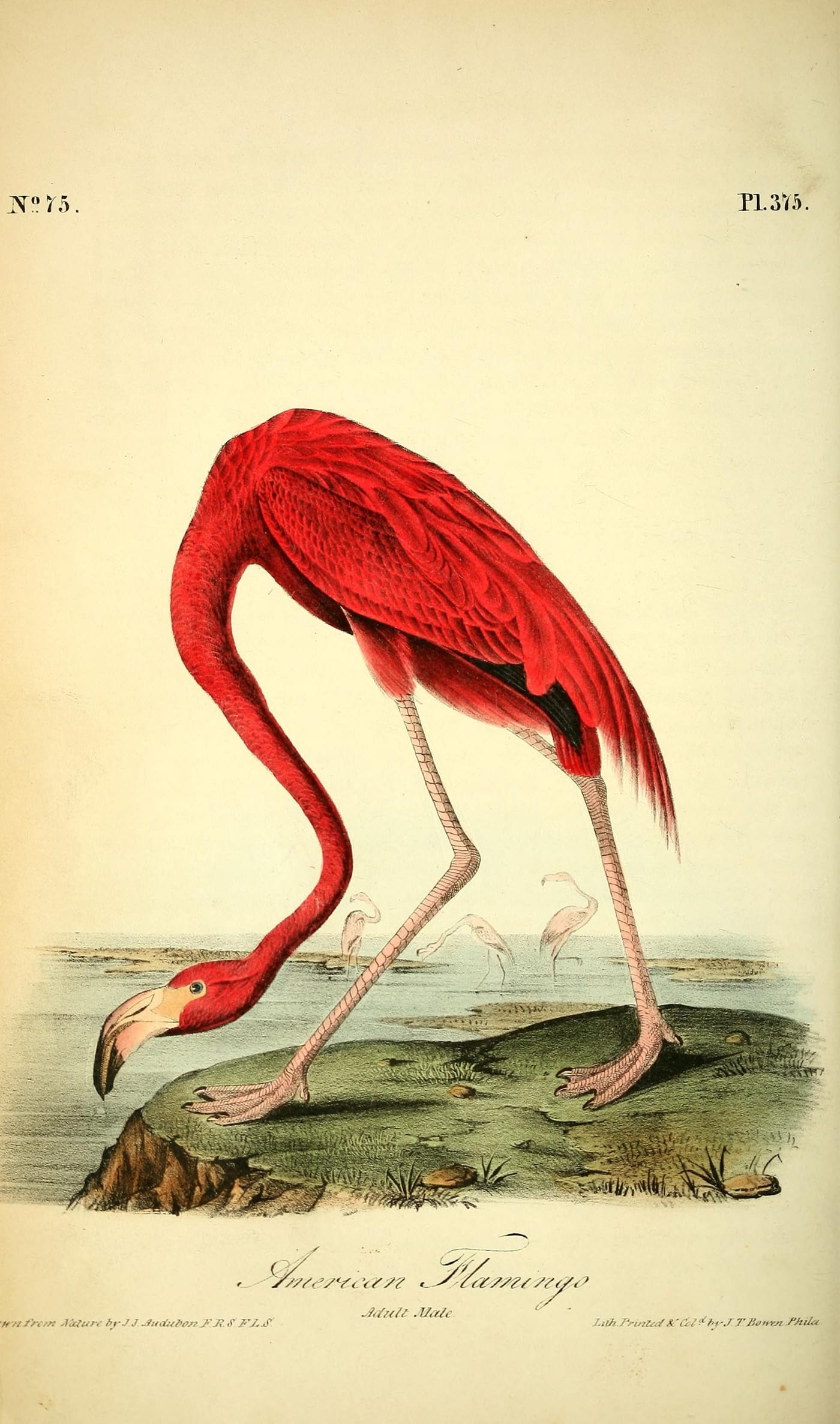
In modern American "spirit animal" usage, the flamingo stands for joy, balance, emotional openness, and the distinctive bright color that emerges when one is nourished well. That reading is largely Andrews 1993 + lawn-ornament pop-cultural imagery. The older traditions are specific. In Egyptian hieroglyphics the flamingo is the sign dshr (𓅟), with a red-sun association tying it to Ra. Romans ate flamingo tongues as an imperial luxury (Apicius's Res Coquinaria 6.6; Suetonius on Vitellius). Andean Atacama peoples held the Chilean and Andean flamingos in reverence, with the bird appearing in Tiwanaku-era textiles and contemporary Aymara folklore. Caribbean Taíno incorporated flamingo feathers into ritual objects. The flamingo's spiritual traditions are primarily equatorial-American and Mediterranean, reflecting the bird's real geographic distribution.
The flamingo has one of the shortest deep-spiritual-tradition lists in this catalog, and the honest move is to say so. Flamingos occupy specific wetland habitats, mostly outside the core territories of the major ancient civilizations. They show up in Egyptian hieroglyphics as a color-determinative rather than as a separate god. They show up in Roman cookbooks as a luxury-food ingredient rather than as a sacred bird. They show up in Andean textiles and Aymara folklore, but that tradition is primarily oral-and-material rather than textual, and therefore less available to a remote researcher than the Mediterranean and East Asian material.
What they show up in, vividly, is 20th-century American material culture, by way of Don Featherstone’s 1957 plastic pink flamingo lawn ornament. That is a real tradition, and being honest about it is the right editorial call.
The four traditions, plus the lawn ornament
The dshr hieroglyph. Egyptian. Gardiner sign G27. Determinative for red. The bird’s coloration makes it a natural marker for the color and, by extension, for the solar red of Ra at sunrise and sunset. No separate cult that we know of.
Roman imperial cuisine. Apicius, Suetonius, Pliny, Martial all reference flamingo-tongue dishes as luxury. The Shield of Minerva dish attributed to Vitellius (Suetonius 13) included flamingo tongues among other rare ingredients. This is the bird as conspicuous consumption, not as spiritual figure.
Andean Atacama. Three species of flamingo inhabit the high-altitude salt lakes of the Altiplano. Tiwanaku-era textiles depict flamingo imagery. Contemporary Aymara and Quechua folklore preserves flamingo-and-salt-lake narratives. The tradition is alive but less textually-documented than the Mediterranean strand.
Caribbean Taíno. Flamingo feathers incorporated into ritual objects. The post-1492 demographic collapse means the documentation is fragmentary; Ramón Pané’s 1498 Relación (see our hummingbird page) is the primary source.
Don Featherstone’s 1957 plastic pink flamingo. Union Products, Leominster, Massachusetts. One of the most-recognized pieces of 20th-century American material culture. 1996 Ig Nobel Prize in Art. Reclaimed as camp in John Waters’s 1972 film Pink Flamingos. This, not the Egyptian dshr sign, is what most Americans have in mind when they picture a flamingo.
The honest reading
The modern spirit-animal flamingo is a joy-and-balance figure drawn about 80% from the 1957 lawn-ornament pop image and 20% from loose borrowings from older traditions. The bird does stand on one leg, its color is striking, and its flocking behavior does provide a natural “community” metaphor. These are real observations. They are also not ancient.
When the tradition is thin, saying so is the right move. That is what the thin-tradition notes in the sections above do.
Working with the Flamingo
If you want a regular practice rather than a one-time read, an oracle deck is the standard tool: you draw a card and sit with whatever animal comes up. The foundational modern spirit-animal oracle: 44 cards drawn from Sams's Seneca and other Indigenous teachings, with a guidebook that actually explains its sources. The deck most later ones are imitating.

Medicine Cards
The foundational modern spirit-animal oracle: 44 cards drawn from Sams's Seneca and other Indigenous teachings, with a guidebook that actually explains its sources. The deck most later ones are imitating.
Compare the field in our ranked guide to spirit animal oracle decks, or browse decks, crystals, and journals in spirit animal gifts & tools.
Across traditions
Egyptian (the dshr hieroglyph)
The Egyptian hieroglyph dshr (𓅟, Gardiner sign G27), depicting a flamingo, is the determinative for the color red (deshret, also the word for the "Red Crown" of Lower Egypt and for the "red desert" outside the Nile valley). The bird's pink-red coloration made it a natural iconographic marker for red, and by extension for the solar red of Ra at sunrise and sunset.
The phoenix-adjacent Bennu (see our phoenix page) has sometimes been identified with the flamingo rather than the heron, though the consensus is the heron. The flamingo itself does not seem to have had a separate cult in Egyptian religion, but its use as a color-determinative is well-established. Alan Gardiner's Egyptian Grammar (Griffith Institute, 3rd ed. 1957) is the standard philological reference.
- PEER-REVIEWED Alan H. Gardiner, Egyptian Grammar (sign G27 for dshr) — Griffith Institute, 3rd ed. 1957.
- PEER-REVIEWED Richard Wilkinson, Symbol and Magic in Egyptian Art — Thames & Hudson, 1994.
Roman (imperial flamingo-tongue cuisine)
Romans ate flamingo tongues as an imperial luxury. Apicius's De Re Coquinaria (On the Subject of Cooking, 4th–5th century CE collection drawing on earlier recipes) Book 6, recipe 6 includes specific instructions for preparing phoenicopterus (flamingo). Suetonius's Life of Vitellius 13 describes the emperor Vitellius's notorious "Shield of Minerva" dish, which included flamingo tongues among other rare ingredients.
Pliny's Natural History 10.68 calls the flamingo's tongue a particular delicacy. Martial (Epigrams 13.71) and Juvenal also reference Roman flamingo consumption. The bird's association in Roman imperial culture was with conspicuous luxury rather than spiritual reverence, an unusual counter-current to most ancient animal-traditions.
- PRIMARY Apicius, De Re Coquinaria 6.6 — Grocock & Grainger ed./trans., Prospect Books, 2006.
- PRIMARY Suetonius, Life of Vitellius 13 — Rolfe trans., Loeb Classical Library.
- PRIMARY Pliny the Elder, Natural History 10.68 — Rackham trans., Loeb Classical Library.
Andean (Atacama and Aymara)
Three flamingo species (James's, Andean, and Chilean) inhabit the high-altitude salt lakes of the Atacama and Altiplano regions across Chile, Bolivia, Peru, and Argentina. Tiwanaku-era (c. 500–1000 CE) and later textiles depict flamingo imagery, and Aymara and Quechua contemporary folklore preserves flamingo-and-salt-lake narratives. Thomas Abercrombie's Pathways of Memory and Power: Ethnography and History Among an Andean People (University of Wisconsin Press, 1998) treats the broader Aymara religious-historical memory context.
The Andean flamingo-traditions are less textually-documented than the Mediterranean, African, or East Asian material, because the Aymara and Quechua record is primarily oral and material-cultural rather than textual. The flamingo appears in contemporary Andean festival-costumes and textile-motifs as a living tradition.
- MUSEUM Tiwanaku textiles with flamingo motifs (Museo Nacional de Arqueología, La Paz)
- PEER-REVIEWED Thomas A. Abercrombie, Pathways of Memory and Power — University of Wisconsin Press, 1998.
- PEER-REVIEWED Charles Stanish, Ancient Titicaca: The Evolution of Complex Society in Southern Peru and Northern Bolivia — University of California Press, 2003.
American lawn-ornament (Don Featherstone's 1957 pink flamingo)
The single most widely-recognized flamingo image in 20th- and 21st-century American culture is neither ancient nor spiritual. It is Don Featherstone's 1957 plastic pink lawn flamingo, originally designed for Union Products in Leominster, Massachusetts. Featherstone won the 1996 Ig Nobel Prize in Art for the design. The plastic pink flamingo became a standard feature of American postwar suburban lawns, a symbol of kitsch reclaimed as camp by the 1970s (John Waters's 1972 film Pink Flamingos), and a durable piece of American material culture.
This 1957 lawn-ornament image is, candidly, a more significant source for the modern American "flamingo spirit animal" reading than any ancient tradition. Ted Andrews's 1993 reading sits inside the cultural memory of the pink plastic bird on the lawn, even if he doesn't cite Featherstone directly.
- REFERENCE Don Featherstone, original 1957 plastic pink flamingo design — Union Products, Leominster, Massachusetts.
- PEER-REVIEWED Jennifer Price, Flight Maps: Adventures with Nature in Modern America — Basic Books, 1999.
Ted Andrews (1993)
Andrews's 1993 flamingo is a joy-and-balance personal-spirit figure drawn from the bird's bright color and striking one-legged standing habit, softened into keyword form. The Egyptian dshr hieroglyph, the Roman imperial cuisine tradition, and the Andean Aymara-Quechua reverence are all absent.
- REFERENCE Ted Andrews, Animal Speak — Llewellyn, September 1993.
Frequently asked
- What does a flamingo symbolize spiritually?
- In modern pop usage, joy, balance, and the bright color that emerges from being nourished, the Andrews 1993 reading plus 20th-century American lawn-ornament pop-cultural imagery (Don Featherstone's 1957 plastic pink flamingo). Older traditions are narrower because flamingos occupy specific wetland habitats. The Egyptian hieroglyph dshr (𓅟) uses the flamingo as the determinative for red. Romans ate flamingo tongues as an imperial luxury (Apicius, Suetonius). And Andean Atacama peoples hold flamingo reverence in Tiwanaku-era textiles and Aymara folklore.
- Why did Romans eat flamingo tongues?
- As an imperial-luxury dish, conspicuously rare and expensive. Apicius's De Re Coquinaria Book 6 recipe 6 gives specific preparation instructions. Suetonius's Life of Vitellius 13 describes the notorious Shield of Minerva dish, which included flamingo tongues among other rare ingredients. Pliny Natural History 10.68 and Martial Epigrams 13.71 corroborate the practice. It was less a spiritual tradition than a display of wealth; the bird's rarity in the Mediterranean (it does not naturally breed there in most periods) made the dish possible.
- Is the pink flamingo lawn ornament really that important?
- Yes, in American material culture. Don Featherstone's 1957 plastic pink lawn flamingo (Union Products, Leominster, Massachusetts) is one of the most widely-recognized pieces of 20th-century American design. Featherstone won the 1996 Ig Nobel Prize for the work. John Waters's 1972 film Pink Flamingos reclaimed the ornament as camp. The image is, candidly, a more significant source for the modern American 'flamingo spirit animal' reading than any ancient tradition. Jennifer Price's Flight Maps (Basic Books, 1999) treats the cultural history.
- Are there ancient Egyptian flamingo gods?
- No separate cult, but the flamingo hieroglyph dshr (𓅟, Gardiner sign G27) is the determinative for the color red (deshret) in Egyptian writing. The bird's pink-red coloration made it a natural iconographic marker for red, and by extension for the solar red of Ra at sunrise and sunset. The phoenix-adjacent Bennu has sometimes been identified with the flamingo rather than the heron, though consensus is the heron. Gardiner's Egyptian Grammar (Griffith Institute, 1957) is the standard philological source.
Sources
- PEER-REVIEWEDAlan H. Gardiner, Egyptian Grammar (sign G27) — Griffith Institute, 3rd ed. 1957.
- PEER-REVIEWEDRichard Wilkinson, Symbol and Magic in Egyptian Art — Thames & Hudson, 1994.
- PRIMARYApicius, De Re Coquinaria 6.6 — Grocock & Grainger ed., Prospect Books, 2006.
- PRIMARYSuetonius, Life of Vitellius 13 — Loeb Classical Library.
- PRIMARYPliny the Elder, Natural History 10.68 — Loeb Classical Library.
- MUSEUMTiwanaku textiles (Museo Nacional de Arqueología, La Paz)
- PEER-REVIEWEDThomas A. Abercrombie, Pathways of Memory and Power — University of Wisconsin Press, 1998.
- PEER-REVIEWEDCharles Stanish, Ancient Titicaca — UC Press, 2003.
- REFERENCEDon Featherstone, 1957 plastic pink flamingo — Union Products.
- PEER-REVIEWEDJennifer Price, Flight Maps — Basic Books, 1999.
- REFERENCETed Andrews, Animal Speak — Llewellyn, September 1993.