Spirit Animal
Falcon Spirit Animal
Falcon spirit animal meaning, distinguished from the hawk and traced from the modern focus-and-precision reading back through Ted Andrews's Animal Speak to the Egyptian Horus, Frederick II's 1240s De Arte Venandi cum Avibus, Arab-Bedouin falconry (UNESCO Intangible Heritage), and Mongol imperial hunting.
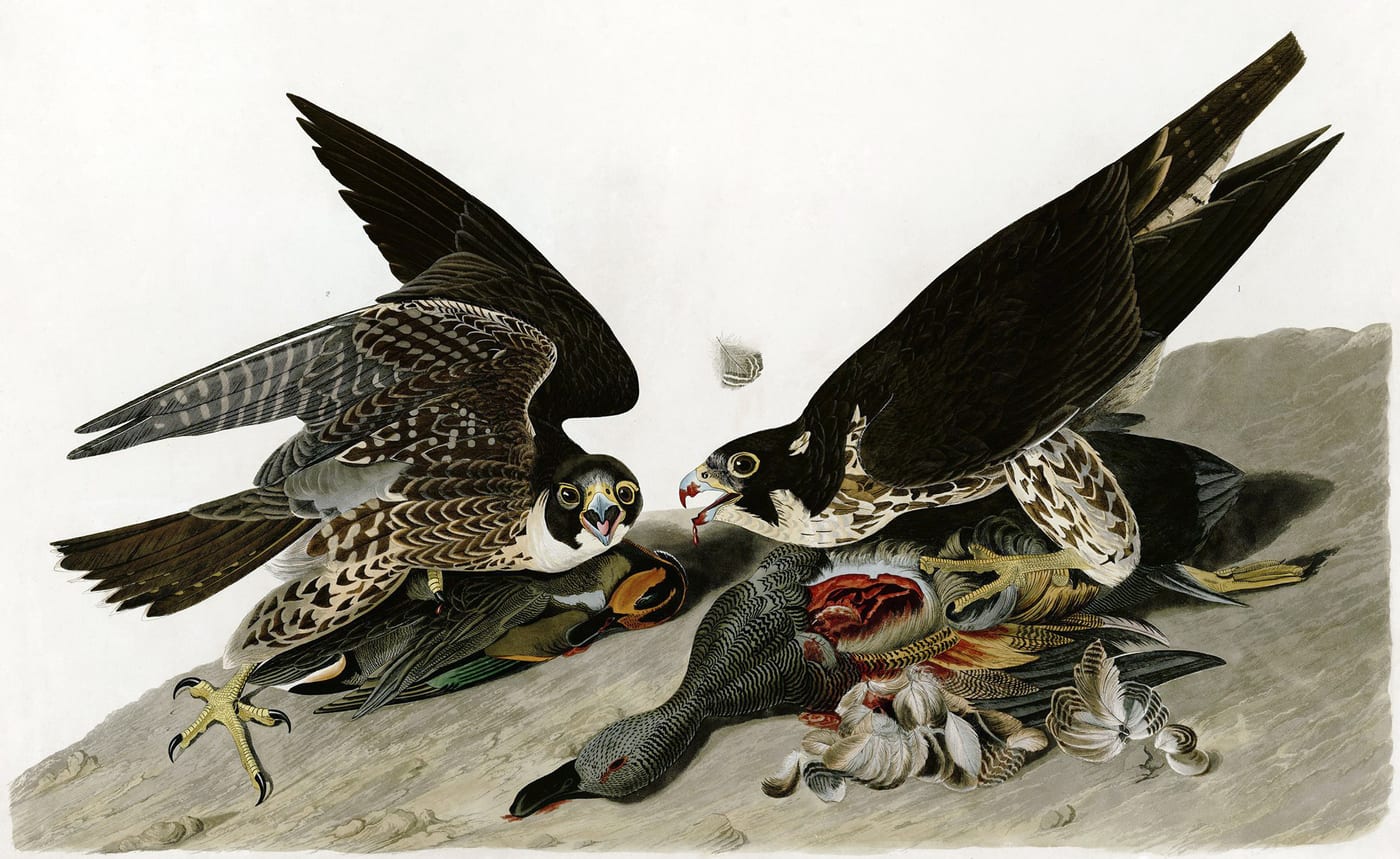
In modern American "spirit animal" usage, the falcon overlaps with the hawk (see our hawk page for the main Horus treatment) but carries specific falconry-tradition associations: focus, precision, disciplined partnership between human and bird. The Egyptian Horus is rendered iconographically as a falcon, not a generic hawk. Frederick II of Hohenstaufen's De Arte Venandi cum Avibus (c. 1240s, Vatican Library MS Pal. lat. 1071) is the foundational medieval European falconry manual. The Arab-Bedouin falconry tradition, inscribed on the UNESCO Representative List of the Intangible Cultural Heritage of Humanity (2010, 2012, 2016, 2021), is one of the oldest continuously-practiced human-animal partnerships on earth. Mongol imperial falconry is documented in Rashid al-Din's 14th-century Jami' al-Tawarikh.
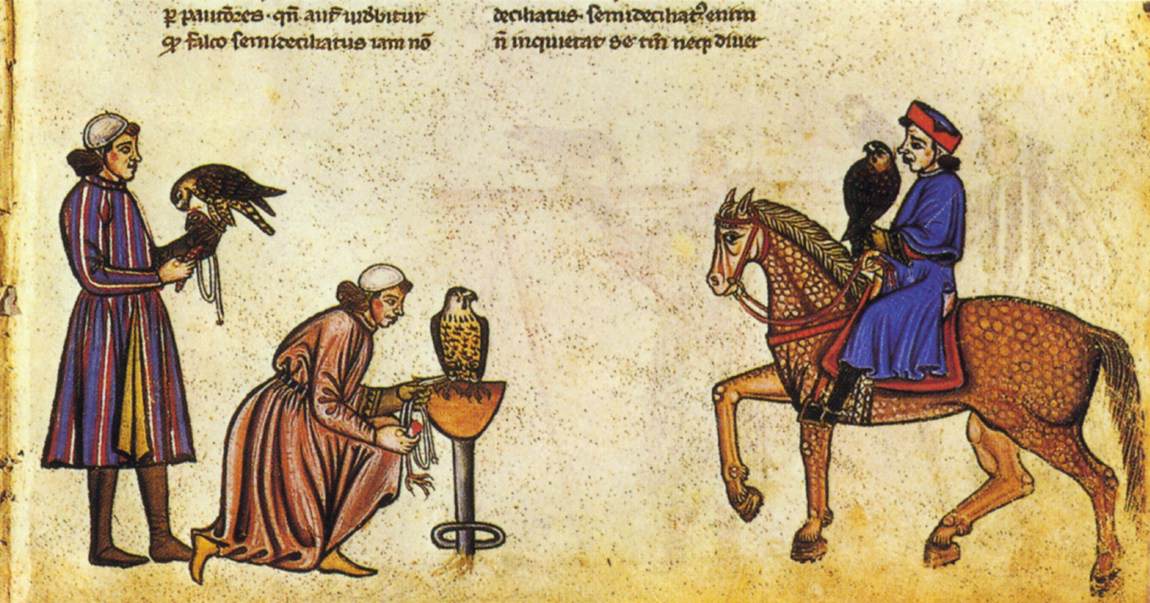
The Vatican Library holds a manuscript written in the 1240s by the Holy Roman Emperor. It is not a sermon, not a theological treatise, not a chronicle. It is a practical manual on how to hunt with birds, written by a ruler who kept thousands of falcons and treated the subject with the kind of empirical care his contemporaries reserved for almost nothing else. De Arte Venandi cum Avibus, “On the Art of Hunting with Birds,” Frederick II of Hohenstaufen, c. 1240s, Vatican MS Pal. lat. 1071. The Wood and Fyfe 1943 Stanford University Press translation is still the standard.
Frederick wrote from direct personal experience. He corresponded with Arab falconers. He rejected received Aristotelian biology where his own observations of birds contradicted it. His treatise shaped European noble culture for four hundred years, and falconry as chivalric practice runs directly from his court into the 17th century and, through continuous tradition in the Gulf states and Central Asia, into the present.
Four traditions, one continuous bird
Horus. Egyptian, falcon-headed, documented from the Predynastic period (c. 3200 BCE) through the Ptolemaic era. The hawk spirit animal entry covers Horus, Ra-Horakhty, the Eye of Horus, and the related Bennu in full detail. The falcon entry here focuses on the falconry tradition specifically.
Frederick II. Medieval European. 1240s. Vatican MS Pal. lat. 1071. The foundational European falconry manual. Empirical, multilingual (Frederick could read Arabic), skeptical of received authority. His court at Palermo was one of the great multicultural intellectual centers of medieval Europe; his falconry work sits inside that context.
Arab-Bedouin falconry. Pre-Islamic origin, carried through the Islamic caliphates and the Ottoman court into contemporary Gulf practice. UNESCO Representative List of the Intangible Cultural Heritage of Humanity (inscribed 2010, extended 2012, 2016, 2021). Currently 18 participating nations, one of the largest multi-national inscriptions on the UNESCO list. The saker falcon (Falco cherrug) and peregrine are the traditional birds.
Mongol imperial. Rashid al-Din’s Jami’ al-Tawarikh (c. 1310) documents Genghis Khan’s and later khans’ hunting parties with hundreds of falcons. Marco Polo corroborates from the Venetian perspective. The Mongol gyrfalcon was a prestige-gift across Eurasian diplomacy; Frederick II himself received Mongol gyrfalcons. Thomas Allsen’s The Royal Hunt in Eurasian History (Penn Press, 2006) is the standard treatment.
What the falcon tradition actually carries
The modern “focus and precision” reading is a simplification of something denser. The falcon is the animal of the disciplined partnership between human and bird, in which the bird is trained (by manning, hooding, casting, stooping) but not owned, and in which the falconer’s technical vocabulary is a body of specialist knowledge passed from master to apprentice across centuries.
That partnership-tradition is what Frederick II was writing about in 1243. It is what the Bedouin tradition has kept alive for roughly 4,000 years. It is what the Mongol khans carried across Eurasia. The modern pop-spiritual falcon is the last sliver of that massive inheritance.
The traditions sections above point at the inheritance, not just the sliver.
Working with the Falcon
If you want a regular practice rather than a one-time read, an oracle deck is the standard tool: you draw a card and sit with whatever animal comes up. The foundational modern spirit-animal oracle: 44 cards drawn from Sams's Seneca and other Indigenous teachings, with a guidebook that actually explains its sources. The deck most later ones are imitating.
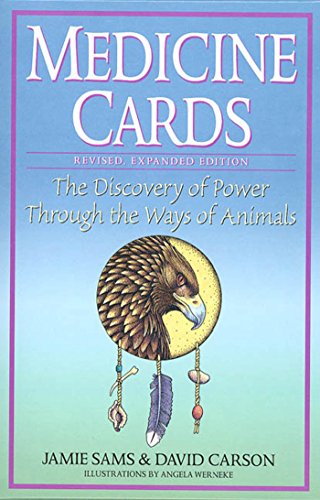
Medicine Cards
The foundational modern spirit-animal oracle: 44 cards drawn from Sams's Seneca and other Indigenous teachings, with a guidebook that actually explains its sources. The deck most later ones are imitating.
Compare the field in our ranked guide to spirit animal oracle decks, or browse decks, crystals, and journals in spirit animal gifts & tools.
Across traditions
Egyptian (Horus the falcon)
The Egyptian sky-god Horus is iconographically a falcon (Falco biarmicus lanner falcon or F. peregrinus peregrine falcon), not a generic hawk. The distinction matters: Egyptian art is precise about the bird's taxonomic profile, with the forked tail and long pointed wings of the falcon consistently depicted. The hawk spirit animal entry covers Horus, Ra-Horakhty, the Eye of Horus, and the Bennu in full.
The falcon's most substantial cross-cultural tradition is falconry: the specific human-animal partnership tradition that descends from Arab-Bedouin, medieval European, and Mongol streams and is treated in the remaining traditions below.
- PRIMARY Pyramid Texts, Utterances 467–468 — Faulkner trans., Oxford, 1969.
- PRIMARY Book of the Dead, Chapter 78 — Allen trans., SAOC 37, 1974.
Medieval European (Frederick II's De Arte Venandi)
Frederick II of Hohenstaufen, Holy Roman Emperor from 1220 to 1250, wrote De Arte Venandi cum Avibus ("On the Art of Hunting with Birds") in the 1240s. The manuscript, now in the Vatican Library as MS Pal. lat. 1071, is the foundational medieval European treatise on falconry. Frederick wrote from direct personal experience: he kept thousands of falcons, corresponded with Arab falconers, and insisted on empirical observation over the received Aristotelian biology of his contemporaries.
The treatise covers the anatomy and classification of birds, the different species used in falconry, training methods (manning, hooding, casting, stooping), and the craft of the falconer. Casey Wood and F. Marjorie Fyfe's 1943 English translation The Art of Falconry, by Frederick II of Hohenstaufen (Stanford University Press) remains the standard. Frederick's work shaped European noble culture for four hundred years; falconry as chivalric practice runs directly from his court to the 17th century.
- PRIMARY Frederick II, De Arte Venandi cum Avibus (Vatican Library MS Pal. lat. 1071) — Wood & Fyfe trans. (The Art of Falconry), Stanford University Press, 1943.
- ARCHIVE Vatican Apostolic Library, MS Pal. lat. 1071
- PEER-REVIEWED Charles Haskins, Studies in the History of Mediaeval Science — Harvard University Press, 1924.
Arab-Bedouin (UNESCO Intangible Heritage)
Arab falconry (al-ṣaqāra) is one of the oldest continuously-practiced forms of hunting cooperation between humans and birds, documented in pre-Islamic Arabia and carried through the Islamic caliphates, the Ottoman court, and contemporary Gulf states. The tradition was inscribed on the UNESCO Representative List of the Intangible Cultural Heritage of Humanity in 2010 (initial inscription by UAE, Belgium, Czechia, France, South Korea, Mongolia, Morocco, Qatar, Saudi Arabia, Spain, Syria) and extended in 2012, 2016, and 2021 to 18 participating countries.
The specific Bedouin tradition uses the saker falcon (Falco cherrug) and peregrine for hunting houbara bustard and other game across the Arabian Peninsula. The falconer's bond with an individual bird is understood as a lifetime partnership. Mark Allen's Falconry in Arabia (Orbis, 1980) is the standard English-language treatment; more recent work by Khalid al-Khattaf at the Arab Center for Research and Documentation adds contemporary context.
- REFERENCE UNESCO Intangible Cultural Heritage inscription: Falconry, a living human heritage — Initial 2010, extended 2012, 2016, 2021.
- PEER-REVIEWED Mark Allen, Falconry in Arabia — Orbis Publishing, 1980.
- REFERENCE Khalid al-Khattaf, Arab falconry documentation projects — Arab Center for Research and Documentation, Kuwait.
Mongol imperial (Rashid al-Din and the royal hunt)
Mongol imperial falconry is documented extensively in Rashid al-Din's Jami' al-Tawarikh ("Compendium of Chronicles," completed c. 1310 CE), the great Il-Khanate universal history. Rashid al-Din describes Genghis Khan's and later khans' hunting parties with hundreds of falcons, the specific breeds favored (saker and gyrfalcon), and the falcon's status as royal gift across Eurasian diplomacy.
Marco Polo's Travels (c. 1298) corroborates the scale of Kublai Khan's falconry from the Venetian traveler's perspective. Thomas Allsen's The Royal Hunt in Eurasian History (University of Pennsylvania Press, 2006) is the standard modern scholarly treatment. The Mongol gyrfalcon was a prestige-gift between courts from Korea to Europe; Frederick II himself received Mongol gyrfalcons.
- PRIMARY Rashid al-Din, Jami' al-Tawarikh — Thackston trans., Harvard University, 1998–99.
- PRIMARY Marco Polo, Travels — Latham trans., Penguin Classics, 1958.
- PEER-REVIEWED Thomas T. Allsen, The Royal Hunt in Eurasian History — University of Pennsylvania Press, 2006.
Ted Andrews (1993)
Andrews's 1993 falcon is the focus-and-precision figure, drawn from the Egyptian Horus material and from the general falconry imagery of medieval Europe, softened into personal-spirit keyword form. The specific medieval-European and Arab-Bedouin falconry traditions, with their technical vocabulary and their specific primary-source texts (Frederick II, Rashid al-Din), are absent.
- REFERENCE Ted Andrews, Animal Speak — Llewellyn, September 1993.
Frequently asked
- What does a falcon symbolize spiritually?
- In modern pop usage, focus, precision, and disciplined partnership, the Andrews 1993 reading. Older traditions are specific. The Egyptian sky-god Horus is iconographically a falcon (see our hawk page for the full Egyptian treatment). Frederick II of Hohenstaufen's 1240s De Arte Venandi cum Avibus is the foundational medieval European falconry manual. Arab-Bedouin falconry is UNESCO-recognized Intangible Cultural Heritage (2010 onward). Mongol imperial falconry is documented in Rashid al-Din's Jami' al-Tawarikh.
- Are a falcon and a hawk the same thing?
- No. Falcons (family Falconidae) and hawks (family Accipitridae) are taxonomically distinct, separated by roughly 60 million years of evolutionary divergence. Falcons have long pointed wings, forked tails, and a distinctive 'tomial tooth' used to sever the neck of prey. Hawks have broader rounded wings and hunt by ambush. In English popular usage the two are often conflated; 'hawk' in translations of Egyptian material almost always refers specifically to the falcon. Our site separates them where the sources do.
- Who was Frederick II and why did he write about falcons?
- Frederick II of Hohenstaufen (1194–1250), Holy Roman Emperor from 1220 to 1250, was a polyglot scholar-ruler who kept thousands of falcons and corresponded extensively with Arab falconers. His De Arte Venandi cum Avibus (c. 1240s), now in the Vatican Library as MS Pal. lat. 1071, is the foundational medieval European falconry manual and one of the earliest European scientific-natural-history works grounded in empirical observation rather than received Aristotelian biology. Wood and Fyfe's 1943 Stanford University Press translation is the standard English edition.
- Is falconry really recognized by UNESCO?
- Yes. Falconry, specifically the Arab-Bedouin and related traditions, was inscribed on the UNESCO Representative List of the Intangible Cultural Heritage of Humanity in 2010 (initially by 11 countries), extended in 2012, 2016, and 2021 to 18 participating countries. The inscription recognizes falconry as a living human heritage with a documented continuous practice across Arabia, Central Asia, and Europe. It is one of the largest multi-national intangible-heritage inscriptions on the UNESCO list.
Sources
- PRIMARYPyramid Texts, Utterances 467–468 — Faulkner trans., Oxford, 1969.
- PRIMARYFrederick II, De Arte Venandi cum Avibus — Wood & Fyfe trans., Stanford University Press, 1943.
- ARCHIVEVatican Library, MS Pal. lat. 1071
- PEER-REVIEWEDCharles Haskins, Studies in the History of Mediaeval Science — Harvard University Press, 1924.
- REFERENCEUNESCO Intangible Heritage: Falconry
- PEER-REVIEWEDMark Allen, Falconry in Arabia — Orbis, 1980.
- PRIMARYRashid al-Din, Jami' al-Tawarikh — Thackston trans., Harvard University, 1998–99.
- PRIMARYMarco Polo, Travels — Latham trans., Penguin, 1958.
- PEER-REVIEWEDThomas T. Allsen, The Royal Hunt in Eurasian History — University of Pennsylvania Press, 2006.
- REFERENCETed Andrews, Animal Speak — Llewellyn, September 1993.