Spirit Animal
Dove Spirit Animal
Dove spirit animal meaning, traced to the Genesis 8 Noah's flood narrative, Aphrodite-Venus iconography, the Christian Holy Spirit descending at Christ's baptism, Mesopotamian Ishtar attribution, and Picasso's 1949 peace-dove poster.
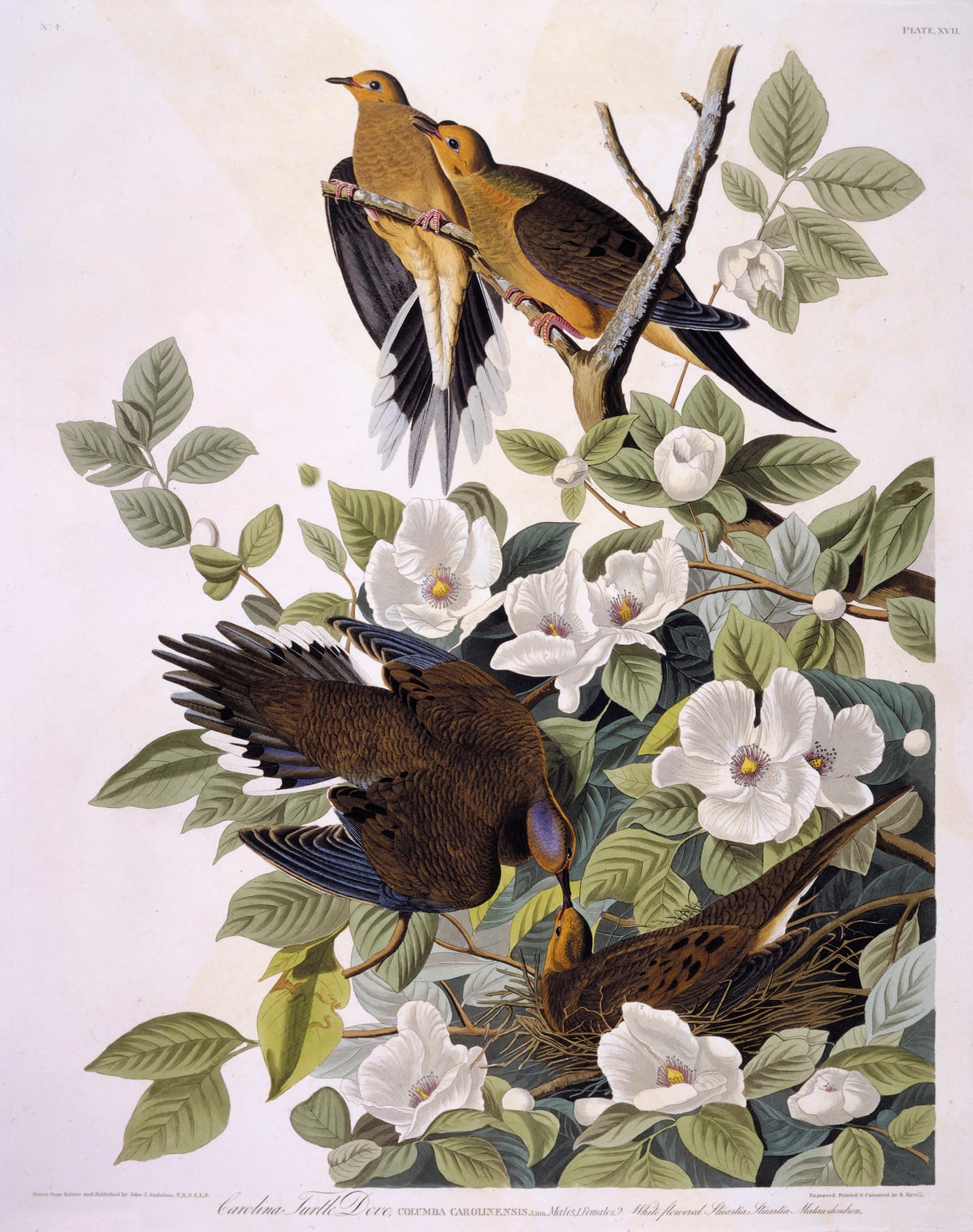
In modern pop-spiritual usage, the dove stands for peace, divine presence, and the soul's tender aspect. That reading draws from multiple ancient layers. Genesis 8:8–12 has Noah release a dove that returns with an olive leaf signaling the Flood's end. Aphrodite-Venus's attribute-bird in Greek and Roman iconography is the dove. Matthew 3:16 (and parallel Gospel passages) describes the Holy Spirit descending upon Jesus at his baptism 'like a dove.' In Mesopotamian tradition, Ishtar/Inanna's associated bird is sometimes identified as a dove. And Picasso's 1949 peace-dove poster for the World Peace Congress established the modern international peace-symbol.
The dove has one of the deepest documented peace-symbol traditions of any animal, running from at least the 10th century BCE through the present day. Unlike most animal symbols, where the pop reading diverges significantly from the primary sources, the dove’s peace meaning has genuine textual anchors. The contemporary reading is not wrong, it is, unusually, well-sourced.
Genesis 8: Noah’s dove with the olive branch
Genesis 8:8–12 narrates Noah’s release of a dove from the ark after the flood. The first release returns with nothing. The second returns with a freshly-plucked olive leaf, evidence that the waters have receded and land has become accessible. The third time the dove does not return at all, signaling that it has found a permanent home. Rashi’s 11th-century Hebrew commentary on this passage reads the olive leaf as a specific theological statement: even bitter food from the hand of God is better than sweet food from a human. The dove becomes in this reading not only the bearer of the good news but a figure for dependence on divine provision over human comfort.
This narrative is the direct ancestor of every dove-with-olive-branch image in Western art and political iconography. The BHS Masoretic text and JPS 1985 translation are the standard critical and English versions.
Aphrodite and Venus
The dove was Aphrodite’s bird in the Greek tradition. Sappho’s Fragment 1 (c. 630–570 BCE), the earliest surviving poem by a named Greek woman, opens with an invocation of Aphrodite: “Deathless Aphrodite of the spangled mind / child of Zeus, who twists lures, I beg you / do not break with hard pains, / O lady, my heart.” The goddess arrives drawn by sparrows (some translations render the bird as doves) from Olympus. Apuleius’s Metamorphoses 6.6 has Venus’s chariot drawn explicitly by doves.
This love-goddess connection is as old as the peace-symbol connection. The dove in the West carries both valences simultaneously: peace from the biblical tradition and love from the Greek-Roman one. They are not separate readings; they layer.
The Holy Spirit at the Jordan
Matthew 3:16 (“and he saw the Spirit of God descending like a dove and coming to rest on him”) is the canonical Christian baptism passage. The Greek construction is hōs peristera (ὡς περιστεράν), a simile. Mark 1:10 and Luke 3:22 use the same simile. John 1:32 has the Baptist say he saw “the Spirit descend from heaven like a dove, and it remained on him.” The consistency across all four Gospels made the dove-as-Holy-Spirit the most universally recognized visual convention in Christian iconography.
Duccio’s Maestà (Siena Cathedral, 1311) (one of the foundational works of Western panel painting) shows the dove descending at the baptism with the golden dove-icon centered above Christ’s head, establishing the dove-as-Spirit form that has persisted ever since.
Picasso’s La Colombe
Pablo Picasso’s La Colombe lithograph (1949), created for the Communist-aligned World Peace Congress in Paris, put the dove-peace symbol on an internationally-distributed poster that reached millions. Picasso did not invent the connection (the biblical and Romantic traditions had been doing that work for centuries) but he crystallized it into a single image that crossed language and religious barriers in a post-WWII moment of desperate longing for stability. John Richardson’s A Life of Picasso Volume III (Knopf, 2007) covers the La Colombe commission and its political context.
The bird Picasso used for the drawing was a white pigeon given to him by Matisse. Technically a pigeon, but culturally a dove, the distinction is biological (doves and pigeons are the same family, Columbidae), not symbolic.
Andrews 1993
Andrews reads peace, divine presence, and tender soul. This is the most accurate summary of any animal in his 1993 text relative to the primary sources. The dove’s peace and love meanings are genuinely old and genuinely well-documented. The synthesis is honest.
Across traditions
Hebrew Bible (Noah's flood, Genesis 8:8–12)
Genesis 8:8–12 narrates Noah's release of a dove (Hebrew yonah) from the Ark to test whether the flood-waters had receded. The dove returns with an olive leaf in her beak, signaling that vegetation has reemerged. The scene established the dove-with-olive-branch as a symbol of divine peace after judgment in the Jewish, Christian, and Islamic traditions that inherit the narrative.
Related dove passages include Psalm 55:6 ('Oh, that I had wings like a dove') and Song of Songs 2:14. Rashi's 11th-century commentary on Genesis 8 and Ibn Ezra's parallel exegetical work treat the dove's symbolic role in the narrative.
- PRIMARY Genesis 8:8–12 — BHS Masoretic text; JPS 1985 English trans.
- PRIMARY Psalm 55:6, Song of Songs 2:14 — BHS; JPS 1985.
- PRIMARY Rashi, Commentary on Genesis — Silbermann trans., Shapiro Valentine, 1929–34.
Greek / Roman (Aphrodite-Venus)
The dove is the attribute-bird of Aphrodite (Greek) and Venus (Roman) from archaic Greek iconography onward. Sappho's fragment 1 (the 'Hymn to Aphrodite,' c. 600 BCE) has the goddess's chariot drawn by sparrows, but later iconography consistently pairs her with doves; Apuleius's Metamorphoses (The Golden Ass) 6.6 describes Venus's dove-drawn chariot. The Aphrodite-of-Milos (Venus de Milo) is the most famous surviving classical Aphrodite, though without dove-attributes present on the sculpture.
- PRIMARY Sappho, fragment 1 ('Hymn to Aphrodite') — Carson trans. (If Not, Winter), Knopf, 2002.
- PRIMARY Apuleius, Metamorphoses 6.6 — Kenney trans., Penguin, 1998.
- PRIMARY Homeric Hymn 5 (to Aphrodite) — West trans., Loeb Classical Library.
Christian (Holy Spirit descending)
Matthew 3:16, Mark 1:10, Luke 3:22, and John 1:32 all describe the Holy Spirit descending upon Jesus at his baptism in the Jordan 'like a dove.' The image became the standard Christian iconographic representation of the Holy Spirit, visible on thousands of baptistry mosaics, altar-piece paintings, and manuscript illuminations from the 4th century CE through the present. Duccio di Buoninsegna's Maestà (Siena Duomo, 1311) and virtually every subsequent Renaissance Baptism-of-Christ painting carry the motif.
- PRIMARY Matthew 3:16, Mark 1:10, Luke 3:22, John 1:32 — NA28 Greek; NRSV trans., 1989.
- MUSEUM Duccio, Maestà (Siena Duomo, 1311)
Mesopotamian (Ishtar-Inanna)
Doves appear as attribute-birds of the Mesopotamian love-and-war goddess Ishtar/Inanna in some iconographic contexts. The Burney Relief (Queen of the Night, British Museum, c. 1800 BCE) shows a nude winged goddess often identified as Ishtar, though the bird-attributes on the relief are lions and owls rather than doves. Specific dove-Ishtar attribution is more secure in later Hellenistic-period syncretism than in strictly Sumerian-Akkadian material.
- MUSEUM Burney Relief (Queen of the Night, c. 1800 BCE) — British Museum.
- PEER-REVIEWED Thorkild Jacobsen, The Treasures of Darkness — Yale University Press, 1976.
Modern peace-symbol (Picasso 1949)
The modern international peace-dove symbol is Pablo Picasso's La Colombe (The Dove), a lithograph created for the 1949 World Peace Congress in Paris. Picasso's dove, based on a real bird gifted to him by Henri Matisse, became the international peace-movement emblem and was subsequently adapted for dozens of peace-campaign uses. The Picasso estate and the Musée National Picasso-Paris hold the lithograph archive.
- MUSEUM Pablo Picasso, La Colombe (1949 lithograph) — Musée National Picasso-Paris.
- PEER-REVIEWED John Richardson, A Life of Picasso Volume III — Alfred A. Knopf, 2007.
Ted Andrews (1993)
Andrews's 1993 dove is the peace-divine-presence-tender-soul figure drawing from the Noah's flood + Christian-Holy-Spirit + Picasso peace-poster complex, softened into personal-spirit keyword form.
- REFERENCE Ted Andrews, Animal Speak — Llewellyn, September 1993.
Frequently asked
- What does a dove symbolize spiritually?
- In modern pop usage, peace and divine presence. The tradition is dense. Genesis 8:8–12 has Noah release a dove that returns with an olive leaf after the flood. Aphrodite-Venus's attribute-bird is the dove (Apuleius Metamorphoses 6.6). The Holy Spirit descends 'like a dove' at Christ's baptism (Matthew 3:16 and parallels). And the modern international peace-dove symbol is Picasso's 1949 La Colombe lithograph for the World Peace Congress.
- Why is the dove a peace symbol?
- Because of two convergent traditions. Genesis 8:8–12 has Noah release a dove that returns with an olive leaf, signaling divine peace after the flood's judgment. Picasso's 1949 La Colombe lithograph for the World Peace Congress in Paris established the modern international peace-dove symbol and made it global. The two together, biblical plus modern-political, carry the contemporary peace-dove image.
- Is the Holy Spirit really a dove?
- Matthew 3:16 (and parallel passages in Mark 1:10, Luke 3:22, and John 1:32) describe the Holy Spirit descending upon Jesus at his baptism in the Jordan 'like a dove.' The Greek construction is hōs peristera (ὡς περιστεράν), a simile rather than an identification. Christian iconography from the 4th century CE onward consistently uses the dove-form to represent the Holy Spirit, and this has become the standard visual convention across Christian traditions.
Sources
- PRIMARYGenesis 8:8–12; Psalm 55:6; Song of Songs 2:14 — BHS / JPS 1985.
- PRIMARYRashi, Commentary on Genesis — Silbermann trans., 1929–34.
- PRIMARYSappho, fragment 1 — Carson trans., Knopf, 2002.
- PRIMARYApuleius, Metamorphoses 6.6 — Penguin, 1998.
- PRIMARYHomeric Hymn 5 — Loeb Classical Library.
- PRIMARYMatthew 3:16 and parallel Gospel passages — NA28 / NRSV 1989.
- MUSEUMDuccio, Maestà (Siena Duomo, 1311)
- MUSEUMBurney Relief (British Museum)
- PEER-REVIEWEDThorkild Jacobsen, The Treasures of Darkness — Yale, 1976.
- MUSEUMPablo Picasso, La Colombe (1949)
- PEER-REVIEWEDJohn Richardson, A Life of Picasso Volume III — Knopf, 2007.
- REFERENCETed Andrews, Animal Speak — Llewellyn, September 1993.