Spirit Animal
Dolphin Spirit Animal
Dolphin spirit animal meaning, traced from the modern joy-and-intelligence reading back through Ted Andrews's Animal Speak to the Homeric Hymn to Apollo at Delphi, Arion's rescue by a dolphin in Herodotus, the Minoan Knossos dolphin fresco, and the Amazonian boto encantado tradition.
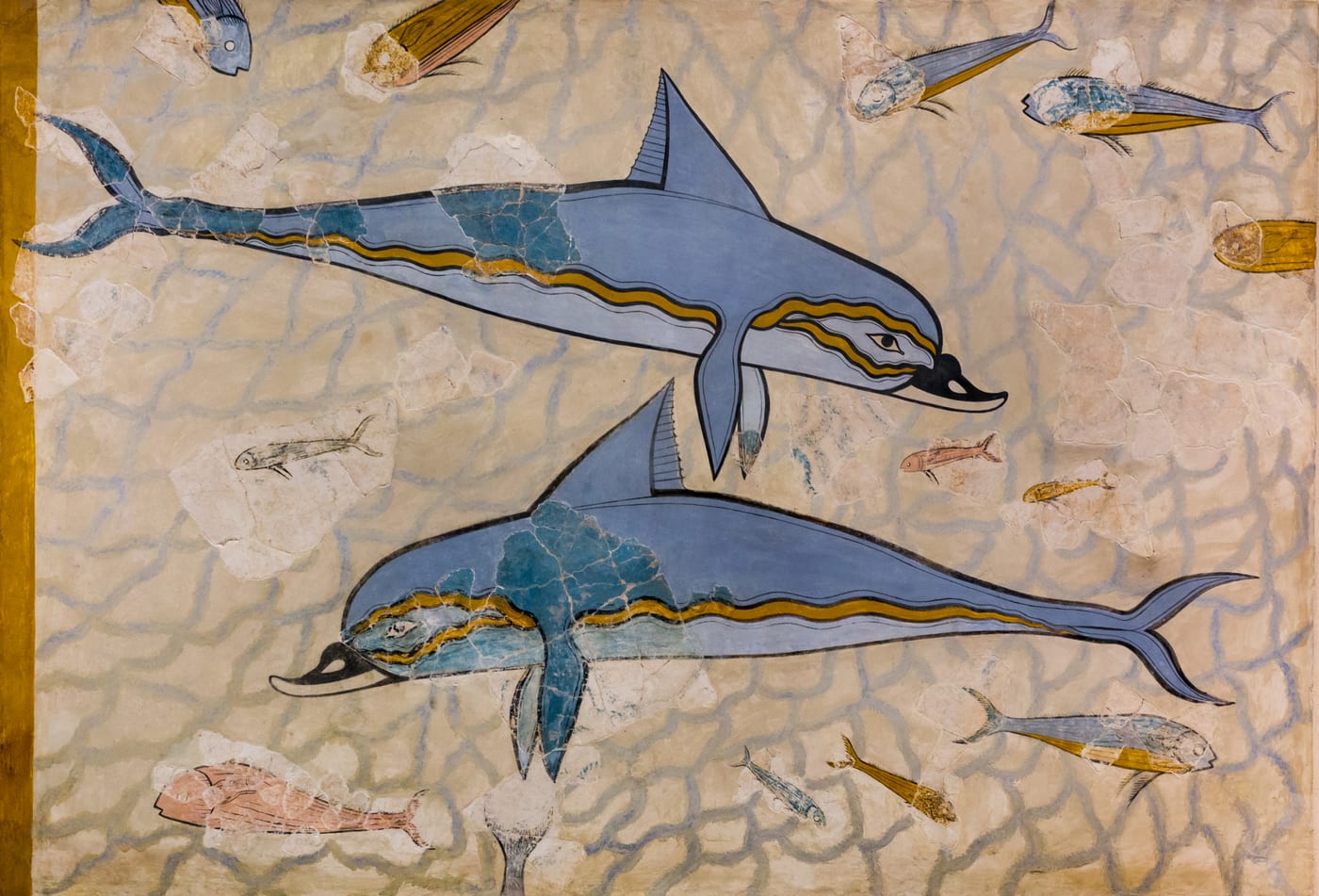
In modern American "spirit animal" usage, the dolphin stands for joy, play, intelligence, and a protective friendliness toward humans in distress. That reading comes through Ted Andrews's Animal Speak (Llewellyn, 1993). The older traditions are narrower and more specific. The Homeric Hymn to Apollo narrates the god taking the form of a dolphin to lead Cretan sailors to Delphi, and the name 'Delphi' itself derives from delphis, dolphin. Herodotus 1.23–24 preserves the story of Arion, the lyre-player thrown overboard by sailors and carried to shore on a dolphin's back. The Minoan Queen's Megaron at Knossos (c. 1600 BCE) has the famous dolphin fresco. In the Amazon, the pink river dolphin (boto) is a shape-shifting encantado who seduces humans at festivals, documented by Candace Slater's 1994 fieldwork.
Delphi, the most important oracular sanctuary in the ancient Greek world, is named after a dolphin. That is not a metaphor. The Homeric Hymn to Apollo tells the story: the god leaps from Olympus in the form of a dolphin, lands on a passing Cretan merchant ship, and directs it to the bay at Krisa below Mount Parnassus. When the sailors reach shore, he reveals himself and tells them they will be the priests of his new sanctuary. From Apollo Delphinios, “Apollo of the Dolphin,” comes the place-name. It is one of the few cases in the Greek pantheon where a major sanctuary’s name is an explicit zoological pun.
If the idea that dolphins are benevolent guides to humans is ancient, this is the passage where that idea first takes institutional form.
The Herodotean dolphin
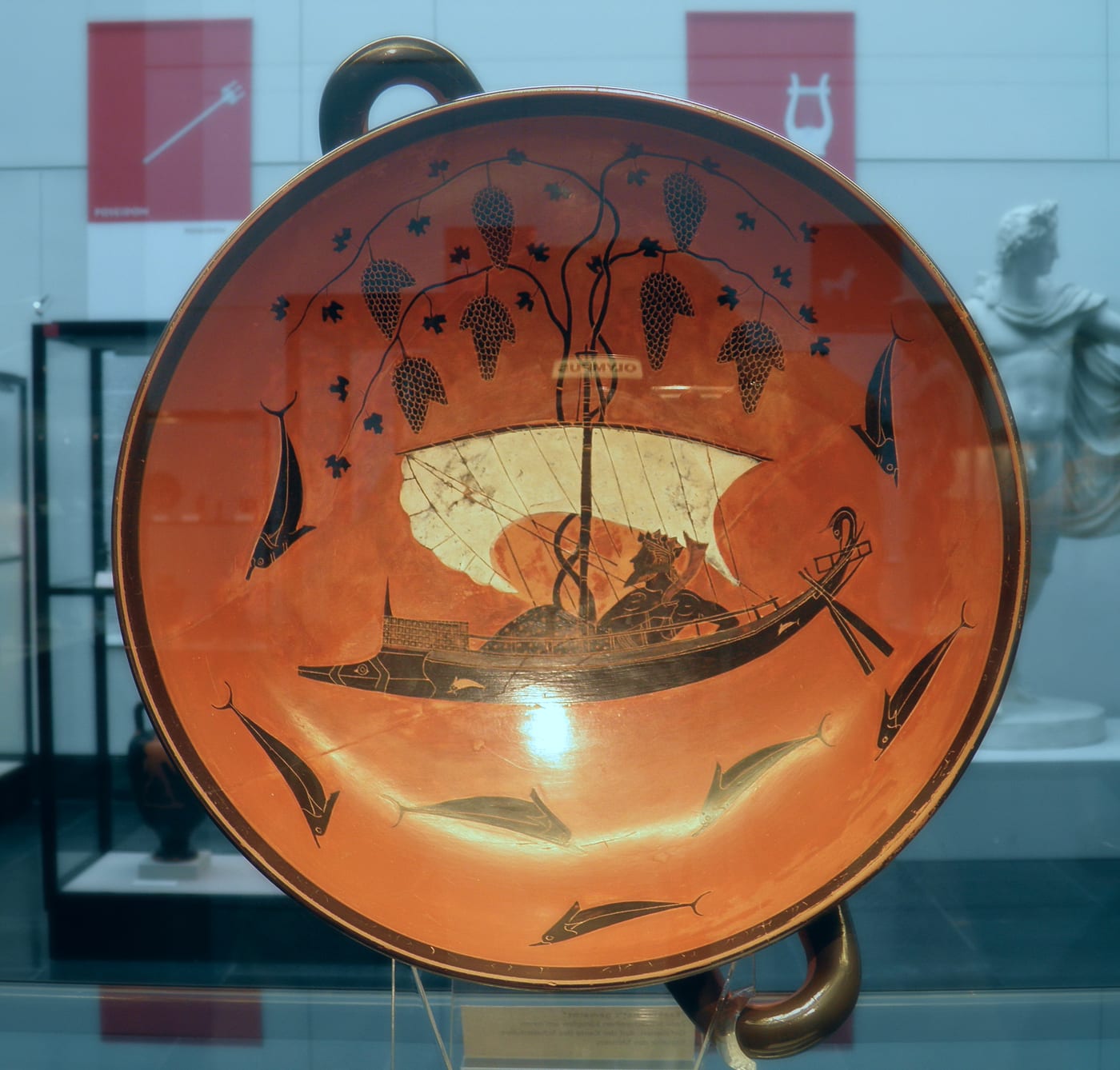
Herodotus does not narrate the Arion story as a myth. He tells it as a recent historical incident with a surviving monument. Arion of Methymna was a real kithara-player, the most celebrated of his age, who made a lot of money touring in southern Italy and was on his way back to Corinth when the crew of his ship decided to throw him overboard. He asked permission to play one last song, put on his full performance costume, played, jumped, and was picked up by a dolphin drawn to the music. The dolphin carried him to Cape Tainaron. A bronze statue of man-and-dolphin stood there still in Herodotus’s day. Pausanias, writing five hundred years later, confirmed the monument was still on the cape.
Whether the rescue actually happened is not the interesting question. The interesting question is why, when a Greek traveler of the 5th century BCE wanted to point to an example of a dolphin interacting meaningfully with a human, they had a bronze monument to walk up to.
The Minoan dolphins are older
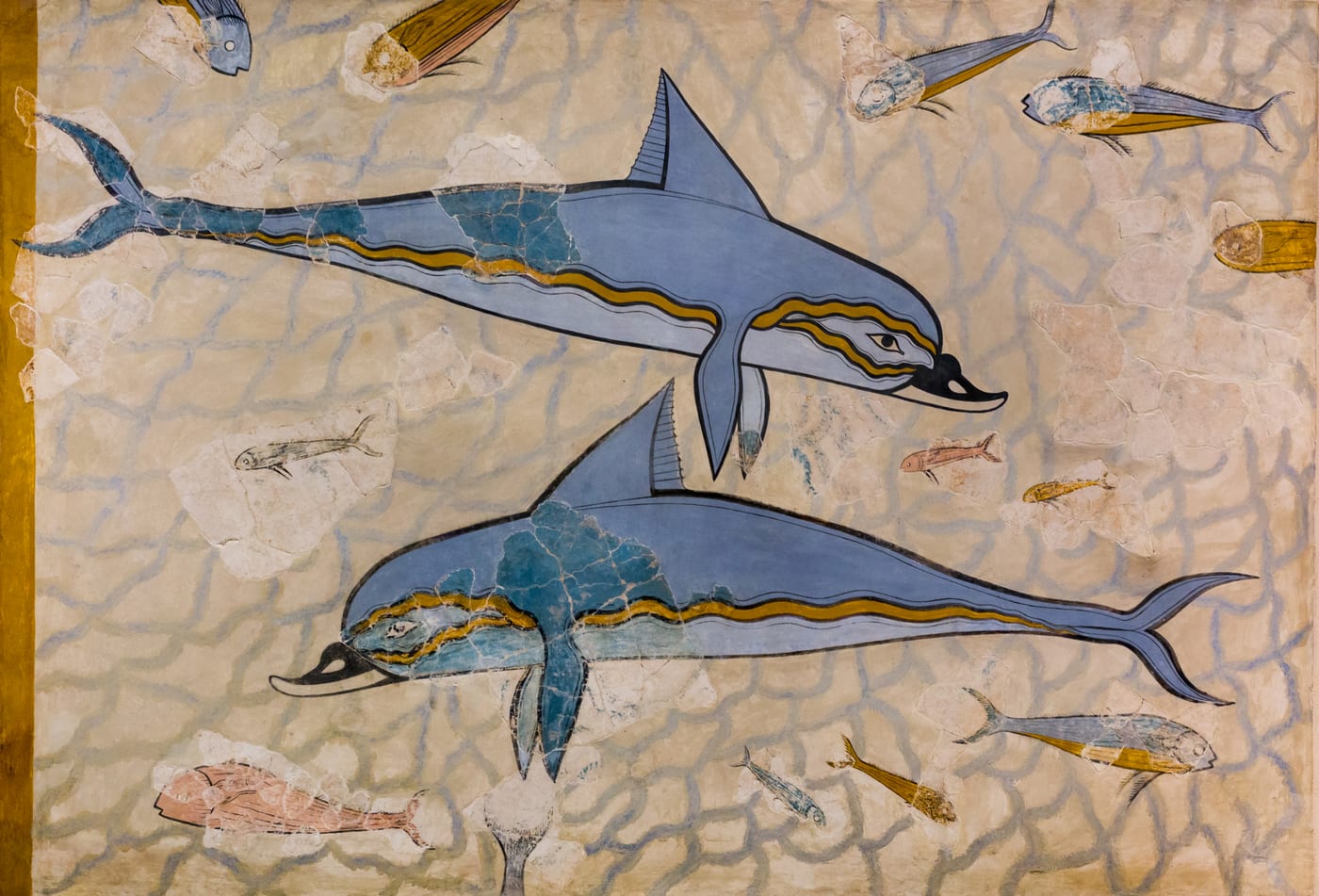
Arthur Evans’s reconstruction of the Queen’s Megaron at Knossos is contested; the specific “dolphin fresco” as it exists today is heavily overpainted. What is not contested is the broader Minoan corpus: dolphin motifs on pottery, seal stones, and wall-paintings across the Late Bronze Age Aegean, consistently showing socially-arranged groups of dolphins in ways that match real Mediterranean-dolphin behavior. Sinclair Hood’s The Arts in Prehistoric Greece (Penguin, 1978) walks through the material.
The Minoans did not leave written religious texts we can read, so we are left with the images. What the images say is that Late Bronze Age people around the Aegean were watching dolphins, painting them accurately, and treating them as worth painting in sacred and palatial spaces.
The Amazonian boto changes the picture
Every Mediterranean dolphin tradition is, essentially, a friendly tradition. The Amazonian boto is not. Candace Slater’s 1994 University of Chicago Press fieldwork in the Brazilian Amazon, Dance of the Dolphin, documented a living folklore in which the pink river dolphin (Inia geoffrensis) is a shape-shifter who emerges from the river at night, takes the form of an unusually handsome man, seduces a local woman at a festa, and returns to the water before dawn. A child whose paternity is otherwise unexplained can be identified as filho de boto, son of the boto.
This is the same kind of ambivalent shape-shifter tradition we find in the Japanese kitsune and the Chinese húli jīng: attractive, dangerous, leaving social consequences. Importantly, the cultural taboo against killing the boto has given the Amazonian pink dolphin stronger protection than most other wildlife in the basin has received. Folklore, in this case, is doing conservation work.
What the 1993 pop synthesis left out
Ted Andrews’s Animal Speak reads the dolphin as joy, play, intelligence, and a protective friendliness toward humans. That is the Greek tradition, cleaned up, with a dusting of late-20th-century dolphin-consciousness discourse (John Lilly’s 1960s–80s work, the SeaWorld-era mass-cultural image, the “dolphins are smart” pop science). The Amazonian boto would have complicated that reading considerably; Andrews dropped it.
Reading all four traditions, the Greek Homeric, the Herodotean, the Minoan, and the Amazonian, gives you the dolphin in its full range. Friendly guide, yes. But also social shape-shifter, ambivalent seducer, and the animal that happens to be the most protected river mammal in the world partly because a folklore told people not to kill it.
Working with the Dolphin
If you want a regular practice rather than a one-time read, an oracle deck is the standard tool: you draw a card and sit with whatever animal comes up. The foundational modern spirit-animal oracle: 44 cards drawn from Sams's Seneca and other Indigenous teachings, with a guidebook that actually explains its sources. The deck most later ones are imitating.
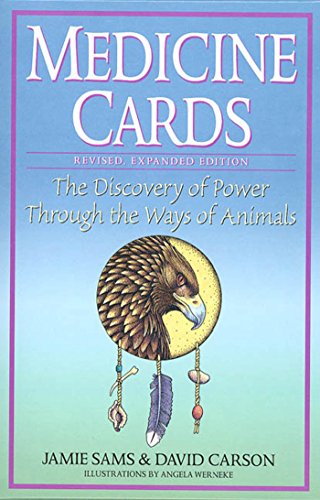
Medicine Cards
The foundational modern spirit-animal oracle: 44 cards drawn from Sams's Seneca and other Indigenous teachings, with a guidebook that actually explains its sources. The deck most later ones are imitating.
Compare the field in our ranked guide to spirit animal oracle decks, or browse decks, crystals, and journals in spirit animal gifts & tools.
Across traditions
Greek (Delphi, the Homeric Hymn to Apollo)
The name of the oracular sanctuary at Delphi descends from delphis, the Greek word for dolphin. The Homeric Hymn to Apollo (3.388–544, c. 7th century BCE) narrates how Apollo, choosing priests for his new shrine at Krisa below Parnassus, leapt from the sky in the form of a dolphin onto a passing Cretan merchant ship, then led the crew to become his attendants. The etiological pun is explicit: Apollo-dolphin, Apollo Delphinios, the sanctuary of Delphi.
The Greek dolphin is not a distant mythological beast. Dolphins were observed by Aristotle (History of Animals 9.48) and Pliny (Natural History 9.7–8), both of whom record specific cases of dolphins rescuing swimmers and interacting with fishing boats. The pop image of the dolphin as a helpful, human-loving creature is classically Mediterranean before it is New Age.
- PRIMARY Homeric Hymn to Apollo 3.388–544 — West trans., Loeb Classical Library.
- PRIMARY Aristotle, History of Animals 9.48 — Peck trans., Loeb Classical Library.
- PRIMARY Pliny the Elder, Natural History 9.7–8 — Rackham trans., Loeb Classical Library.
Greek (Arion's rescue)
Herodotus, Histories 1.23–24, tells the story of Arion of Methymna, the most accomplished kithara-player of his age, who was thrown overboard by the crew of a ship traveling from Taras to Corinth so they could steal his winnings. Before jumping, Arion played a final song in full costume. A dolphin, drawn by the music, carried him safely to shore at Cape Tainaron, where a bronze statue of man-and-dolphin stood in Herodotus's own day.
The story is repeated by Pausanias, Aulus Gellius, and Pliny, each adding details. The historicity is questionable; the cultural presence of the image is not. A dolphin-rescues-musician bronze at Tainaron was something Greek travelers could go see for themselves.
- PRIMARY Herodotus, Histories 1.23–24 — Godley trans., Loeb Classical Library.
- PRIMARY Pausanias, Description of Greece 3.25.7 — Jones trans., Loeb Classical Library.
- PRIMARY Pliny the Elder, Natural History 9.8 — Loeb Classical Library.
Minoan (Knossos dolphin fresco)
The so-called Queen's Megaron at Knossos, reconstructed by Arthur Evans in the early 20th century, contains the most famous dolphin image from the ancient Mediterranean: five large dolphins swimming against a white ground, dating to roughly the Middle/Late Minoan transition (c. 1600–1500 BCE). The fresco is now displayed in the Heraklion Archaeological Museum.
Evans's reconstruction has been critiqued for overpainting. What is securely Minoan is the broader corpus of dolphin imagery across Late Bronze Age Aegean wall painting, ceramic, and seal-stone work, documented in Sinclair Hood's The Arts in Prehistoric Greece (Penguin, 1978) and subsequent scholarship. The image of playful, socially-arranged sea-creatures is authentically Minoan.
- MUSEUM Dolphin Fresco, Queen's Megaron, Knossos — Heraklion Archaeological Museum; c. 1600–1500 BCE.
- PEER-REVIEWED Sinclair Hood, The Arts in Prehistoric Greece — Penguin, 1978.
Amazonian (boto encantado)
In the Brazilian Amazon, the pink river dolphin (Inia geoffrensis, locally boto) is an encantado: a shape-shifter who emerges from the river on festival nights in the form of an unusually handsome man, seduces a local woman, and returns to the water before morning. A child of ambiguous paternity may then be explained as filho de boto, 'child of the boto.' The tradition is alive and contemporary, documented in Candace Slater's Dance of the Dolphin: Transformation and Disenchantment in the Amazonian Imagination (University of Chicago Press, 1994).
This is not a gentle New Age dolphin. The boto is dangerous charm, a sexual trickster who leaves social consequences. The tradition persists in part because it provides a narrative for otherwise unexplained pregnancies in riverine communities. It also grounds a strong cultural protection against killing the boto, a protection that has survived industrial fisheries pressures better than almost any other traditional Amazonian wildlife taboo.
- PEER-REVIEWED Candace Slater, Dance of the Dolphin: Transformation and Disenchantment in the Amazonian Imagination — University of Chicago Press, 1994.
- REFERENCE Vera da Silva et al., 'Conservation of Amazon river dolphins' (Inia geoffrensis) — IUCN Red List technical assessment.
Ted Andrews (1993)
Andrews's 1993 dolphin is almost purely Mediterranean: joy, play, intelligence, the friendly helper. He draws on the Greek strand without specific citation and adds the marine-mammal science popularized by John Lilly and the 1980s dolphin-consciousness discourse. The Amazonian boto is not in his treatment. The resulting synthesis is the one most pop spirit-animal pages rearrange.
- REFERENCE Ted Andrews, Animal Speak — Llewellyn, September 1993.
Frequently asked
- Why is Delphi named after a dolphin?
- Because of the etiological myth in the Homeric Hymn to Apollo (3.388–544), which narrates Apollo leaping onto a Cretan ship in the form of a dolphin and leading the crew to his new shrine at Krisa below Parnassus. The sanctuary took his dolphin-form as Apollo Delphinios, and the name Delphi descends from the Greek delphis, dolphin.
- Who was Arion and the dolphin?
- Arion of Methymna was a historical kithara-player of the 7th century BCE. Herodotus 1.23–24 preserves the story: sailors from Taras planned to throw him overboard and steal his earnings. He played one final song in full costume before jumping. A dolphin, drawn by the music, carried him safely to Cape Tainaron. A bronze statue of man-and-dolphin stood there in Herodotus's own day.
- Are dolphins really sacred in the Amazon?
- In much of the Brazilian Amazon, yes, the boto (pink river dolphin, Inia geoffrensis) is an encantado, a shape-shifting trickster who seduces humans at festivals. The tradition is alive and contemporary, documented in Candace Slater's 1994 University of Chicago Press fieldwork. The cultural taboo against killing the boto has given it stronger protection than most other Amazonian wildlife.
- What did ancient Greeks think about dolphin intelligence?
- They observed it closely. Aristotle's History of Animals 9.48 and Pliny's Natural History 9.8 both record specific cases of dolphin social behavior, cooperation with fishermen, and apparent rescues of drowning swimmers. The Greeks treated dolphins as what we would now call cognitively unusual animals, a reading the modern pop-spiritual tradition inherited.
Sources
- PRIMARYHomeric Hymn to Apollo 3.388–544 — Loeb Classical Library.
- PRIMARYHerodotus, Histories 1.23–24 — Loeb Classical Library.
- PRIMARYAristotle, History of Animals 9.48 — Loeb Classical Library.
- PRIMARYPliny the Elder, Natural History 9.7–8 — Loeb Classical Library.
- PRIMARYPausanias, Description of Greece 3.25.7 — Loeb Classical Library.
- MUSEUMDolphin Fresco, Queen's Megaron, Knossos — Heraklion Archaeological Museum.
- PEER-REVIEWEDSinclair Hood, The Arts in Prehistoric Greece — Penguin, 1978.
- PEER-REVIEWEDCandace Slater, Dance of the Dolphin — University of Chicago Press, 1994.
- REFERENCEIUCN Red List, Inia geoffrensis
- REFERENCETed Andrews, Animal Speak — Llewellyn, September 1993.