Spirit Animal
Dog Spirit Animal
Dog spirit animal meaning, traced from the modern loyalty-and-companionship reading back through Ted Andrews's Animal Speak to Egyptian Anubis, Greek Cerberus, the Homeric Argos at Odysseus's doorstep, and the Mexica Xolotl and xoloitzcuintli.
In modern American "spirit animal" usage, the dog stands for loyalty, protection, service, and unconditional companionship. That reading comes through Ted Andrews's Animal Speak (Llewellyn, 1993) and the broader American pet-culture inheritance. The older traditions are mostly about dogs and death. Egyptian Anubis is the jackal-or-dog-headed god of the embalming and the weighing-of-the-heart, per Book of the Dead Chapter 125. Greek Cerberus guards the gates of Hades in Hesiod's Theogony 310. Homeric Argos, the old hound who recognizes Odysseus on his return after twenty years and dies on the threshold, is one of the most painted scenes in Greek literature (Odyssey 17.290–327). And the Mexica Xolotl, twin of Quetzalcóatl, is the dog-headed god who guides souls through Mictlan, with the xoloitzcuintli (Mexican hairless dog) as his living avatar.
In 2015, a team led by Paul Nicholson at Cardiff University finished mapping the Catacombs of Anubis at Saqqara. The final count: roughly eight million mummified canids, mostly dogs and jackals, stacked through roughly 173 meters of main gallery and innumerable side chambers. Eight million. That is not a mistake. The Anubis cult operated on a scale that has almost no analog in the religious history of other civilizations. The dog, in Egyptian thought, was not a companion. It was the priest who walked your soul through the judgment chamber.
That is a long way from “man’s best friend.”
Where the pop reading came from
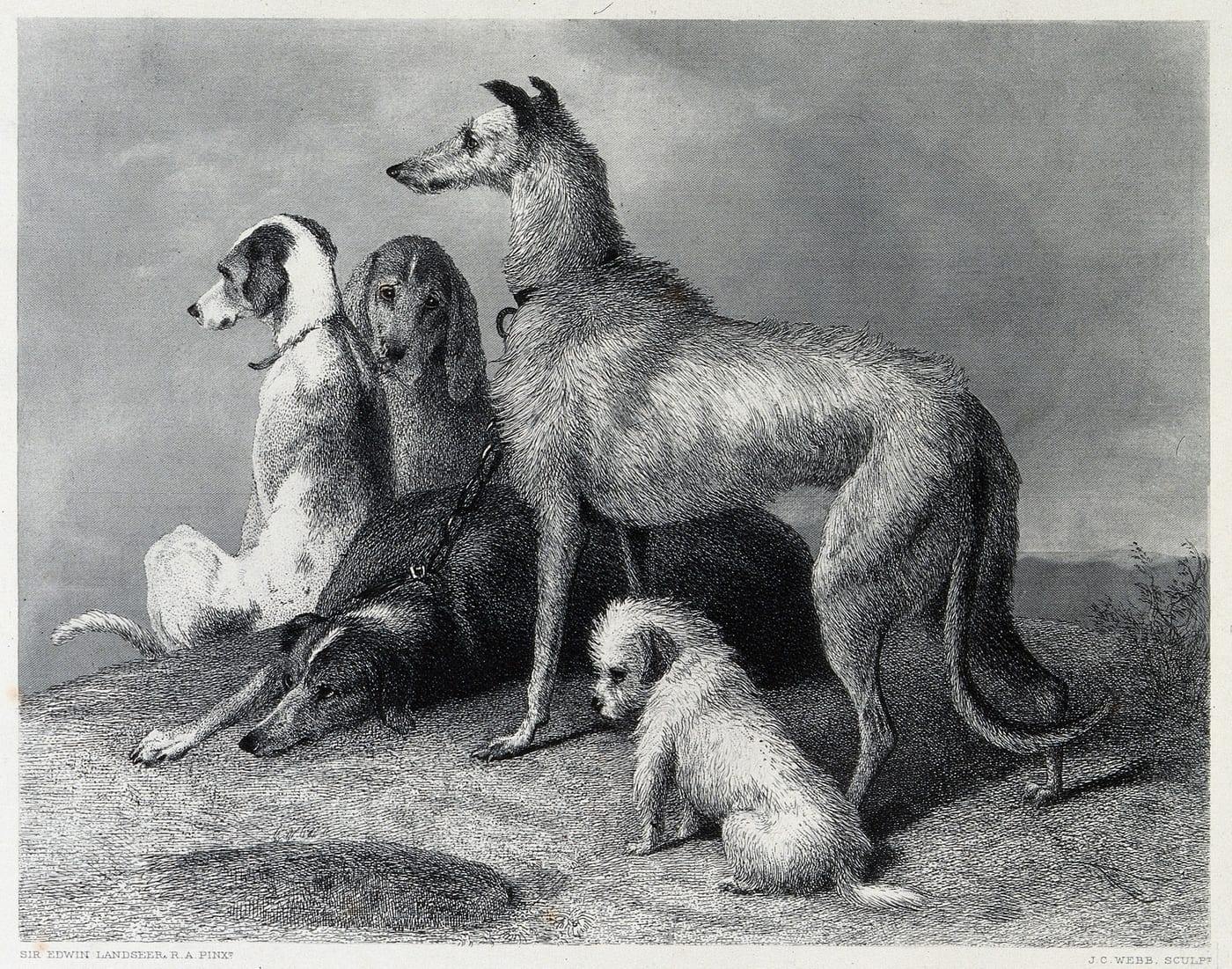
The loyalty-and-companionship reading of the dog is almost entirely modern. The 19th century produced the first generation of purebred-dog-breed clubs, the first dog shows, the first “dog as beloved pet” literature (Edwin Landseer’s paintings, Marley & Me and its ancestors, Lassie come home). By the late 20th century, the American pet-dog industry was worth tens of billions of dollars annually, and Ted Andrews’s 1993 spirit-animal synthesis landed inside a culture that already read the dog as unconditional-loving-companion.
Andrews’s reading is real, and it is genuinely important to the people who hold it. But it is not what the ancient traditions thought the dog was.
The ancient traditions all converge on death
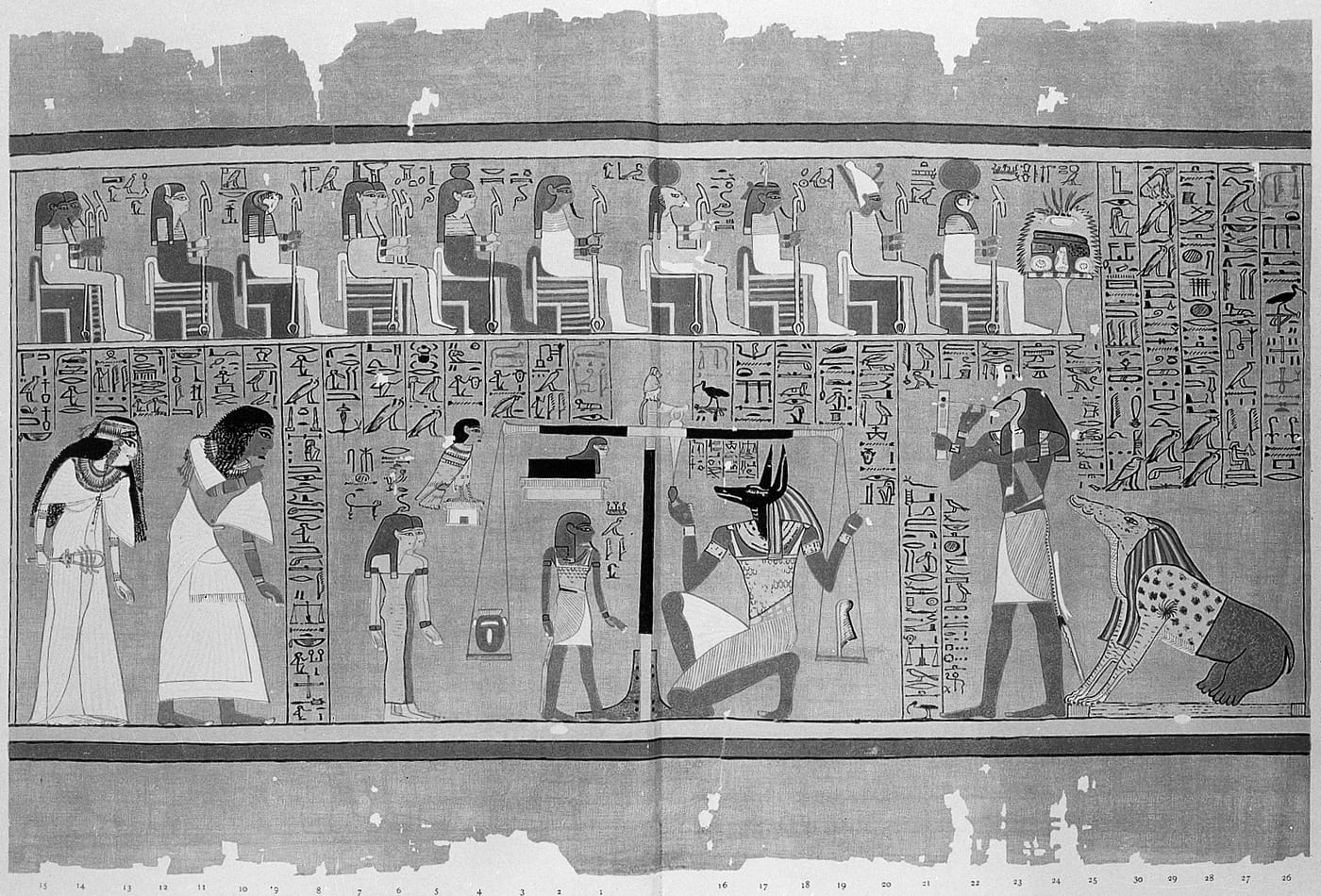
Anubis. Jackal-dog-headed god of the Egyptian necropolis. The weighing of the heart against the feather of Ma’at in the Hall of Two Truths (Book of the Dead 125) is performed under his supervision. The eight million mummies at Saqqara are, in part, votive offerings purchased by pilgrims and deposited by priests on their behalf. The scale tells you how seriously Egyptians took the dog’s role as the soul’s guide.
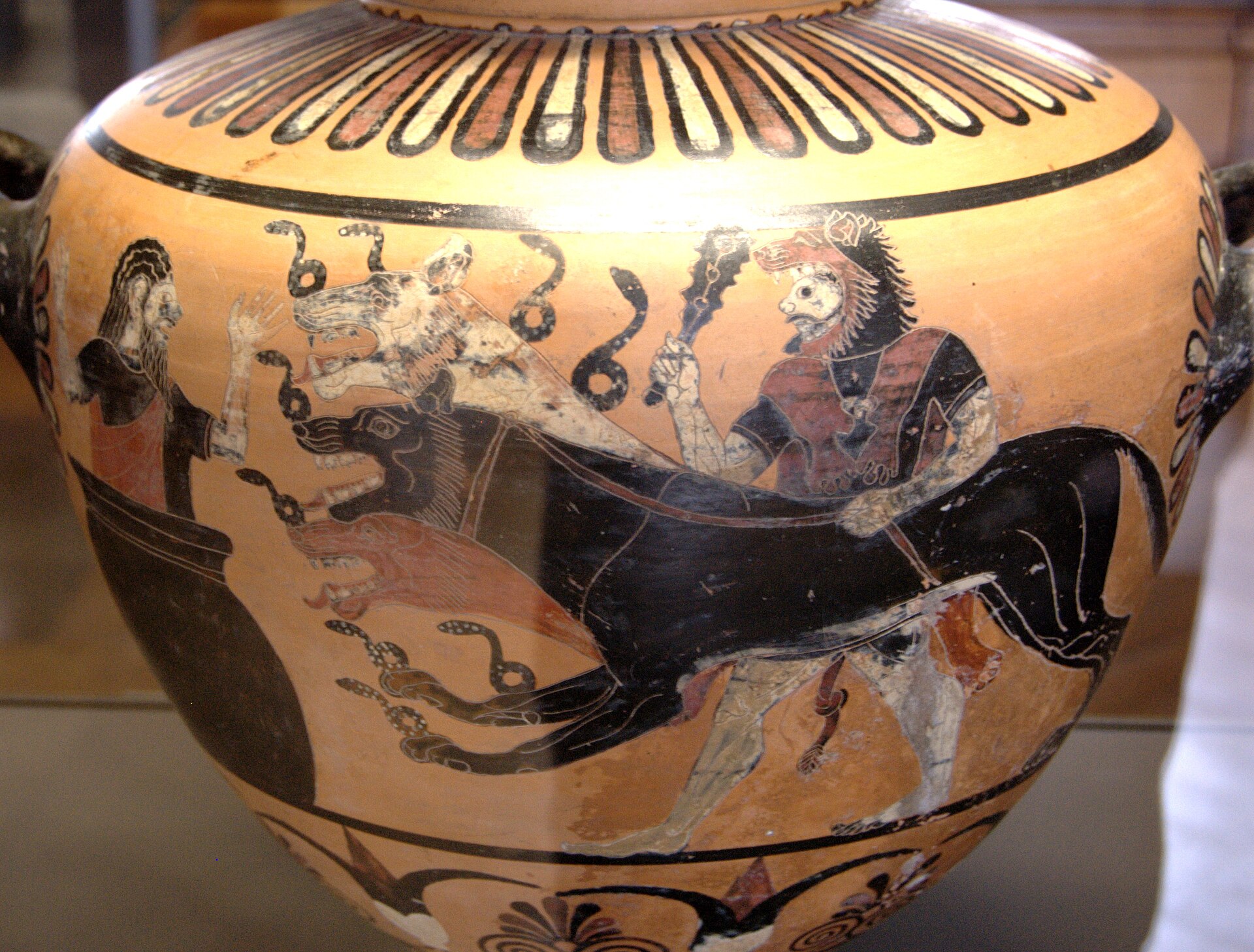
Cerberus. Three-headed, chained at the gate of Hades, one of the monsters Heracles must defeat as his twelfth labor. Hesiod’s Theogony gives him the parents: Typhon and Echidna. Dante places him in the third circle of Hell. The Greek underworld has a dog at its gate.
Argos. The tender counter-example. Odysseus’s old hound, raised as a puppy, has been lying neglected on a dunghill for twenty years when his master returns in disguise. Argos recognizes him. He wags his tail. He dies. The scene is three hundred lines into Book 17 of the Odyssey, and it is still doing the same emotional work three thousand years later.
Xolotl. The dog-headed twin of Quetzalcóatl, psychopomp of the Mexica underworld. His living avatar is the xoloitzcuintli, the Mexican hairless dog, bred in Mexico for at least 3,500 years. Archaeological dog-burials at Teotihuacan and Copán show dogs interred with human dead, consistent with the guide-through-Mictlan role.
The Zoroastrian four-eyed dog. The most unusual of the set. The sagdīd rite of Zoroastrianism uses a dog, preferably one with facial markings suggesting a second pair of eyes, to view the corpse. The dog’s unique perception is believed to confirm death and drive away the Nasu, the corpse-demon. The rite is still performed in Parsi communities today.
What all five share
Dogs at thresholds. Dogs at the gate of the underworld, dogs leading the judgment, dogs guiding souls through nine levels, dogs detecting death. The ancient traditions agree almost unanimously that the dog’s unique spiritual role is to stand at the boundary between the living and the dead and handle the crossing in a way no other animal can. The modern pet-dog reading is the opposite of that. The modern dog stays in the living world, curled on the couch, keeping us company.
Both readings are real. The second is recent and the first is ancient. A spirit-animal article about the dog that only gives you the couch-companion reading has skipped most of the record.
Working with the Dog
If you want a regular practice rather than a one-time read, an oracle deck is the standard tool: you draw a card and sit with whatever animal comes up. The foundational modern spirit-animal oracle: 44 cards drawn from Sams's Seneca and other Indigenous teachings, with a guidebook that actually explains its sources. The deck most later ones are imitating.
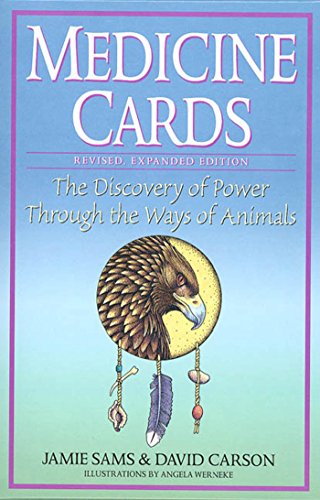
Medicine Cards
The foundational modern spirit-animal oracle: 44 cards drawn from Sams's Seneca and other Indigenous teachings, with a guidebook that actually explains its sources. The deck most later ones are imitating.
Compare the field in our ranked guide to spirit animal oracle decks, or browse decks, crystals, and journals in spirit animal gifts & tools.
Across traditions
Egyptian (Anubis, god of embalming)
Anubis (Egyptian Inpw, "he who is upon his mountain") is the jackal- or dog-headed god of embalming, mummification, and the judgment of the dead. Book of the Dead Chapter 125 (Allen trans., SAOC 37, 1974) is the central text: Anubis leads the deceased into the Hall of Two Truths, weighs the heart against the feather of Ma'at, and delivers a negative confession on the deceased's behalf. The image of the black-headed jackal-god at the balance is one of the most reproduced in all of Egyptian art.
Salima Ikram's ongoing Animal Mummy Project has documented thousands of dog and jackal mummies interred at Anubis-associated sites including Saqqara, where a single catacomb was found in 2015 to contain roughly eight million canid mummies. The scale of the Anubis cult rivals the scale of the Bastet cult.
- PRIMARY Book of the Dead, Chapter 125 (Weighing of the Heart) — Allen trans., SAOC 37, University of Chicago, 1974.
- PRIMARY Pyramid Texts, Utterance 437 (Anubis references) — Faulkner trans., Oxford, 1969.
- PEER-REVIEWED Salima Ikram, Divine Creatures — AUC Press, 2005.
- PEER-REVIEWED Paul T. Nicholson et al., 'The Catacombs of Anubis at Saqqara' — Antiquity 89:345, 2015.
Greek (Cerberus and the Homeric Argos)
Cerberus, the three-headed dog who guards the gate of Hades, appears in Hesiod's Theogony 310–312 (c. 700 BCE). Heracles's twelfth labor is to drag Cerberus up to the living world and back (Apollodorus 2.5.12). The image has been in Western art continuously for nearly three thousand years; Dante's Inferno Canto 6 (c. 1320) places Cerberus in the third circle of Hell.
Homer's Odyssey 17.290–327 gives us a different dog entirely. Odysseus, returning after twenty years, approaches his palace disguised as a beggar. His old hound Argos, whom he raised himself as a puppy, is lying on a dunghill, neglected, covered in vermin. Argos recognizes Odysseus, lifts his head, wags his tail, and dies. The scene is one of the most frequently-cited examples of animal-recognition in world literature. It is also the most psychologically modern dog in the ancient corpus, a genuinely beloved companion animal.
- PRIMARY Hesiod, Theogony 310–312 — Most trans., Loeb Classical Library.
- PRIMARY Homer, Odyssey 17.290–327 (Argos episode) — Murray trans., Loeb Classical Library.
- PRIMARY Apollodorus, Library 2.5.12 — Frazer trans., Loeb Classical Library.
- PRIMARY Dante, Inferno Canto 6 — Hollander trans., Doubleday, 2000.
Mexica (Xolotl and the xoloitzcuintli)
Xolotl is the dog-headed twin of Quetzalcóatl in Mexica (Aztec) religion, the god who accompanies souls through Mictlan, the underworld, on their nine-level journey after death. Bernardino de Sahagún's Florentine Codex Appendix to Book 3 records the Xolotl mythology; the Codex Borgia (pre-Hispanic ritual screenfold, c. 1450 CE, now Biblioteca Apostolica Vaticana) shows Xolotl alongside Quetzalcóatl in the night-sky complex.
The xoloitzcuintli, the Mexican hairless dog, is the living avatar of Xolotl and has been bred in Mexico for at least 3,500 years per archaeological evidence. Archaeological dog-burials at sites including Teotihuacan and Copán suggest the dog's psychopomp role was culturally central: a dog was buried with or near the dead to guide them through Mictlan. The breed survives today and is the national dog of Mexico.
- PRIMARY Bernardino de Sahagún, Florentine Codex (Appendix to Book 3) — Anderson & Dibble trans., University of Utah Press, 1950–82.
- ARCHIVE Codex Borgia — Biblioteca Apostolica Vaticana, Borg.mess.1; pre-Hispanic c. 1450 CE.
- PEER-REVIEWED Michael Coe & Rex Koontz, Mexico: From the Olmecs to the Aztecs — Thames & Hudson, 7th ed. 2013.
Zoroastrian / Iranian (the sagdīd rite)
In Zoroastrian practice, the sagdīd ("dog-sight") rite is a central funerary ceremony: a dog, usually a four-eyed dog (one with facial markings above the eyes that look like a second pair of eyes), views the corpse to confirm death and drive away the corpse-demon Nasu. The rite is described in the Vendidad, a section of the Zoroastrian Avesta, and is still practiced in Parsi communities in India today.
Mary Boyce's A History of Zoroastrianism (Brill, 1975–91) is the standard English-language treatment. The dog's unique canine perception is, in this tradition, a spiritual-sanitation function that no human priest can replace.
- PRIMARY Vendidad (Avestan), selections on sagdīd — Darmesteter trans., Sacred Books of the East 4, 1880.
- PEER-REVIEWED Mary Boyce, A History of Zoroastrianism (3 vols.) — Brill, 1975–91.
Ted Andrews (1993)
Andrews's 1993 dog is the modern American pet-culture dog reduced to a personal-spirit keyword: loyalty, protection, service, unconditional companionship. He nods toward Anubis and Cerberus briefly. The psychopomp-guide role that dominates the actual ancient traditions (Anubis leading the judgment, Xolotl guiding through Mictlan, sagdīd driving the corpse-demon) is minimized in favor of the modern pet-companion frame.
- REFERENCE Ted Andrews, Animal Speak — Llewellyn, September 1993.
Frequently asked
- What does a dog symbolize spiritually?
- In modern pop usage, loyalty, protection, and unconditional companionship, the Andrews 1993 reading rooted in American pet culture. Older traditions are mostly about dogs and death. Egyptian Anubis leads the weighing of the heart. Greek Cerberus guards Hades; the Homeric Argos dies recognizing Odysseus after twenty years. The Mexica Xolotl guides souls through the nine levels of Mictlan. And the Zoroastrian sagdīd rite uses a four-eyed dog to confirm death and drive away the corpse-demon.
- Why is Anubis a dog?
- Anubis (Egyptian Inpw) is usually represented as a jackal or a jackal-dog hybrid, the animal associated with desert cemeteries because jackals dug up shallow burials. By attaching the necropolis-jackal to a god of the dead, Egyptian theology turned the threat into the protector: Anubis is the embalmer and the judge of the heart (Book of the Dead Chapter 125). A catacomb at Saqqara, excavated through 2015, was found to contain roughly eight million canid mummies.
- Who was Argos in the Odyssey?
- Argos was Odysseus's old hound, whom he had raised from a puppy before leaving for Troy. In Odyssey 17.290–327, Odysseus returns after twenty years disguised as a beggar. Argos, now aged and neglected, recognizes him from the yard, lifts his head, wags his tail, and dies. It is one of the most-cited examples of animal-recognition in world literature and one of the most psychologically modern dog-scenes in the ancient corpus.
- What is the Mexican hairless dog's spiritual role?
- The xoloitzcuintli (Mexican hairless dog) is the living avatar of Xolotl, the dog-headed twin of Quetzalcóatl in Mexica religion. The dog accompanies souls through Mictlan, the underworld, on their nine-level journey after death. Archaeological dog-burials at Teotihuacan and Copán suggest the breed's psychopomp role was central. The xoloitzcuintli is now the national dog of Mexico.
Sources
- PRIMARYBook of the Dead, Chapter 125 — Allen trans., University of Chicago, 1974.
- PRIMARYPyramid Texts, Utterance 437 — Faulkner trans., Oxford, 1969.
- PEER-REVIEWEDSalima Ikram, Divine Creatures — AUC Press, 2005.
- PEER-REVIEWEDPaul T. Nicholson et al., 'The Catacombs of Anubis at Saqqara' — Antiquity 89:345, 2015.
- PRIMARYHesiod, Theogony 310–312 — Loeb Classical Library.
- PRIMARYHomer, Odyssey 17.290–327 — Loeb Classical Library.
- PRIMARYApollodorus, Library 2.5.12 — Loeb Classical Library.
- PRIMARYDante, Inferno Canto 6 — Hollander trans., Doubleday, 2000.
- PRIMARYSahagún, Florentine Codex (Appendix to Book 3) — Anderson & Dibble trans.
- ARCHIVECodex Borgia
- PRIMARYVendidad (SBE 4, 1880)
- PEER-REVIEWEDMary Boyce, A History of Zoroastrianism — Brill, 1975–91.
- REFERENCETed Andrews, Animal Speak — Llewellyn, September 1993.