American folk-belief, sourced
What It Actually Means When a Cardinal Visits You
The "cardinal is a visit from a loved one" belief is real, widely held, and almost entirely recent. Here's where it actually came from.
The belief that a cardinal sighting is a visit from a deceased loved one is a living American folk-tradition that dates, in its current specific form, to roughly the 1990s. It does not appear in Newbell Niles Puckett's 1926 Folk Beliefs of the Southern Negro or in the extensive Frank C. Brown Collection of North Carolina folklore compiled through the 1940s, which cover hundreds of bird omens. The Cherokee have a separate, older tradition of the cardinal (totsuhwa) as daughter of the sun, recorded by James Mooney (Smithsonian BAE, 1900). The modern American 'cardinal-from-heaven' belief is its own thing: late, folk-Christian, and genuinely meaningful to the people who hold it.
If you Google "cardinal visiting meaning" you will land on twenty pages that tell you the same thing in the same words. Cardinal equals loved one. Cardinal equals divine presence. Cardinal equals sign. None of those pages will tell you where the belief actually came from, which is a shame, because the real answer is more interesting than the repeated one.
What the 1926 record does and doesn't say
Newbell Niles Puckett was a sociologist at Western Reserve University who, between 1920 and 1926, traveled through the American South collecting folk beliefs primarily from African-American informants. His 1926 book Folk Beliefs of the Southern Negro (University of North Carolina Press) remains one of the great primary-source archives of early-20th-century American folk tradition. Puckett catalogs dozens of bird omens: hooting owls, whippoorwills, mockingbirds, doves, crows, and others. The cardinal as a sign from a deceased loved one is not in his collection.
Two decades later, Wayland Hand edited the Frank C. Brown Collection of North Carolina folklore, published in seven volumes by Duke University Press (1952–64). Volumes VI and VII cover popular beliefs and superstitions, including an exhaustive bird section. Again: cardinals appear, but not with the specific meaning of visiting deceased loved ones. The older American folk-corpus does not have this belief.
What the Cherokee record actually says
The Cherokee name for the cardinal is totsuhwa. James Mooney's Myths of the Cherokee, published as the 19th Annual Report of the Smithsonian's Bureau of American Ethnology in 1900, is one of the most comprehensive ethnographies of Cherokee oral tradition ever compiled. Mooney records the cardinal as associated with the daughter of the sun in a specific narrative. The bird in that tradition is a sun-figure, not a messenger from the dead.
Some contemporary Cherokee educators, notably at the Cherokee Nation Cultural Resources office, have noted that the modern Anglo-American "cardinal is grandma" belief does not trace to Cherokee teaching and should not be labeled as such. Our editorial position: the Cherokee tradition is its own thing, the modern American folk-belief is its own thing, and conflating them is a category error we try to avoid here.
Where the modern belief actually seems to come from
The trail is fuzzier than a footnote-able scholar would like, but the shape is clear. By the mid-1990s, American sympathy-card inventory had incorporated the cardinal as a memorial motif. By 2000, Hallmark, American Greetings, and a long tail of smaller publishers were printing cardinals on condolence cards as a standard inventory item. By 2010, an Etsy search for "cardinal memorial" returned thousands of results. By 2020, funeral homes across the Eastern and Midwestern US reported cardinal imagery as one of the single most-requested motifs on memorial cards and service programs.
The belief seems to have emerged from the intersection of three things: the cardinal's year-round presence in the Eastern US (it doesn't migrate, so grieving people see it in winter when other birds have left), the bird's striking scarlet color (which draws attention), and a folk-Christian reading that treats visible natural signs as potential communications from the afterlife. Add a few decades of sympathy-card reinforcement and a belief becomes ubiquitous.
None of this is an argument that the belief is silly or invalid. Living folk-beliefs are how grief finds traction. The argument is a historiographic one: the belief is recent, American, and folk-Christian in its specific shape, not ancient or Cherokee or Biblical.
What the bird actually is
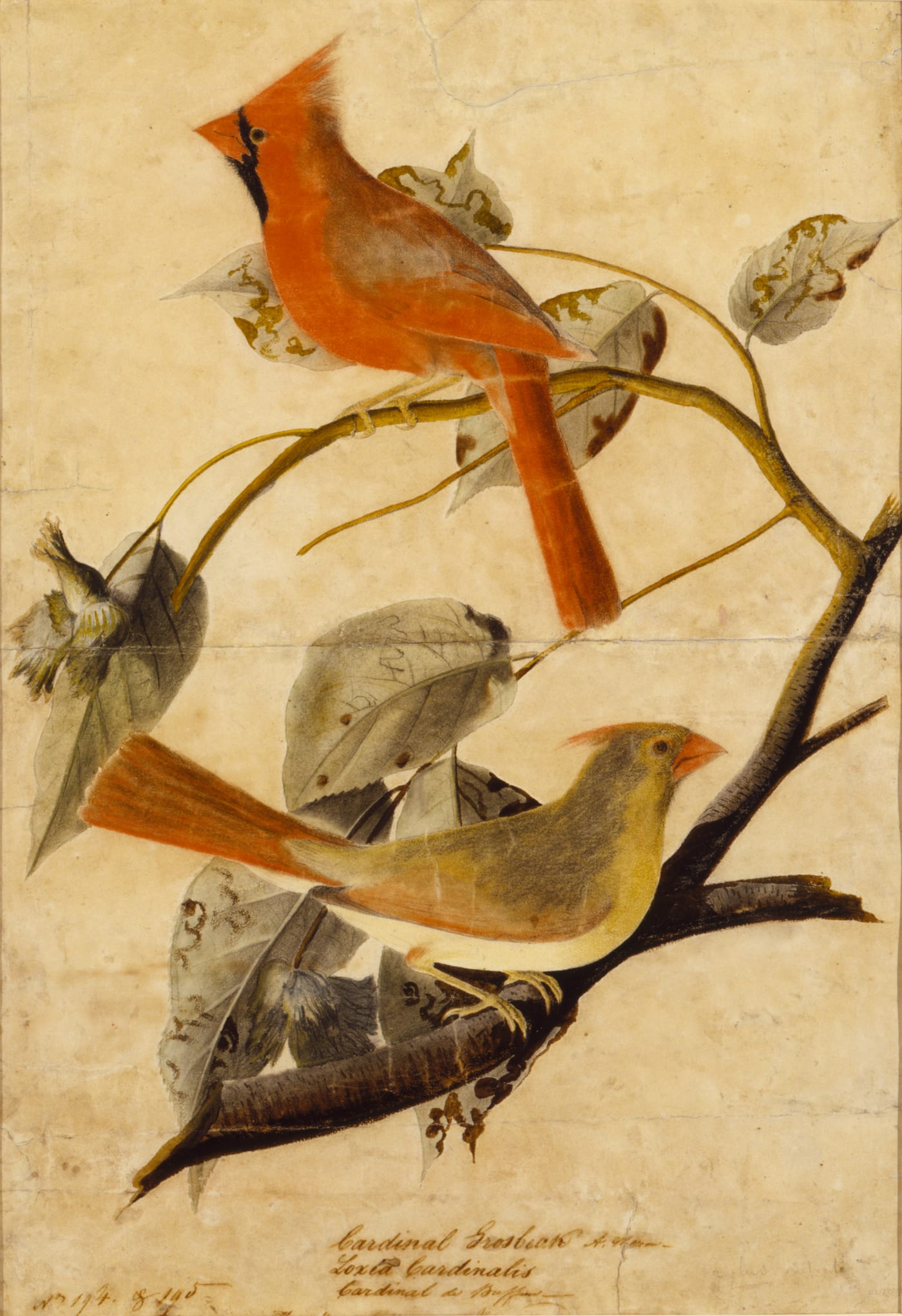
The northern cardinal (Cardinalis cardinalis) is a year-round resident across most of the eastern and central United States. Males are brilliant red; females are a duller brown with red accents. Both sexes sing, which is unusual among North American songbirds. They defend territories aggressively against their own reflections, which is why you sometimes see a cardinal repeatedly attacking a window or car mirror (Cornell Lab of Ornithology species account). They eat seeds, fruit, and insects, and they visit feeders readily. All of this adds up to maximal encounter frequency with humans, which is part of why the bird became a folk-omen candidate in the first place.
The bird got its English name by 1672 (Oxford English Dictionary) because its scarlet plumage matched the vestments of Roman Catholic cardinals. John James Audubon's Birds of America plate CLIX (1827–38) popularized the name in North America. The bird's ecclesiastical-red association is, unlike the memorial tradition, genuinely old.
So what should you make of a cardinal at the feeder?
If you read it as a visit from a loved one, you are participating in a living American folk-tradition that is probably thirty to forty years old in its current specific form. That is a real tradition. It brings real comfort. It should not be dismissed as "made up" just because it's not ancient, because all folk traditions were once recent.
If you want to read it historically, the bird is one of the most conspicuous songbirds in American backyards, the folk-belief is recent, and the Cherokee tradition behind the name totsuhwa is separate and older. You can hold both readings at once. The one thing this site asks is that you not confuse the two.
Frequently asked
- Is a cardinal really a sign from a deceased loved one?
- The belief is real, widely held, and almost entirely 20th- and 21st-century American. It does not appear in Newbell Niles Puckett's 1926 compendium of Southern folk beliefs or in Wayland Hand's North Carolina folklore collection. It does appear everywhere in American grief and memorial literature from roughly the 1990s onward and is now standard in sympathy cards and memorial merchandise. Treat it as a living, recent American folk-belief rather than an ancient tradition.
- Did Cherokee people have a cardinal-messenger belief?
- The Cherokee cardinal, totsuhwa, has its own teaching in James Mooney's Myths of the Cherokee (Smithsonian Bureau of American Ethnology, 1900), where it appears associated with the daughter of the sun rather than with deceased loved ones. The contemporary American 'cardinal-from-heaven' belief is not a continuation of that Cherokee tradition.
- Why is the cardinal named after a Catholic cardinal?
- The red vestments came first. English speakers began calling the bird 'cardinal' by 1672 (OED) because its color matched the scarlet vestments of the Roman Catholic cardinals. John James Audubon's Birds of America plate CLIX (1827–38) popularized the name further. The bird was named after the clothing, not vice versa.
- What does a cardinal visit actually mean, honestly?
- In modern American folk-belief, many people read it as a visit from a deceased loved one or a sign of divine presence. Ornithologically, northern cardinals (Cardinalis cardinalis) are year-round residents of much of the eastern US, territorial, and conspicuous at feeders, which maximizes encounter frequency. Both facts are true at once. Whether you read your sighting as a meaningful sign is a question of faith; whether the meaning you attach to it is ancient tradition, it is not.
Sources
- PRIMARYJames Mooney, Myths of the Cherokee — Smithsonian Bureau of American Ethnology Annual Report 19, 1900.
- PRIMARYNewbell Niles Puckett, Folk Beliefs of the Southern Negro — University of North Carolina Press, 1926.
- PRIMARYWayland Hand (ed.), Popular Beliefs and Superstitions from North Carolina (Frank C. Brown Collection) — Duke University Press, vols. VI–VII, 1961–64.
- ARCHIVEJohn James Audubon, The Birds of America (plate CLIX, Cardinal Grosbeak) — 1827–38.
- REFERENCEOxford English Dictionary, 'cardinal (noun), sense 5' (the bird) — OED records English use by 1672.
- REFERENCEAmerican Folklore Society, Journal of American Folklore archive
- REFERENCECornell Lab of Ornithology, Northern Cardinal (Cardinalis cardinalis) species account
- REFERENCETed Andrews, Animal Speak — Llewellyn, September 1993.