Spirit Animal
Bee Spirit Animal
Bee spirit animal meaning, traced from the modern community-and-industry reading back through Ted Andrews's Animal Speak to the Egyptian bjt (bee of Lower Egypt), the Ephesian Artemis priestesses called Melissae, Virgil's Georgics Book 4, the Samson-and-honey episode in Judges 14, and Mellonia as Roman household goddess.
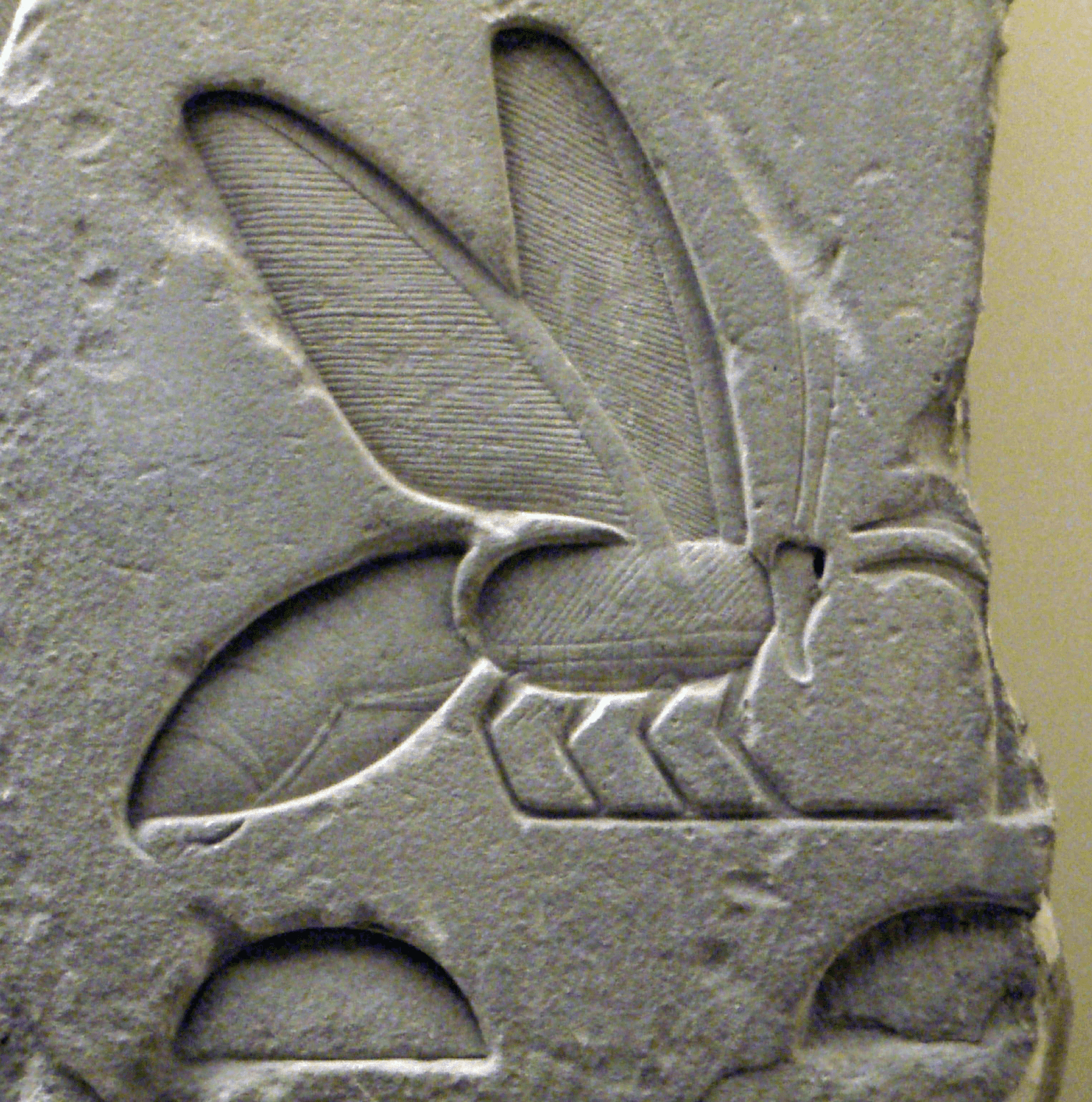
In modern American "spirit animal" usage, the bee stands for community, industry, fertility, and the sweet fruits of disciplined collective labor. That reading comes through Ted Andrews's Animal Speak (Llewellyn, 1993). The older traditions are precise and very old. The Egyptian hieroglyph bjt (𓆤) is the bee of Lower Egypt, one of the two royal glyphs (with the sedge of Upper Egypt) that made up the pharaoh's title nswt-bjt (King of Upper and Lower Egypt). The priestesses of Ephesian Artemis were called Melissae ('bees'). Virgil's Georgics Book 4 (c. 29 BCE) is the most detailed ancient beekeeping manual. Samson's riddle in Judges 14:14 is founded on bees nesting in a lion's corpse. And the Roman household goddess Mellonia presided over beehives and honey.
On every pharaoh’s cartouche going back to the First Dynasty, around 3100 BCE, there is a bee. The hieroglyph bjt (𓆤) represents the bee of Lower Egypt, one half of the pharaoh’s formal title nswt-bjt, “He of the Sedge and the Bee,” meaning “King of Upper and Lower Egypt.” For roughly three thousand years, every ruler of Egypt carried a bee on their throne-name. No other insect in world history has that kind of royal weight.
The modern “bee spirit animal = community and industry” reading hardly ever gets to this.
Four deep traditions, each with its own shape
The Egyptian royal bee. Pharaonic emblem of Lower Egypt. First Dynasty through the Ptolemies. Beekeeping documented at temple reliefs including the Tomb of Rekhmire at Thebes (c. 1450 BCE). Gardiner’s Egyptian Grammar (sign L2) is the standard philological reference.

The Ephesian Melissae. Priestesses of Artemis at Ephesus, called “bees,” serving at one of the Seven Wonders of the Ancient World. The bee on the Ephesian silver tetradrachm is the city’s emblem from the 6th century BCE through the Roman imperial period. The Delphic Pythia was called a “bee” in related Greek tradition. Pindar’s Pythian 4.60 preserves the epithet. The earlier Anatolian Mother-Goddess cult seems to be the source.
Virgil’s Georgics Book 4. The most detailed ancient beekeeping manual, 566 hexameter lines covering hive construction, swarming, pests, honey-harvesting, the bougonia myth (bees generated from a dead bullock), and a final embedded Orpheus-and-Eurydice poem. The Georgics treats the bee-colony as a model of Roman civic and imperial order. The text was central to medieval monastic education and shaped every subsequent Western bee-metaphor from Bernard of Clairvaux to 19th-century Utah (the beehive is the state symbol).
The Hebrew bees-in-the-lion. Judges 14:14. Samson tears apart a lion, returns later, finds bees nesting in the corpse, eats the honey, poses his riddle at the wedding: “Out of the eater came something to eat; out of the strong came something sweet.” The image rests on the ancient bougonia belief, shared between Egypt, Near East, Greece, and Rome, that bees can spontaneously generate from a dead animal. Virgil preserves the same belief. The Samson riddle has been on the Lyle’s Golden Syrup tin in the UK continuously since 1885, the longest-running consumer product design in the world.
What the traditions share
The bee in each is an animal of royal or sacred organization. The pharaoh’s emblem. The goddess’s priestesshood. The civic model. The hero’s honey-in-the-lion mystery. None of the four is “the bee symbolizes community and industry” in the generic way modern spirit-animal articles use the phrase, though that reading does emerge from them if you trace Virgil forward through monastic bee-metaphor through 19th-century industrial-symbolism.
Ted Andrews’s 1993 reading is the end of that chain, cleaned up for personal-spirit language. It is a real reading. It is also thirty-three centuries downstream of the Egyptian bjt.
Across traditions
Egyptian (bjt, the bee of Lower Egypt)
The Egyptian hieroglyph bjt (𓆤), depicting a bee, was the royal emblem of Lower Egypt. The pharaoh's full title was nswt-bjt ("He of the Sedge and the Bee," meaning "King of Upper and Lower Egypt"), with the sedge (sut) representing Upper Egypt and the bee representing Lower Egypt. The combined glyph appears on royal cartouches from the First Dynasty (c. 3100 BCE) onward.
Egyptian beekeeping itself is documented in temple reliefs (notably the Old Kingdom tomb of Rekhmire at Thebes, c. 1450 BCE) and in practical apiarian texts in the Edwin Smith Medical Papyrus and Ebers Papyrus. Honey was a major Egyptian trade commodity, offered in temple rituals, and used in funerary provisioning. The bee, in Egypt, was both a royal emblem and a working agricultural animal at state scale.
- PRIMARY Egyptian nswt-bjt royal title (First Dynasty onward) — Cairo Museum, Abydos royal tomb inscriptions; Petrie, Royal Tombs of the Earliest Dynasties, 1900–01.
- MUSEUM Tomb of Rekhmire (TT100), beekeeping relief — Sheikh Abd el-Qurna, Thebes; c. 1450 BCE.
- PEER-REVIEWED Alan H. Gardiner, Egyptian Grammar (sign E21/L2 for bjt) — Griffith Institute, 3rd ed. 1957.
Greek (Ephesian Artemis and the Melissae)
The priestesses of Artemis at Ephesus were called Melissae ("bees"); the high priestess bore the title Essene (also related to the bee). The bee was the city emblem of Ephesus, stamped on its silver tetradrachms from at least the 6th century BCE. The Temple of Artemis at Ephesus, one of the Seven Wonders of the Ancient World, was the center of the cult.
The bee-priestess tradition predates the Ionian Greek settlement of Ephesus and is thought to derive from an earlier Anatolian Mother-Goddess cult. Pindar (Pythian 4.60) calls the Delphic Pythia a "Delphic bee," preserving a related Greek tradition of bee-priestesses at Delphi. Susan Guettel Cole's Landscapes, Gender, and Ritual Space (University of California Press, 2004) treats the Ephesian material.
- PRIMARY Pindar, Pythian 4.60 — Race trans., Loeb Classical Library.
- MUSEUM Ephesus silver tetradrachms (British Museum collection)
- PEER-REVIEWED Susan Guettel Cole, Landscapes, Gender, and Ritual Space — University of California Press, 2004.
Roman (Virgil's Georgics, Mellonia)
Virgil's Georgics Book 4 (c. 29 BCE) is the most detailed ancient text on beekeeping, running to 566 hexameter lines covering hive construction, the life cycle of the bees, swarming, the treatment of pests, the famous bougonia (spontaneous-generation-of-bees-from-a-bullock-corpse), and the final embedded epyllion of Orpheus and Eurydice. Virgil treats the bee-colony as a model of civic virtue and imperial order.
The minor Roman household goddess Mellonia (named after mel, honey) was the specific patron of beehives; Arnobius's Adversus Nationes 4.7 (c. 300 CE) lists her among the Roman numina. The Romans took beekeeping seriously enough to have a dedicated goddess; Varro's Res Rusticae 3.16 devotes a full chapter to it.
- PRIMARY Virgil, Georgics Book 4 — Fairclough trans., Loeb Classical Library.
- PRIMARY Varro, Res Rusticae 3.16 — Hooper & Ash trans., Loeb Classical Library.
- PRIMARY Arnobius, Adversus Nationes 4.7 — Bryce & Campbell trans., Ante-Nicene Fathers 6, 1886.
Hebrew Bible (Samson's riddle, Judges 14)
Judges 14:5–9 narrates Samson's encounter with a young lion, which he tears apart with his bare hands. Days later, returning to the corpse, he finds a swarm of bees and honey inside it. He eats the honey and gives some to his parents. At his wedding feast, he poses the riddle: "Out of the eater came something to eat; out of the strong came something sweet" (Judges 14:14, JPS 1985 trans.).
The riddle presupposes the ancient bougonia belief (bees spontaneously generating from a dead animal's corpse), which also appears in Virgil's Georgics 4 and in earlier Egyptian and Near Eastern traditions. The image of the bees in the lion's corpse became canonical in Christian art and is depicted on the Lyle's Golden Syrup tin in the United Kingdom since 1885, making it one of the longest-running consumer-product uses of a Biblical image.
- PRIMARY Judges 14:5–18 — BHS Masoretic text; JPS 1985 English trans.
- REFERENCE Lyle's Golden Syrup tin (Abram Lyle & Sons, 1885) — Longest-running consumer product design (Guinness Book of World Records).
Ted Andrews (1993)
Andrews's 1993 bee is the Virgil-to-medieval-monastic-hive-metaphor-to-19th-century-industry bee, condensed into a personal spirit-animal summary: community, industry, collective sweetness. He does not draw substantially on the Egyptian hieroglyphic tradition or the Ephesian Melissae priesthood, both of which would give the reading considerably more historical depth.
- REFERENCE Ted Andrews, Animal Speak — Llewellyn, September 1993.
Frequently asked
- What does a bee symbolize spiritually?
- In modern pop usage, community, industry, and the sweet fruits of collective labor, the Andrews 1993 reading. Older traditions are precise. The Egyptian hieroglyph bjt was the royal emblem of Lower Egypt, part of the pharaoh's nswt-bjt title. The priestesses of Artemis at Ephesus were called Melissae ('bees'). Virgil's Georgics Book 4 (c. 29 BCE) is the most detailed ancient beekeeping manual. The Hebrew Bible's Samson finds honey in a lion's corpse (Judges 14). And Roman Mellonia was the specific goddess of beehives.
- Why was the bee the emblem of Lower Egypt?
- The hieroglyph bjt (𓆤, depicting a bee) was the royal emblem of Lower Egypt from at least the First Dynasty (c. 3100 BCE). The pharaoh's title nswt-bjt ('He of the Sedge and the Bee') combined the sedge of Upper Egypt with the bee of Lower Egypt to mean 'King of Upper and Lower Egypt.' Egyptian beekeeping is documented in temple reliefs, including the tomb of Rekhmire at Thebes (c. 1450 BCE), and honey was a major trade and ritual commodity.
- Were there really bee-priestesses in ancient Greece?
- Yes. The priestesses of Artemis at Ephesus were called Melissae ('bees'), and the bee was the city emblem of Ephesus, stamped on its silver tetradrachms from the 6th century BCE. The Delphic Pythia was called a 'Delphic bee' in Pindar's Pythian 4.60. The tradition is thought to derive from an earlier Anatolian Mother-Goddess cult. Susan Guettel Cole's Landscapes, Gender, and Ritual Space (UC Press, 2004) is the scholarly treatment.
- What is the Samson riddle about the bees?
- Judges 14:5–18 narrates Samson tearing apart a young lion, then later finding a swarm of bees and honey in the corpse. At his wedding feast he poses the riddle: 'Out of the eater came something to eat; out of the strong came something sweet' (Judges 14:14). The riddle presupposes the ancient bougonia belief (bees spontaneously generating from a dead animal), also attested in Virgil's Georgics 4. The bees-in-the-lion image has been on the Lyle's Golden Syrup tin since 1885, the longest-running consumer product design in the world.
Sources
- PRIMARYEgyptian nswt-bjt royal title (First Dynasty onward) — Petrie, Royal Tombs, 1900–01.
- MUSEUMTomb of Rekhmire (TT100), beekeeping relief — c. 1450 BCE.
- PEER-REVIEWEDAlan H. Gardiner, Egyptian Grammar — Griffith Institute, 3rd ed. 1957.
- PRIMARYPindar, Pythian 4.60 — Loeb Classical Library.
- MUSEUMEphesus silver tetradrachms, British Museum
- PEER-REVIEWEDSusan Guettel Cole, Landscapes, Gender, and Ritual Space — UC Press, 2004.
- PRIMARYVirgil, Georgics Book 4 — Loeb Classical Library.
- PRIMARYVarro, Res Rusticae 3.16 — Loeb Classical Library.
- PRIMARYArnobius, Adversus Nationes 4.7 — Ante-Nicene Fathers 6.
- PRIMARYJudges 14:5–18 — BHS / JPS 1985.
- REFERENCELyle's Golden Syrup tin (1885) — Guinness Book of World Records.
- REFERENCETed Andrews, Animal Speak — Llewellyn, September 1993.