Spirit Animal
Bat Spirit Animal
Bat spirit animal meaning, traced from the modern rebirth-and-shadow reading back through Ted Andrews's Animal Speak to the Maya Camazotz in the Popol Vuh, the Chinese fú homophone pun, Aristotle's classification puzzle, and early-modern European witch-familiar folklore.
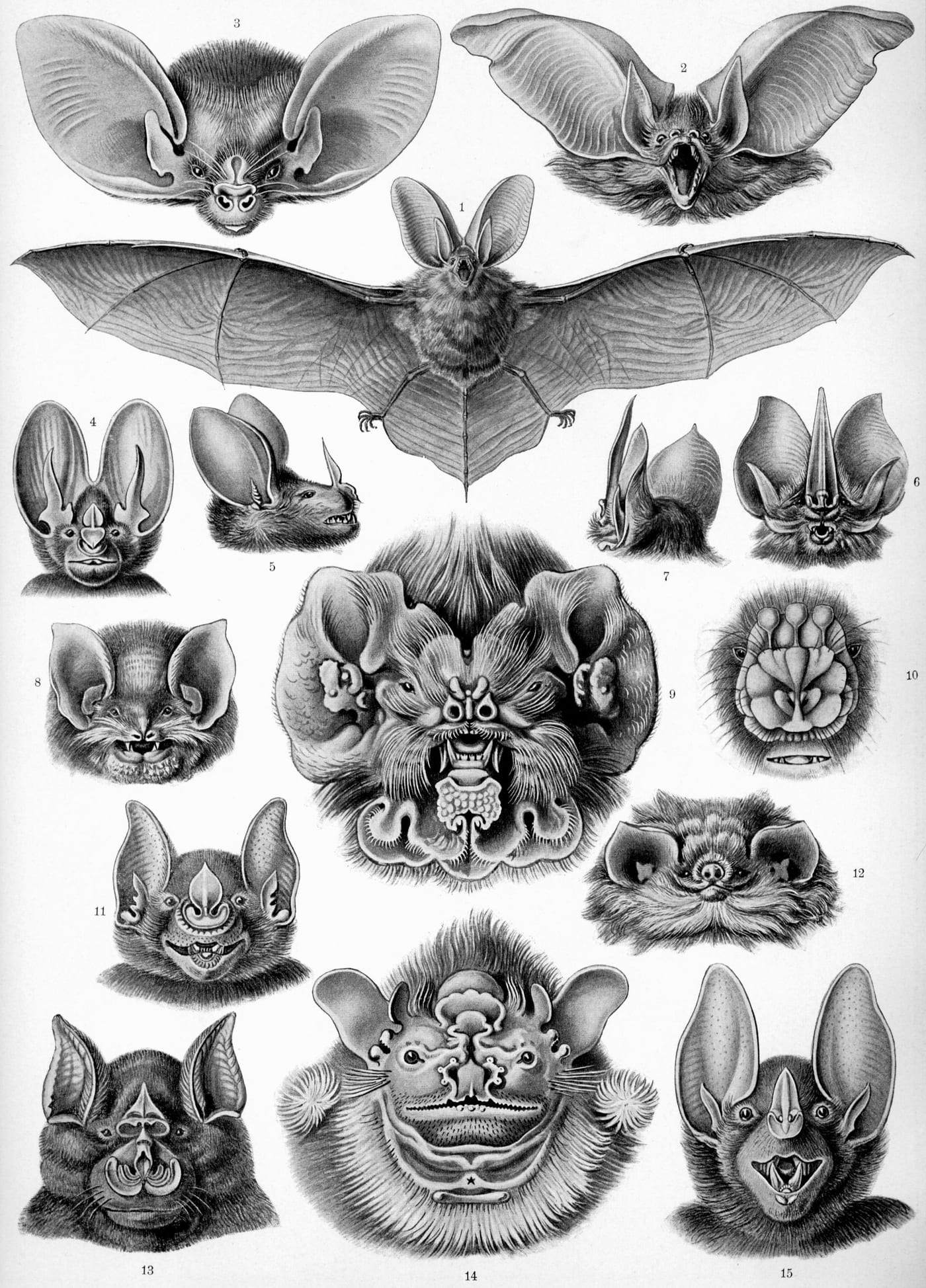
In modern American "spirit animal" usage, the bat stands for rebirth, transformation, navigating the dark (both literal and metaphorical), and the breaking-down of old patterns. That reading comes through Ted Andrews's Animal Speak (Llewellyn, 1993). The older traditions split sharply by hemisphere. The Maya Camazotz ('Death Bat') is one of the underworld deities in the Popol Vuh (Book 3), documented by Dennis Tedlock's 1985 critical edition. Chinese culture treats the bat as a good-fortune symbol because the word fú (蝠, bat) is a homophone of fú (福, fortune); five bats together represent the Five Blessings (Wǔfú). Aristotle's De Partibus Animalium 4.13 famously struggles to classify the bat, since it has features of both birds and mammals. Early-modern European witch-trial records made the bat a standard familiar-spirit, especially in Matthew Hopkins's 1647 Discovery of Witches.
If you walk into a Qing-dynasty imperial robe gallery at the Met, you’ll find small gold bats stitched around the shoulders and hem. Five of them, usually, because five bats (Wǔfú) represent the Five Blessings: longevity, wealth, health, virtue, and a natural death. The bats are there because the Chinese word for bat, fú (蝠), is a homophone of fú (福), meaning fortune. For two thousand years of Chinese visual culture, a bat in your household was a pun that blessed the house.
Across the Pacific and three thousand years earlier, in the K’iche’ Maya creation narrative preserved in the Popol Vuh, the Hero Twins Hunahpu and Xbalanque descend into the underworld Xibalba and must survive the House of Bats. Camazotz, the Death Bat, is the presiding figure. The episode is not symbolic; Xbalanque’s head is severed during the trial, and the Twins must ritually reassemble themselves.
Two civilizations, same animal, opposite readings. That is the sharpest hemispheric split of any animal in this symbolic catalog.
The four pre-modern traditions
Camazotz. Maya underworld figure in the Popol Vuh, Book 3. Dennis Tedlock’s Simon & Schuster critical edition (revised 1996) is the standard English source. Classic Maya vase painting and Zapotec stone sculpture preserve the iconography back to at least 500 BCE. Michael Coe’s The Maya (Thames & Hudson, 2015, 9th ed.) is the standard archaeological overview.
Fú, the fortune-bat. Chinese homophone pun going back at least two millennia. Five Blessings motif (Wǔfú) on Qing imperial regalia, porcelain, rank badges, and domestic ornament. Terese Tse Bartholomew’s Hidden Meanings in Chinese Art (Asian Art Museum of San Francisco, 2006) is the standard catalog.
Aristotle’s taxonomic problem. De Partibus Animalium 4.13 and Historia Animalium 1.1 (c. 350 BCE). The bat flies like a bird but gives live birth like a quadruped. Aristotle never resolved the classification; neither did medieval natural history for nearly two thousand years. Linnaeus finally placed bats in Mammalia Chiroptera in the 18th century.
European witches. Witch-trial records from the 16th–17th centuries list bats among the animal-familiars attributed to accused witches. Matthew Hopkins’s Discovery of Witches (1647) is the specific English-language source. Polidori’s The Vampyre (1819) and Stoker’s Dracula (1897) turned the association Gothic; Hollywood turned it pop. This is the layer the modern American Halloween bat-imagery descends from.
The 1993 synthesis
Andrews’s bat is the European-Gothic figure with the explicit fear filed off, reduced to “rebirth, shadow work, transformation.” The Maya and Chinese traditions, which would give the reading far more substance in opposite directions, are almost absent. Knowing both of them is part of reading the animal fairly.
Working with the Bat
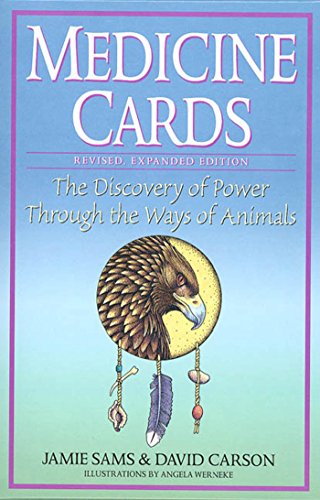
If you want a regular practice rather than a one-time read, an oracle deck is the standard tool: you draw a card and sit with whatever animal comes up. The foundational modern spirit-animal oracle: 44 cards drawn from Sams's Seneca and other Indigenous teachings, with a guidebook that actually explains its sources. The deck most later ones are imitating.
Medicine Cards
The foundational modern spirit-animal oracle: 44 cards drawn from Sams's Seneca and other Indigenous teachings, with a guidebook that actually explains its sources. The deck most later ones are imitating.
Compare the field in our ranked guide to spirit animal oracle decks, or browse decks, crystals, and journals in spirit animal gifts & tools.
Across traditions
Maya (Camazotz, the Death Bat)
Camazotz (K'iche' Kamazotz, 'Death Bat') is one of the underworld deities in the Maya K'iche' creation narrative Popol Vuh, Book 3, where the Hero Twins Hunahpu and Xbalanque must survive the House of Bats during their descent to Xibalba. Dennis Tedlock's Popol Vuh: The Mayan Book of the Dawn of Life (Simon & Schuster, revised 1996 ed.) is the standard English critical translation.
Camazotz is not symbolic or metaphorical in the text: the Hero Twins' severed heads and the bat's role in the passage are central to the plot. The figure appears in Classic Maya vase painting (the Justin Kerr photographic archive is the major documentation resource) and in Zapotec iconography from the Valley of Oaxaca, where stone bat-figures survive from at least 500 BCE. Michael Coe's The Maya (Thames & Hudson, 9th ed. 2015) treats the broader context.
- PRIMARY Popol Vuh (K'iche' Maya) — Dennis Tedlock trans., Simon & Schuster, revised 1996 ed.
- PEER-REVIEWED Michael D. Coe, The Maya — Thames & Hudson, 9th ed. 2015.
- ARCHIVE Justin Kerr, Maya Vase Database (photographic archive)
Chinese (fú, the bat-fortune homophone)
The Chinese character for bat, fú (蝠), is a homophone of fú (福, "fortune" or "happiness"). This shared pronunciation made the bat an emblem of good fortune across at least two millennia of Chinese visual culture. The Five Blessings (Wǔfú), depicted as five bats arranged around the character shòu (寿, longevity), appear on Qing-dynasty imperial robes, porcelain, rank badges, and everyday ornament from the Tang dynasty forward.
Terese Tse Bartholomew's Hidden Meanings in Chinese Art (Asian Art Museum of San Francisco, 2006) catalogs hundreds of bat-motif objects and explains the homophone system. The iconography is the direct opposite of the European fear-reading: a bat in a Chinese domestic interior is a blessing, not a threat.
- PEER-REVIEWED Terese Tse Bartholomew, Hidden Meanings in Chinese Art — Asian Art Museum of San Francisco, 2006.
- MUSEUM Qing imperial rank-badges with bat motifs (Metropolitan Museum of Art, Asian Art collection)
Greek (Aristotle's classification problem)
Aristotle's De Partibus Animalium 4.13 (On the Parts of Animals, c. 350 BCE) and Historia Animalium 1.1 devote substantial attention to the bat (Greek nykteris) as a creature that occupies an awkward taxonomic position: it flies like a bird but gives live birth like a quadruped. Aristotle's classification system, which set the terms for Western natural history for nearly two thousand years, never fully resolved the problem.
Medieval bestiaries including the Physiologus inherited Aristotle's perplexity and added moral readings; the bat was described as neither fully bird nor fully animal, an ambiguity that lent itself to Christian allegory about deceit and in-between-ness. The taxonomic puzzle was only resolved in the 18th century when Linnaeus classified bats as Mammalia Chiroptera in Systema Naturae.
- PRIMARY Aristotle, De Partibus Animalium 4.13 — Peck trans., Loeb Classical Library.
- PRIMARY Aristotle, Historia Animalium 1.1 — Peck trans., Loeb Classical Library.
- PRIMARY Physiologus, chapter on the bat — Curley trans., University of Chicago Press, 2009.
Early-modern European (witches and familiars)
European witch-trial records from the 16th and 17th centuries frequently list bats among the animal-familiars attributed to accused witches. Matthew Hopkins's The Discovery of Witches (London, 1647) records specific bat-familiars alongside cats, toads, and rats. The Malleus Maleficarum (1487, Kramer and Sprenger) is silent on bats specifically, but subsequent Protestant and Catholic demonology built them into the standard witch-familiar set.
The association intensified in 19th-century Gothic literature. John Polidori's The Vampyre (1819) and Bram Stoker's Dracula (1897) made the vampire-bat-aristocrat amalgam a standard Western literary figure. This is the layer the modern American Halloween bat-imagery descends from, filtered through Hollywood. Ted Andrews's 1993 reading inherits it while softening the explicit fear into 'shadow work' language.
- PRIMARY Matthew Hopkins, The Discovery of Witches (London, 1647)
- PRIMARY Malleus Maleficarum (Kramer & Sprenger, 1487) — Mackay trans., Cambridge University Press, 2006.
- PRIMARY Bram Stoker, Dracula — Archibald Constable, 1897.
- PEER-REVIEWED Keith Thomas, Religion and the Decline of Magic — Weidenfeld & Nicolson, 1971.
Ted Andrews (1993)
Andrews's 1993 bat is the rebirth-shadow-transformation figure, drawn primarily from the European-Gothic layer with the explicit fear softened into personal-spirit language. The Maya Camazotz and Chinese fú traditions are largely absent, which is a significant loss since they are the two deepest and most specific bat-traditions in the documented world.
- REFERENCE Ted Andrews, Animal Speak — Llewellyn, September 1993.
Frequently asked
- What does a bat symbolize spiritually?
- Depends which tradition you stand inside. The Maya Camazotz is a Death Bat figure in the Popol Vuh. Chinese culture reads the bat as good fortune because of the fú (蝠/福) homophone pun. Aristotle found the bat taxonomically puzzling. European witch-trial records made it a standard witch-familiar. Modern American pop-spiritual reading (Andrews 1993) is 'rebirth, transformation, shadow work', an American-Gothic flattening of the fear-tradition with the explicit fear removed.
- Why are bats lucky in Chinese culture?
- Because the Chinese word for bat, fú (蝠), is a homophone of fú (福), meaning 'fortune' or 'happiness.' This shared pronunciation made the bat a favorable emblem across at least two millennia of Chinese visual culture. Five bats together, known as Wǔfú, represent the Five Blessings: longevity, wealth, health, virtue, and a natural death. The iconography appears on Qing-dynasty imperial robes, porcelain, and everyday domestic ornament. Terese Tse Bartholomew's Hidden Meanings in Chinese Art (Asian Art Museum of San Francisco, 2006) catalogs the motif.
- Who is Camazotz?
- Camazotz ('Death Bat') is an underworld deity in the Maya K'iche' creation narrative Popol Vuh, Book 3, where the Hero Twins Hunahpu and Xbalanque must survive the House of Bats during their descent to Xibalba. Dennis Tedlock's Popol Vuh: The Mayan Book of the Dawn of Life (Simon & Schuster, revised 1996) is the standard English critical translation. The figure appears in Classic Maya vase painting and in Zapotec stone sculpture from at least 500 BCE.
- Why did Aristotle find the bat confusing?
- Because the bat flies like a bird but gives live birth like a quadruped. Aristotle's De Partibus Animalium 4.13 and Historia Animalium 1.1 devote substantial attention to this taxonomic puzzle. His classification system, which set the terms for Western natural history for nearly two thousand years, never fully resolved the problem; medieval bestiaries inherited the ambiguity and added moral readings. The puzzle was only resolved in the 18th century when Linnaeus classified bats as Mammalia Chiroptera.
Sources
- PRIMARYPopol Vuh (K'iche' Maya) — Tedlock trans., Simon & Schuster, 1996.
- PEER-REVIEWEDMichael D. Coe, The Maya — Thames & Hudson, 2015.
- ARCHIVEJustin Kerr, Maya Vase Database
- PEER-REVIEWEDTerese Tse Bartholomew, Hidden Meanings in Chinese Art — Asian Art Museum of San Francisco, 2006.
- PRIMARYAristotle, De Partibus Animalium 4.13, Historia Animalium 1.1 — Loeb Classical Library.
- PRIMARYPhysiologus (Curley trans., 2009)
- PRIMARYMatthew Hopkins, The Discovery of Witches (1647)
- PRIMARYMalleus Maleficarum (1487) — Mackay trans., Cambridge, 2006.
- PRIMARYBram Stoker, Dracula (1897)
- PEER-REVIEWEDKeith Thomas, Religion and the Decline of Magic — Weidenfeld & Nicolson, 1971.
- REFERENCETed Andrews, Animal Speak — Llewellyn, September 1993.